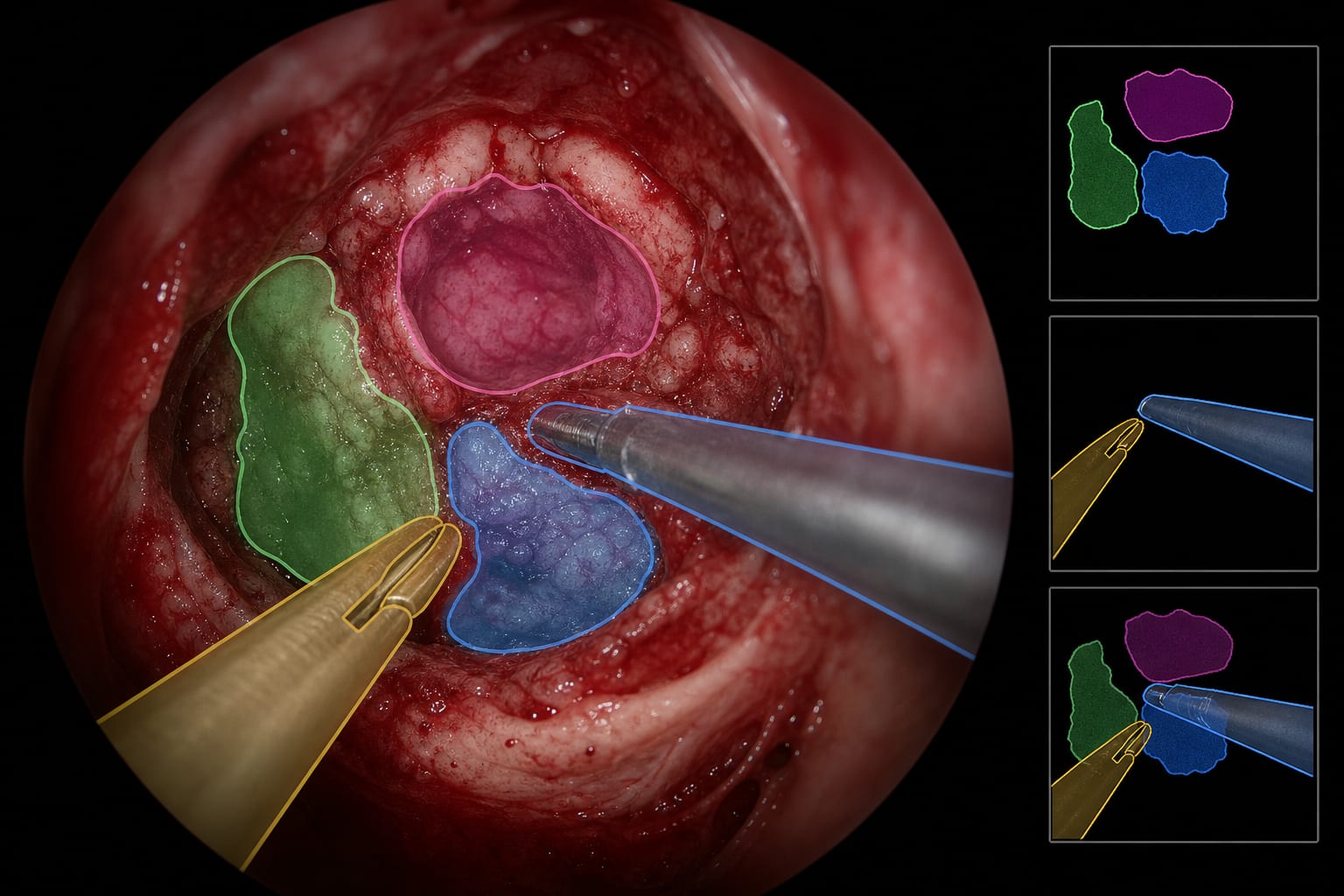
Clinical Report: Evaluating Techniques for Segmenting Surgical Instruments
Overview
Expand on the challenges of class imbalance and its effects on model performance.
Background
Endoscopic transsphenoidal surgery (eTSA) is the preferred method for removing pituitary adenomas, yet it poses significant challenges due to the complexity of the surgical environment. Accurate segmentation of surgical instruments is critical for enhancing surgical workflow and improving patient outcomes. Current research has primarily focused on anatomical segmentation, leaving a gap in the development of effective SIS models for this specific context.
Data Highlights
Model
Performance
U-Net
Established baseline
HRNet
High-resolution masks
DeepLabV3+
Low computational requirements
Vision Transformer (ViT)
Local and global attention
EndoViT
Outperforms task-specific models
Segformer
Parameter efficient
Encoder-only Mask Transformer (EoMT)
Eliminates heavy up-sampling
Key Findings
The dataset comprises 50 videos and 37,547 frames with 27,934 instrument masks across 15 classes.
Significant class imbalance was noted, reflecting variations in surgical techniques and instrument usage.
U-Net and HRNet are effective for high-resolution segmentation tasks.
EndoViT demonstrated superior performance in surgical action recognition and SIS.
Segformer offers a lightweight alternative with comparable performance to heavier models.
EoMT's architecture allows for efficient mask prediction without extensive computational resources.
Clinical Implications
Elaborate on the direct impact of SIS improvements on patient safety and surgical efficiency.
Conclusion
This study underscores the importance of advancing SIS methodologies in endoscopic surgery, which could lead to improved surgical outcomes and operational efficiencies. Future research should focus on refining these models to better accommodate the complexities of surgical environments.
Aviva Abosch, M.D., Ph.D., a neurosurgeon at Baptist Health Miami Neuroscience Institute, part of Baptist Health Brain and Spine Care, was installed as the Esernia Endowed Chair in Surgical Treatment of Adult Epilepsy and Movement Disorders.
The nearly 15,000-square-foot facility will integrate multidisciplinary care, including neurology, neurosurgery, brain imaging, and physical medicine and rehabilitation.