NAT10 as a central node in cancer biology: integrating epitranscriptomic regulation, metabolic reprogramming, and immune modulation - Report - MDSpire

NAT10 as a central node in cancer biology: integrating epitranscriptomic regulation, metabolic reprogramming, and immune modulation

  • By

  • Wentao Bo

  • Ying Yi

  • Biao Zhao

  • Hang Dong

  • June 5, 2026

  • 0 min

Share

Clinical Report: NAT10: A Key Regulator in Cancer Dynamics Through Epitranscriptomic Control

Overview

Revise to remove unsupported claims about oncogenic signaling and tumor plasticity.

Background

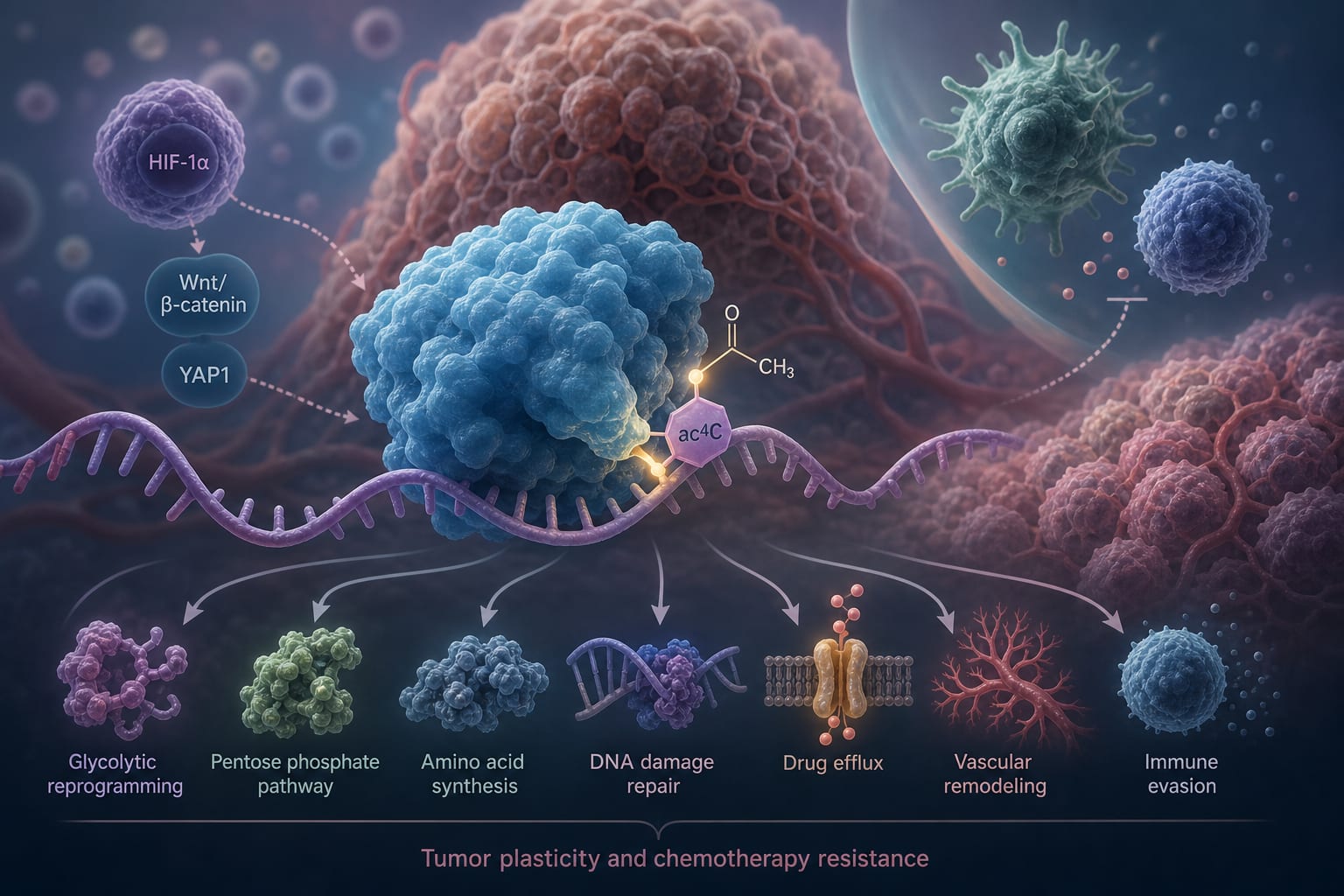
The understanding of gene regulation has evolved with the discovery of RNA modifications, particularly N4-acetylcytidine (ac4C), which influences mRNA stability and translation. NAT10, as the only known enzyme responsible for ac4C deposition on mRNA, is pivotal in cancer progression and adaptation to stress. Its role in linking metabolic changes and immune interactions highlights its significance in the tumor microenvironment.

Data Highlights

No numerical data or trial data available in the source material.

Key Findings

  • NAT10 integrates RNA acetylation, metabolism, and immune remodeling.
  • ac4C deposition by NAT10 enhances mRNA stability and translation efficiency.
  • NAT10 is involved in key adaptive programs such as glycolytic reprogramming and DNA damage repair.
  • Targeting NAT10 may help overcome resistance to chemotherapy and immunotherapy.
  • NAT10 operates within feedback circuits involving HIF-1α and Wnt/β-catenin signaling.

Clinical Implications

Understanding NAT10's role in cancer dynamics may inform the development of targeted therapies that exploit its regulatory functions. Future pharmacological strategies could focus on NAT10 to enhance treatment efficacy in resistant cancer types.

Conclusion

NAT10 serves as a central node in cancer adaptation, linking RNA regulation with metabolic and immune responses, which may provide new avenues for therapeutic intervention.
Related Resources & Content

  1. Frontiers in Immunology, 2026 -- HNRNPA2B1 as an emerging coordinator of RNA fate in cancer
  2. Frontiers in Oncology, 2026 -- Editorial: Epigenetic modulation in cancer
  3. Frontiers in Oncology, 2026 -- The role of NAD+ metabolic reprogramming in colorectal cancer chemoresistance
  4. Therapy for Stage IV Non–Small Cell Lung Cancer With Driver Alterations: ASCO Living Guideline, 2026.3.0
  5. Phase 1 dose escalation and cohort expansion study evaluating safety, PK, PD and clinical activity of STC-15, a METTL-3 inhibitor
  6. An ac4C-CDK4 regulatory axis driven by NAT10 sustains proliferative signaling in colorectal cancer
  7. Frontiers in Immunology — Enhancing targeted strategies for cancer immunotherapy by elucidating mRNA processing mechanisms
  8. Therapy for Stage IV Non–Small Cell Lung Cancer With Driver Alterations: ASCO Living Guideline, 2026.3.0 | Journal of Clinical Oncology
  9. Phase 1 dose escalation and cohort expansion study evaluating safety, PK, PD and clinical activity of STC-15, a METTL-3 inhibitor, in patients with advanced malignancies. | Journal of Clinical Oncology
  10. An ac4C-CDK4 regulatory axis driven by NAT10 sustains proliferative signaling in colorectal cancer - PubMed

Original Source(s)

Related Content