Clinical Report: Utilizing Transformer-Based AI to Improve Anesthetic Choices
Overview
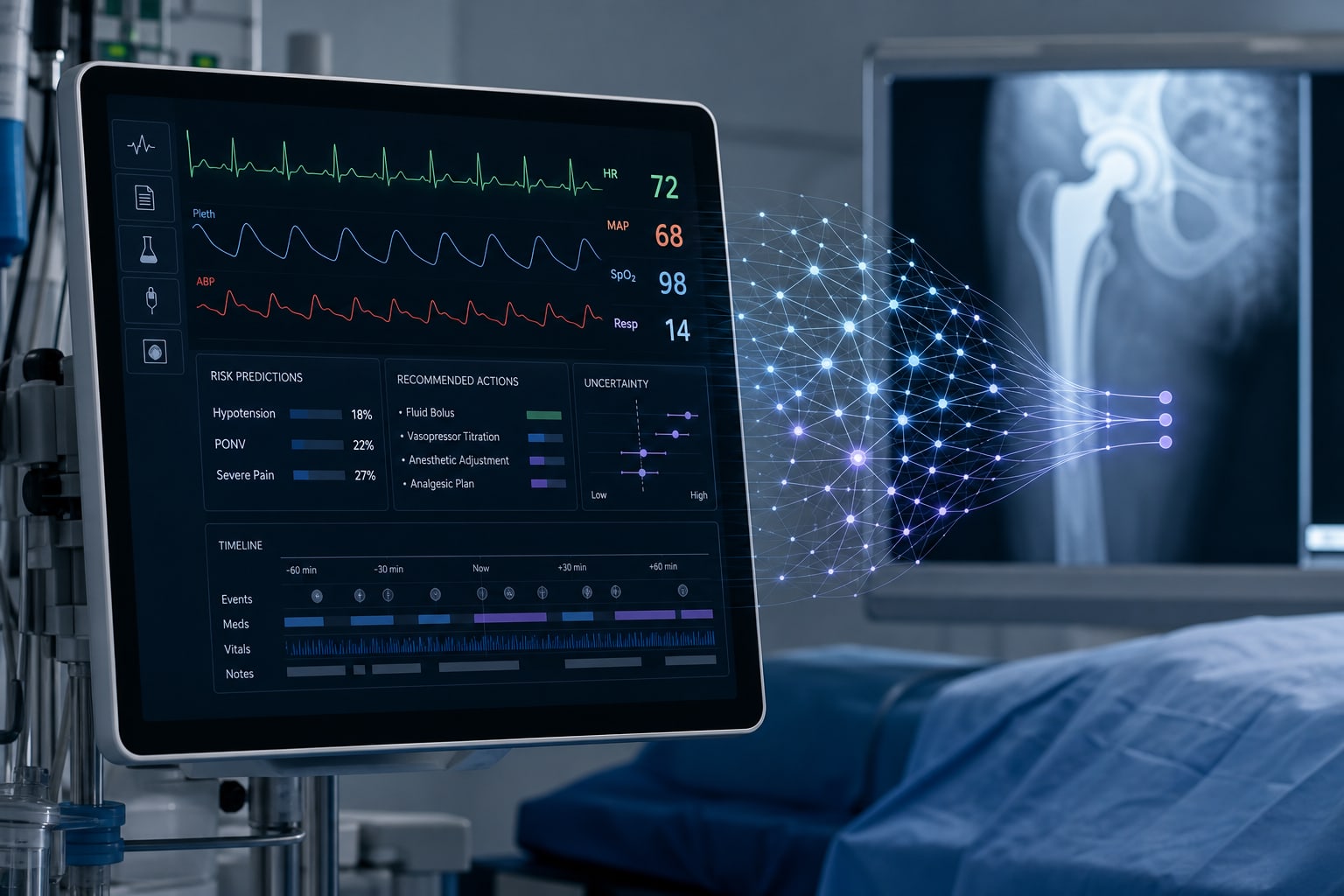
The Ortho PeriFT transformer model enhances anesthetic decision-making in orthopedic surgery by integrating real-time physiological data and providing actionable recommendations. It demonstrates improved discrimination and precision-recall for primary outcomes, while maintaining narrow uncertainty bands.
Background
Orthopedic surgery presents unique anesthetic challenges, particularly in older patients with multiple comorbidities. Effective management of intraoperative hypotension and postoperative complications is crucial for improving patient outcomes. Current anesthetic practices require sophisticated tools to integrate diverse data streams and provide timely, evidence-based recommendations.
Data Highlights
No numerical data available in the source material.
Key Findings
Ortho PeriFT integrates perioperative prediction, therapeutic recommendations, and continuous monitoring.
The model processes second-level waveform patches and minute-level numerical data, enhancing real-time decision-making.
It reduces calibration error and negative log-likelihood compared to classical and neural baselines.
Streaming analyses provide earlier warnings at matched false alarm rates across orthopedic subtypes.
Attribution maps offer case-based rationales aligned with clinical reasoning.
Clinical Implications
The Ortho PeriFT model provides a framework for real-time anesthetic decision-making, potentially improving patient safety and outcomes in orthopedic procedures. Its ability to integrate diverse data sources may enhance the management of intraoperative and postoperative complications.
Conclusion
The findings suggest that transformer-based AI can significantly improve anesthetic choices in orthopedic surgery by providing accurate risk estimates and actionable recommendations within a unified framework.