Relationship between family–school–peer risks and problematic Internet use among boarding high school students in China: based on a latent profile analysis - Report - MDSpire
Advertisement
Relationship between family–school–peer risks and problematic Internet use among boarding high school students in China: based on a latent profile analysis
Clinical Report: Impact of Family, School, and Peer Risks on Internet Use
Overview
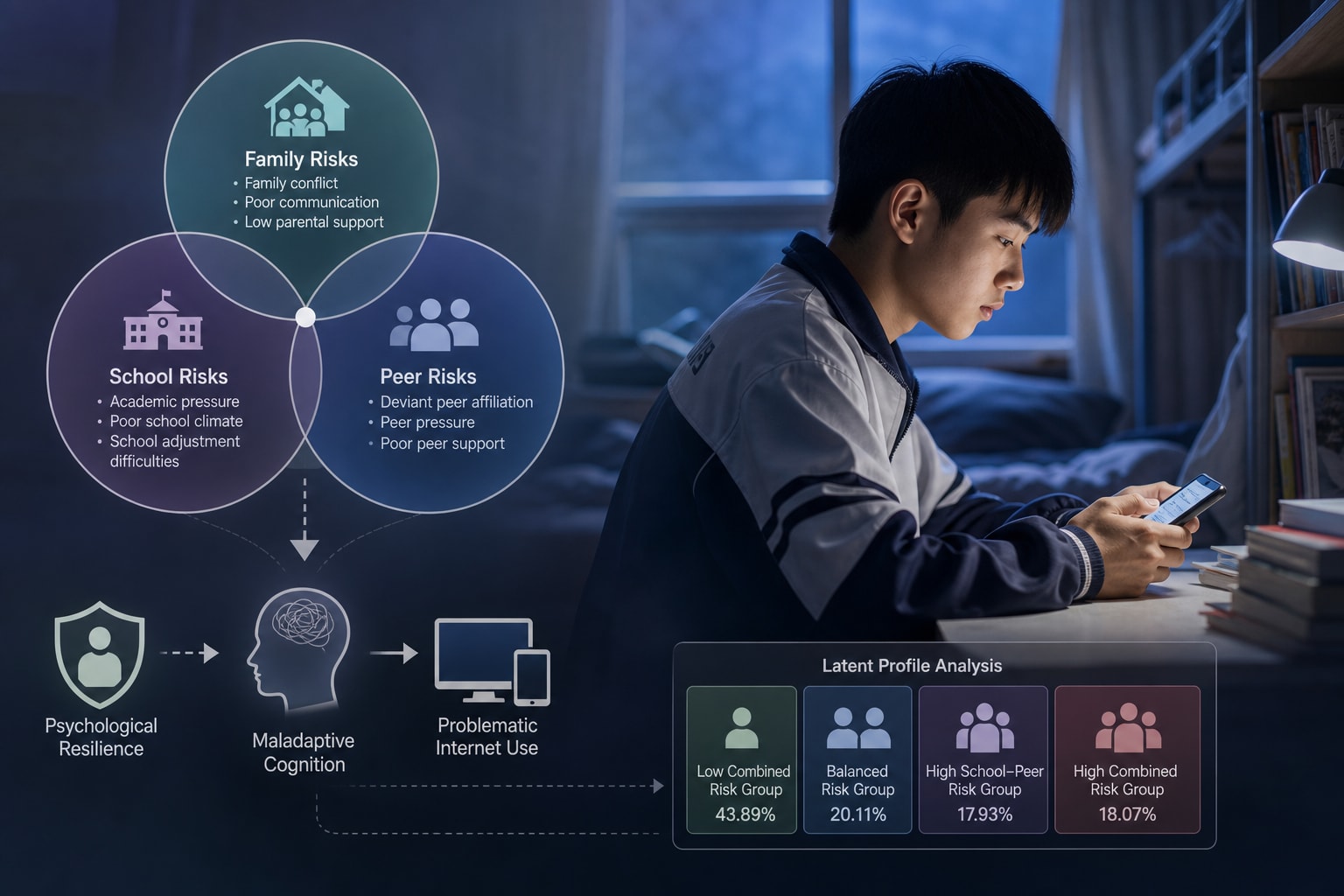
This study identifies how family, school, and peer risk factors contribute to problematic Internet use among Chinese boarding high school students. It highlights the significant differences in Internet use across various risk profiles and the mediating role of maladaptive cognition and moderating role of psychological resilience.
Background
Problematic Internet use (PIU) is a growing concern among adolescents, particularly in high-stress environments like boarding schools. The unique living conditions of boarding students can amplify their exposure to family, school, and peer risks, making it crucial to understand these dynamics. This study employs latent profile analysis to explore these configurations and their association with PIU.
Data Highlights
Risk Profile
Percentage of Students
Low Combined Risk Group
43.89%
Balanced Risk Group
20.11%
High School–Peer Risk Group
17.93%
High Combined Risk Group
18.07%
Key Findings
Four distinct risk profiles were identified among students: Low Combined Risk, Balanced Risk, High School–Peer Risk, and High Combined Risk.
The High Combined Risk Group exhibited the highest levels of problematic Internet use.
Maladaptive cognition partially mediated the relationship between high-risk profiles and problematic Internet use.
Psychological resilience moderated the direct association between risk profiles and problematic Internet use.
Understanding these configurations can inform targeted interventions for at-risk adolescents.
Clinical Implications
Clinicians should consider the interplay of family, school, and peer factors when assessing adolescents for problematic Internet use. Interventions aimed at enhancing psychological resilience and addressing maladaptive cognition may be beneficial in mitigating PIU among high-risk students.
Conclusion
This study underscores the importance of a multi-faceted approach in understanding and addressing problematic Internet use among boarding high school students. The findings highlight the need for targeted strategies that consider the unique risk profiles of this population.