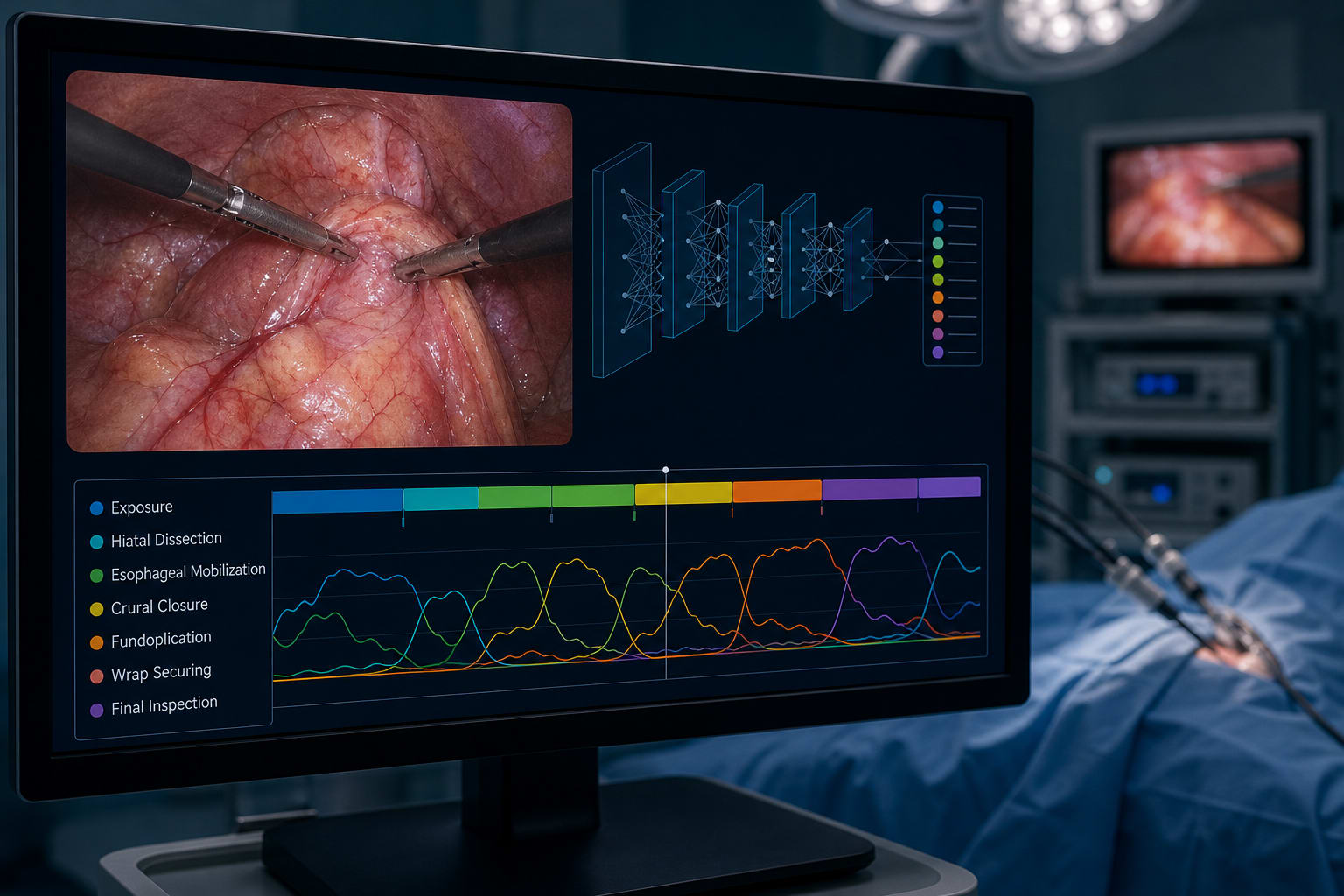
Deep Learning–Based Identification of Surgical Phases in Pediatric Laparoscopic Fundoplication: A Retrospective Video Study
-
By
-
Yohei Sanmoto
-
Luning Li
-
Yudai Goto
-
Xin Zhu
-
Kouji Masumoto
-
October 8, 2026
Clinical Report: Deep Learning–Based Identification of Surgical Phases in Pediatric Laparoscopic Fundoplication
Overview
This retrospective video study developed a deep learning system to identify operative phases during pediatric laparoscopic fundoplication. The supplied article text reports that 38 videos were included and describes planned evaluation of phase classification, reconstruction of operative workflow, and estimation of phase duration; it does not provide model-performance results.
Background
Surgical phase recognition converts continuous operative video into a structured representation of workflow and has been studied in several adult laparoscopic procedures. The article notes that pediatric surgery includes uncommon procedures and that declining case volumes may constrain opportunities to maintain experience, citing 389 laparoscopic fundoplications reported nationwide in Japan in 2023. Fundoplication requires procedure-specific knowledge and technical skills, while automated phase recognition in pediatric surgery remains relatively unexplored. The study was designed as an initial benchmark for automated workflow analysis in pediatric minimally invasive surgery.
Data Highlights
| Measure | Reported data |
|---|---|
| Fundoplications identified, 2015–2025 | 50 |
| Videos excluded for unavailable complete recordings | 5 |
| Additional cases excluded | 7: severe hiatal hernia with gastric herniation (2), recurrent surgery (2), severe intra-abdominal adhesions (3) |
| Final video dataset | 38 |
| Video resolution and frame rate | 640 × 360 at 30 frames/s: 2 (5.3%); 720 × 480 at 30 frames/s: 7 (18.4%); 1920 × 1080 at 30 frames/s: 20 (52.6%); 1920 × 1080 at 60 frames/s: 9 (23.7%) |
| Age at operation | 4–316 months |
| Operative-duration definition | From pneumoperitoneum initiation to shoulder-stitch completion, or to completion of wrap construction if no shoulder stitch was used |
Key Findings
- The study retrospectively evaluated laparoscopic fundoplication videos recorded at the University of Tsukuba Hospital from January 2015 through December 2025.
- After exclusions, the analysis dataset comprised 38 videos; original video resolution and frame rate varied across cases.
- The deep learning system was developed to recognize operative phases and was assessed through phase classification, temporal reconstruction of the complete workflow, and estimation of phase duration.
- The supplied article excerpt does not report classification metrics, phase-duration estimates, or comparative performance results.
- The article situates the work within prior adult surgical phase-recognition research, including studies of laparoscopic cholecystectomy and transfer of phase-recognition methods across procedures.
- The article identifies surgical video review as a potential resource for workflow review, education, and structured feedback, while describing automated phase recognition in pediatric surgery as largely unexplored.
Clinical Implications
The study establishes a pediatric laparoscopic fundoplication video dataset and an evaluation framework for automated phase recognition, but the supplied excerpt does not provide performance results that would support conclusions about clinical deployment. The article describes possible educational and performance-assessment applications as future uses of surgical video analysis, rather than reporting tested clinical effects.
Conclusion
This retrospective study addresses an underexplored application of surgical video analysis by developing deep learning-based phase recognition for pediatric laparoscopic fundoplication. The available source text describes the cohort and evaluation aims but does not include the model's results.
Related Resources & Content
- Study authors, PubMed, 2026 -- Automated surgical phase recognition in pediatric laparoscopic fundoplication using deep learning: a retrospective video-based study
- NASPGHAN-ESPGHAN, NASPGHAN, 2024 -- Summary of the 2018 NASPGHAN-ESPGHAN Pediatric Gastroesophageal Reflux Clinical Practice Guideline
- SAGES, SAGES -- SAGES consensus recommendations on surgical video data use, structure, and exploration
- Surgical Endoscopy, 2026 -- Automated surgical phase recognition and analysis in single-incision laparoscopic cholecystectomy using artificial intelligence
- Surgical Endoscopy, 2022 -- Utilizing Artificial Intelligence for Phase Identification in Complex Laparoscopic Cholecystectomy Procedures
- Surgical Endoscopy, 2023 -- TEsoNet: Transferring Knowledge for Surgical Phase Identification from Laparoscopic Sleeve Gastrectomy to the Laparoscopic Component of Ivor–Lewis Esophagectomy
- Surgical Endoscopy — Recognition of Surgical Workflow Using Privacy-Conscious Depth Video Analysis in the Operating Room
- Summary of the 2018 NASPGHAN-ESPGHAN Pediatric Gastroesophageal Reflux Clinical Practice Guideline
- SAGES consensus recommendations on surgical video data use, structure, and exploration
- Automated surgical phase recognition in pediatric laparoscopic fundoplication using deep learning: a retrospective video-based study
- Summary of the 2018 NASPGHAN-ESPGHAN Pediatric Gastroesophageal Reflux Clinical Practice Guideline
- SAGES-EAES Clinical Practice Guidelines for the use of FLIP/Impedance Planimetry in the surgical work-up and management of GERD, Achalasia and Gastroparesis - A SAGES Publication
- Guidelines for the Surgical Treatment of Gastroesophageal Reflux (GERD) - A SAGES Publication
- Total versus partial fundoplication in children with gastroesophageal reflux disease: a systematic review and comparative meta-analysis of 2633 patients highlighting the trade-off between reflux control and postoperative dysphagia.
- Thal versus Nissen fundoplication for the management of pediatric gastroesophageal reflux disease: a systematic review and meta-analysis - PMC
- Robot-assited vs. laparoscopic Nissen fundoplication in children: an updated meta-analysis with systematic literature review.
- Outcome a decade after laparoscopic and open Nissen fundoplication in children: results from a randomized controlled trial - PMC
- SAGES consensus recommendations on surgical video data use, structure, and exploration (for research in artificial intelligence, clinical quality improvement, and surgical education) - PMC
- Joint EAES-SAGES framework for developing procedure-specific surgical quality assessment tools | Surgical Endoscopy | Springer Nature Link
- Automated surgical phase recognition in pediatric laparoscopic fundoplication using deep learning: a retrospective video-based study.
Based on findings from:
Automated surgical phase recognition in pediatric laparoscopic fundoplication using deep learning: a retrospective video-based study
Yohei Sanmoto, Luning Li, Yudai Goto, Xin Zhu, Kouji Masumoto. Surgical Endoscopy, 2026.
https://link.springer.com/article/10.1007/s00464-026-13437-6
This content is an AI-generated, fully rewritten summary based on a published scholarly article. It does not reproduce the original text and is not a substitute for the original publication. Readers are encouraged to consult the source for full context, data, and methodology.