Scene graph-guided uncertainty decomposition improves confidence calibration in surgical visual question answering - Report - MDSpire

Scene graph-guided uncertainty decomposition improves confidence calibration in surgical visual question answering

  • By

  • Junzhuo Song

  • Yaoxue Xu

  • Zihan Zhu

  • Junshuang Zhou

  • Yuhaohang He

  • Xirui Chen

  • Yunsen Liang

  • Wei Chen

  • Qiurui Liu

  • Jun Li

  • June 5, 2026

  • 0 min

Share

Clinical Report: Enhancing Confidence Calibration in Surgical Visual Question Answering

Overview

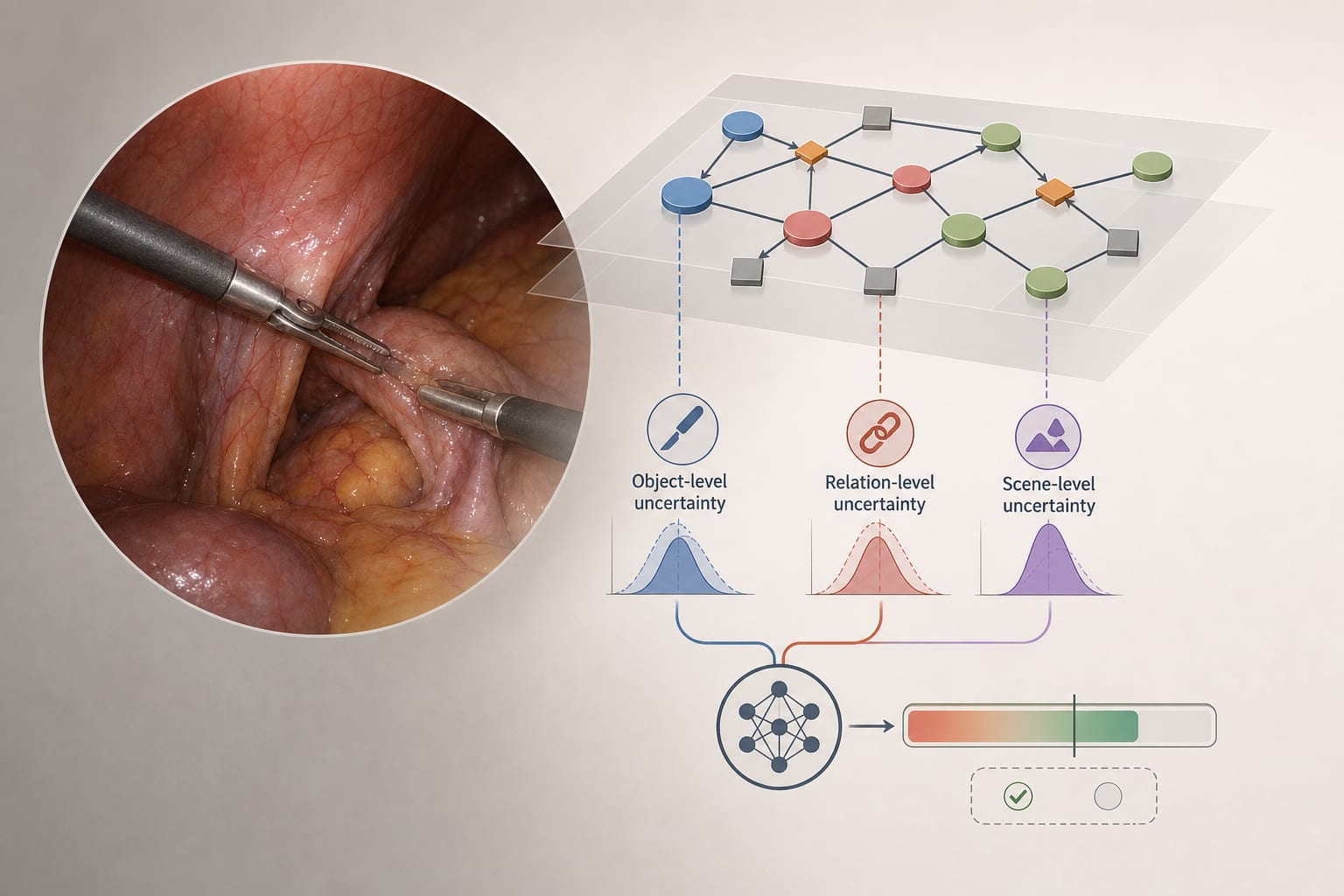
This report presents a novel Scene Graph-Guided Uncertainty Decomposition (SG-UD) framework aimed at improving confidence calibration in surgical visual question answering (VQA). The proposed method achieves an overall accuracy of 63.58% and significantly enhances interpretability of uncertainty in surgical contexts.

Background

Reliable confidence estimation in surgical VQA is critical due to the high stakes involved in clinical decision-making. Traditional methods often oversimplify uncertainty, failing to account for the hierarchical nature of surgical scenes. This can lead to overconfident errors that may compromise patient safety.

Data Highlights

MetricValue
Overall Accuracy63.58%
Expected Calibration Error16.97%
Risk-Coverage AUC0.0861

Key Findings

  • The SG-UD framework decomposes uncertainty into object-level, relation-level, and scene-level components.
  • It incorporates Dirichlet-based calibration to enhance probabilistic quality.
  • Performance improvements were noted across all question types, particularly for relation-type questions (+0.92% over MCAN).
  • Ablation studies indicated that uncertainty decomposition contributed most to answer accuracy (+0.70%).
  • The framework provides more granular uncertainty interpretability compared to traditional methods.

Clinical Implications

The SG-UD framework offers a more nuanced approach to uncertainty in surgical VQA, which may enhance decision support systems in clinical settings. By improving confidence calibration, it aims to reduce the risk of overconfident errors in surgical contexts.

Conclusion

The findings suggest that a structured approach to uncertainty modeling can significantly improve the reliability and interpretability of surgical visual question answering systems.
Related Resources & Content

  1. Enhancing Surgical Video Question Answering through Scene Graph Insights, Springer, 2024 -- Enhancing Surgical Video Question Answering through Scene Graph Insights
  2. Comprehensive Domain Modeling: Utilizing a Semantic Scene Graph Method, Springer, 2023 -- Comprehensive Domain Modeling: Utilizing a Semantic Scene Graph Method
  3. SurGrID: A Scene Graph to Image Diffusion Approach for Manageable Surgical Simulation, Springer, 2025 -- SurGrID: A Scene Graph to Image Diffusion Approach for Manageable Surgical Simulation
  4. Marketing Submission Recommendations for a Predetermined Change Control Plan for Artificial Intelligence-Enabled Device Software Functions, FDA, 2025 -- Marketing Submission Recommendations for a Predetermined Change Control Plan for Artificial Intelligence-Enabled Device Software Functions
  5. Technical Framework for Artificial Intelligence Life Cycle Management, International Medical Device Regulators Forum, 2026 -- Technical Framework for Artificial Intelligence Life Cycle Management
  6. Assessment of Uncertainty Measurement and Decomposition Techniques in Liver Image Segmentation
  7. Marketing Submission Recommendations for a Predetermined Change Control Plan for Artificial Intelligence-Enabled Device Software Functions | FDA
  8. Technical Framework for Artificial Intelligence Life Cycle Management | International Medical Device Regulators Forum
  9. https://academic.oup.com/bjs/article/112/6/znaf121/8169752
  10. Effect of AI-assisted diagnosis on adenomas of different sizes: a meta-analysis with evidence from RCTs and trial sequential analysis | BMC Gastroenterology | Springer Nature Link
  11. SAGES 2025 guidelines for fluorescence image-guided gastrointestinal surgery using indocyanine green - PubMed

Original Source(s)

Related Content