Does bronchoalveolar lavage lymphocytosis predict prognosis in fibrotic hypersensitivity pneumonitis, and is this relationship influenced by low-dose immunomodulatory therapy at the time of BAL? - Report - MDSpire
Advertisement
Can Lymphocytosis Detected in Bronchoalveolar Lavage Serve as a Prognostic Indicator in Fibrotic Hypersensitivity Pneumonitis, and Does Low-Dose Immunomodulatory Therapy Affect This Correlation?
Can Lymphocytosis Detected in Bronchoalveolar Lavage Serve as a Prognostic Indicator?
Overview
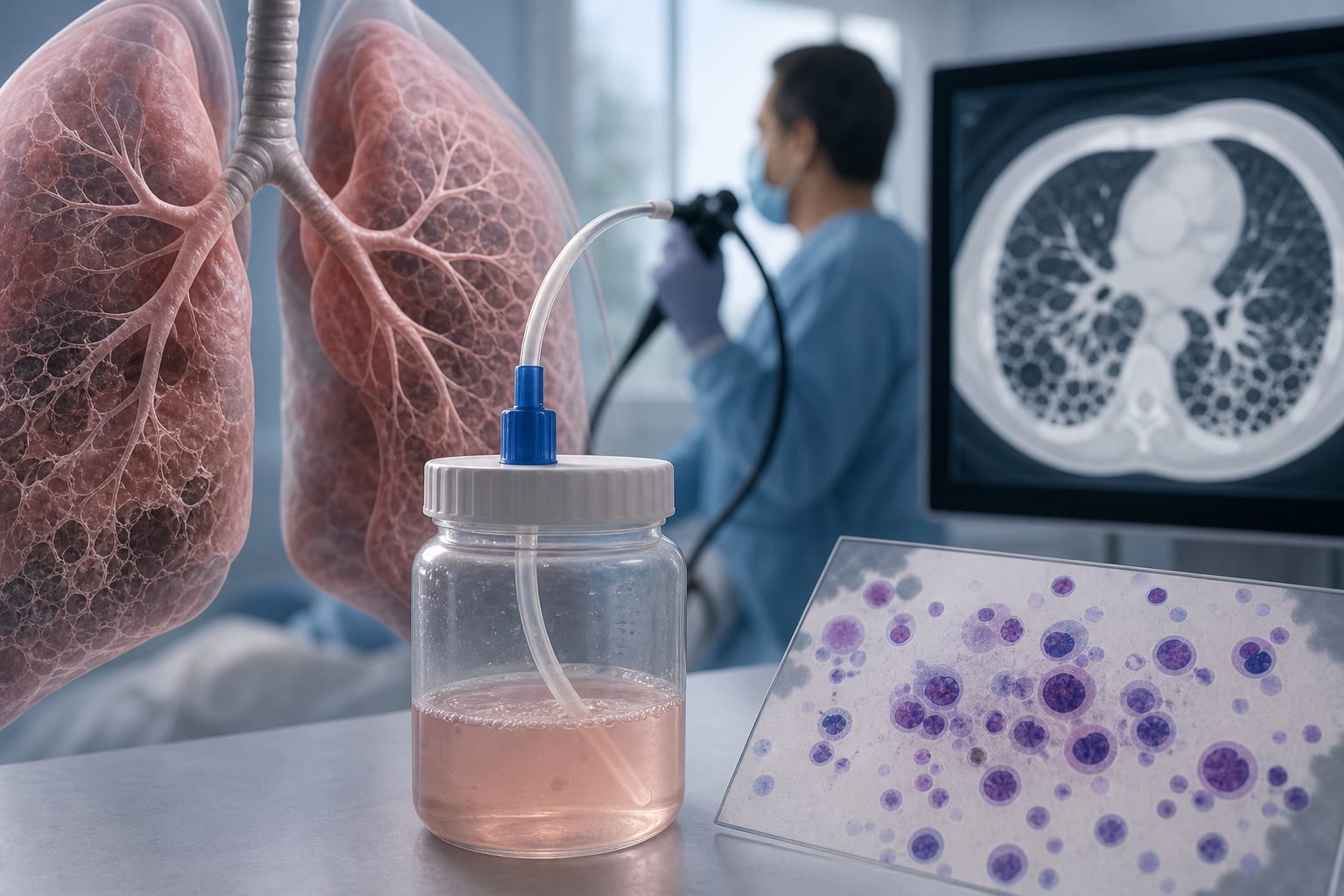
This study investigates the prognostic value of bronchoalveolar lavage (BAL) lymphocytosis in fibrotic hypersensitivity pneumonitis (fHP) patients, particularly in those receiving immunomodulatory therapy.
Background
Fibrotic hypersensitivity pneumonitis (fHP) presents a variable clinical course, making prognostic indicators crucial for patient management. BAL lymphocytosis is a recognized diagnostic feature of fHP, but its prognostic implications, especially under immunomodulatory treatment, remain unclear.
Data Highlights
Parameter
Untreated Patients
Treated Patients
BAL Lymphocyte %
Inversely associated with baseline CPI
Inversely associated with baseline CPI
CPI Change
-1.7 points per 10% increase (p < 0.0001)
-2.0 points per 10% increase (p < 0.0001)
Mortality HR
0.87 per 10% increase (p = 0.036)
0.78 per 10% increase (p = 0.025)
Key Findings
BAL lymphocytosis was associated with less severe disease in both untreated and treated fHP patients.
Higher BAL lymphocyte percentages correlated with more favorable changes in the composite physiologic index (CPI).
In untreated patients, a 10% increase in BAL lymphocytes predicted a 1.7-point improvement in CPI (p < 0.0001).
In treated patients, a similar increase predicted a 2.0-point improvement in CPI (p < 0.0001).
Higher BAL lymphocyte percentages independently predicted lower mortality in both groups.
No significant interaction was found between treatment status and BAL lymphocyte levels regarding outcomes.
Clinical Implications
The findings indicate that BAL lymphocytosis may have prognostic value in fHP patients.
Conclusion
BAL lymphocytosis is associated with less severe disease and favorable outcomes in fHP patients.
by Punchalee Kaenmuang, Fiammetta Danzo, Simon Bax, Richard J. Hewitt, Maria Kokosi, Vasileios Kouranos, Felix Chua, Peter M. George, Gisli Jenkins, Athol U. Wells, Carmel J. W. Stock, Piersante Sestini, Elisabetta A. Renzoni