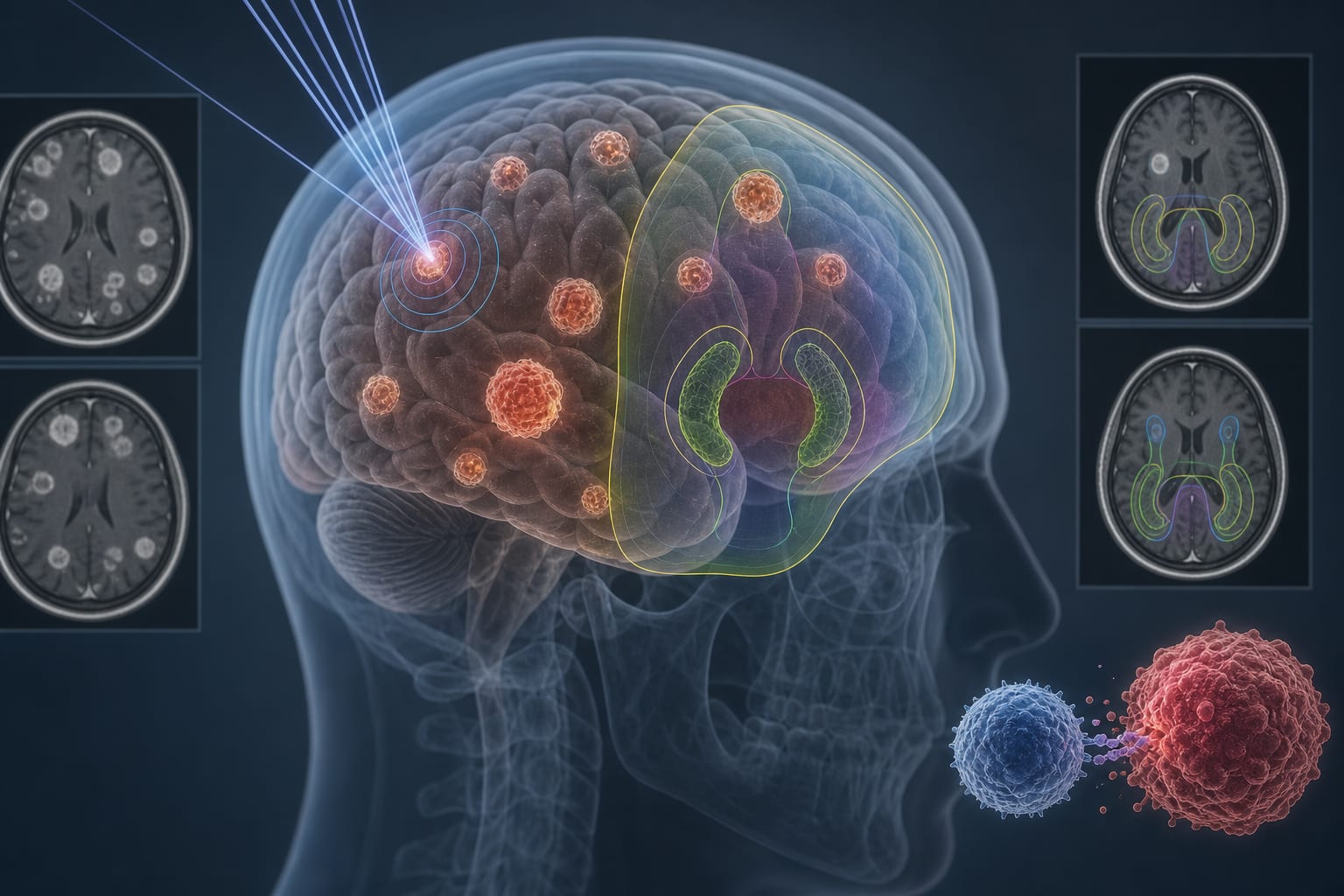
Stereotactic versus hippocampal avoidance whole-brain radiotherapy combined with immune checkpoint inhibitors for multiple brain metastases in non-small cell lung cancer: a multi-center retrospective study - Report - MDSpire

Comparison of Stereotactic Radiotherapy and Hippocampal Avoidance Whole-Brain Radiotherapy with Immune Checkpoint Inhibitors in Non-Small Cell Lung Cancer Patients with Multiple Brain Metastases: A Multi-Center Retrospective Analysis

  • By

  • Xiaoliang Wang

  • Yanan Zheng

  • Aimin Wang

  • Xiaolan Zhao

  • Xudong Ruan

  • Choubin Wu

  • Chunquan Han

  • July 20, 2026

Share

Comparison of Stereotactic Radiotherapy and Hippocampal Avoidance Whole-Brain Radiotherapy

Overview

This study compares the efficacy of stereotactic radiotherapy (SRT) combined with immune checkpoint inhibitors (ICIs) versus hippocampal avoidance whole-brain radiotherapy (HA-WBRT) plus ICIs in non-small cell lung cancer (NSCLC) patients with multiple brain metastases. Results indicate that SRT+ICIs improves overall survival and intracranial progression-free survival compared to HA-WBRT+ICIs.

Background

Brain metastases are a common complication in lung cancer, affecting 20%-40% of patients. The treatment approach for patients with multiple brain metastases remains controversial, particularly regarding the use of SRT versus HA-WBRT.

Data Highlights

CohortMedian OS (months)Median iPFS (months)
SRT + ICIs21.410.5
HA-WBRT + ICIs15.58.1

Key Findings

  • SRT+ICIs cohort had a median OS of 21.4 months compared to 15.5 months for HA-WBRT+ICIs (P<0.001).
  • SRT+ICIs cohort demonstrated a median iPFS of 10.5 months versus 8.1 months for HA-WBRT+ICIs (P<0.001).
  • Multivariate analysis showed SRT+ICIs was independently associated with improved OS (HR 0.381, P<0.001).
  • No grade > 3 adverse events were reported in either cohort.
  • Both treatment approaches had similar adverse event profiles.

Clinical Implications

The findings suggest that SRT combined with ICIs may be a more effective treatment strategy for NSCLC patients with multiple brain metastases compared to HA-WBRT combined with ICIs. Clinicians should consider these results when determining treatment plans for this patient population.

Conclusion

SRT+ICIs is associated with improved overall survival and intracranial progression-free survival in NSCLC patients with multiple brain metastases.

Related Resources & Content

  1. The ASCO Post, 2018 -- Hippocampus-Sparing Whole-Brain Radiotherapy and Neurocognitive Function in Patients With Brain Metastases
  2. The ASCO Post, 2026 -- Stereotactic vs Whole-Brain Radiation for Patients With Brain Metastases
  3. Brain Mets Guideline Document -- ASTRO Guidelines
  4. The ASCO Post — Stereotactic vs Whole-Brain Radiation for Patients With Brain Metastases
  5. Frontiers in Immunology — Stereotactic versus whole-brain radiotherapy combined with immunotherapy in driver gene–negative NSCLC with brain metastases: a real-world IPTW analysis
  6. Brain Mets Guideline Document
  7. Preservation of Memory With Conformal Avoidance of the Hippocampal Neural Stem-Cell Compartment During Whole-Brain Radiotherapy for Brain Metastases (RTOG 0933): A Phase II Multi-Institutional Trial - PMC
  8. First-line immunotherapy ± chemotherapy with or without upfront stereotactic radiotherapy (SRT) in patients with Non-Small cell lung cancer (NSCLC) with asymptomatic brain metastases - ScienceDirect

Original Source(s)

Related Content