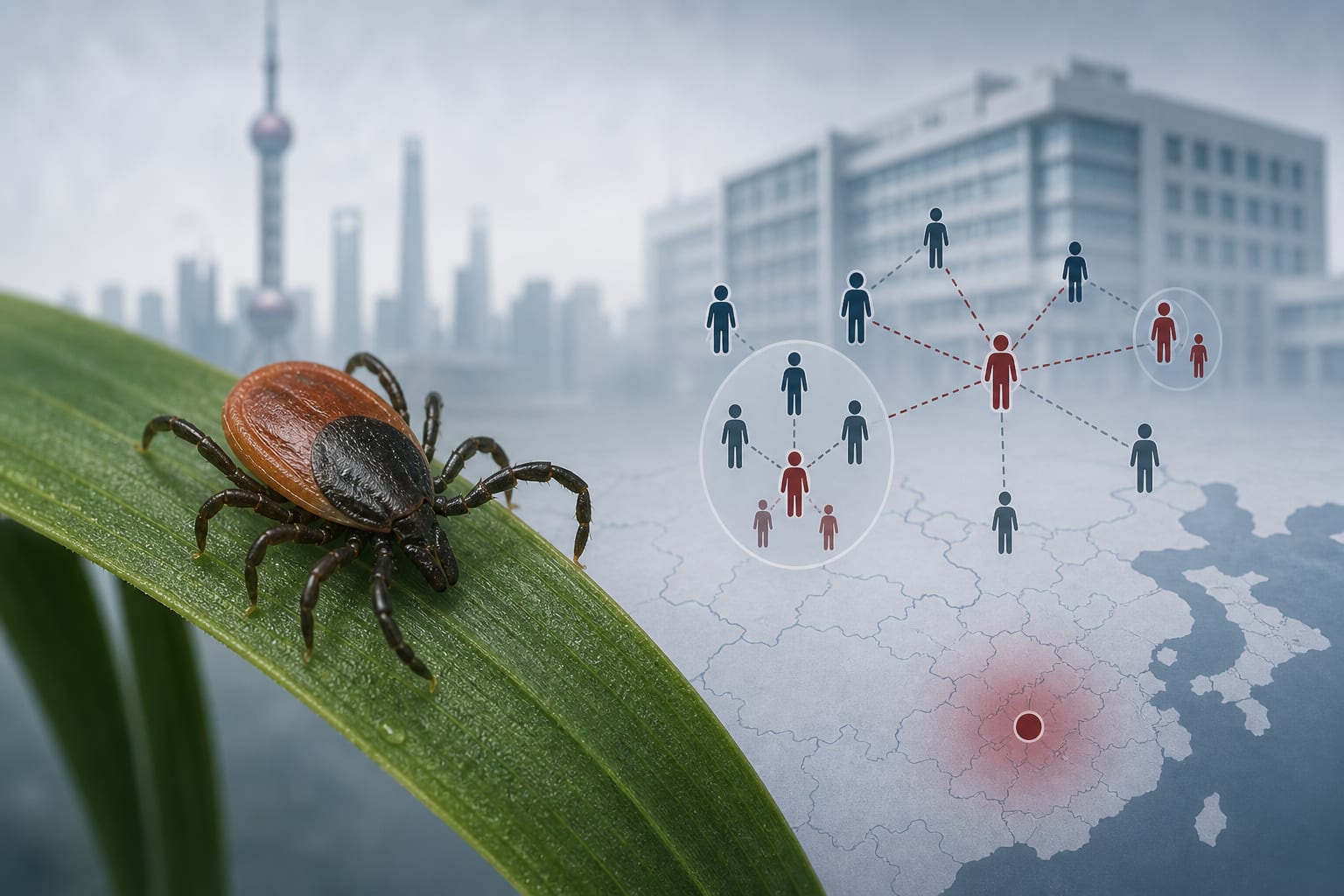
Severe fever with thrombocytopenia syndrome (SFTS) is an emerging infectious disease caused by SFTS virus, also known as Dabie bandavirus. Its reported case-fatality rate ranges from 6% to 30%. SFTS is considered a public health priority because of its severity, China’s fluctuating upward trend in reported incidence, and the absence of vaccines or specific therapies. Understanding transmission in nonendemic areas is important for preventing household and healthcare-associated infections.
Healthcare professionals should consider SFTS in patients with unexplained fever, thrombocytopenia, or hemorrhagic manifestations, particularly when patients have traveled from endemic regions. Thorough exposure histories, greater clinical awareness, staff training, and strict contact and aerosol precautions are important. During high-risk procedures, healthcare workers should use isolation gowns, medical protective masks, and goggles or face shields. Family caregivers should also avoid direct, unprotected contact with patients’ blood and bodily fluids.
This investigation documents family and healthcare-associated SFTSV transmission following an imported case in Shanghai. The findings emphasize the importance of early recognition and rigorous infection-control precautions when managing unexplained febrile hemorrhagic illnesses in nonendemic regions.
Primary study: “A family and healthcare-associated cluster of severe fever with thrombocytopenia syndrome in Shanghai, China: an epidemiological investigation in a nonendemic area” — Yiyi Zhu, Wencheng Wu, Zheng Teng, Yaxu Zheng, Yuanping Wang, Wei Wang, Jian Chen, and Hao Pan; International Journal of Infectious Diseases, Volume 171 (2026), article 108995; accepted July 20, 2026.
Clinical guidance: “Guideline for Prevention and Treatment of Severe Fever with Thrombocytopenia Syndrome (2010 Version)” — Ministry of Health of the People’s Republic of China; Chinese Journal of Clinical Infectious Diseases, Volume 4, Issue 4 (2011), pages 193–194.
WHO research priorities: “World Health Organization methodology to prioritize emerging infectious diseases in need of research and development” — Mehand MS, Millett P, Al-Shorbaji F, Roth C, Kieny MP, and Murgue B; Emerging Infectious Diseases, Volume 24, Issue 9 (2018).
Person-to-person transmission: “Person-to-person transmission of severe fever with thrombocytopenia syndrome virus” — Liu Y, Li Q, Hu W, Wu J, Wang Y, Mei L, and colleagues; Vector-Borne and Zoonotic Diseases, Volume 12, Issue 2 (2012), pages 156–160.
Blood-contact transmission: “Person-to-person transmission of severe fever with thrombocytopenia syndrome bunyavirus through blood contact” — Gai Z, Liang M, Zhang Y, Zhang S, Jin C, Wang SW, and colleagues; Clinical Infectious Diseases, Volume 54, Issue 2 (2012), pages 249–252.
Healthcare-associated transmission: “Nosocomial transmission of severe fever with thrombocytopenia syndrome in Korea” — Kim WY, Choi W, Park SW, Wang EB, Lee WJ, Jee Y, and colleagues; Clinical Infectious Diseases, Volume 60, Issue 11 (2015), pages 1681–1683.
Healthcare-environment contamination: “Extensive severe fever with thrombocytopenia syndrome virus contamination in surrounding environment in patient rooms” — Ryu BH, Kim JY, Kim T, Kim MC, Kim MJ, Chong YP, and colleagues; Clinical Microbiology and Infection, Volume 24, Issue 8 (2018).
Nosocomial person-to-person transmission: “Nosocomial person-to-person transmission of severe fever with thrombocytopenia syndrome” — Jung IY, Choi W, Kim J, Wang E, Park SW, Lee WJ, and colleagues; Clinical Microbiology and Infection, Volume 25, Issue 5 (2019), pages 633.e1–633.e4.