Occult cervical microinvasive squamous cell carcinoma with superficial endometrial spread mimicking high-grade squamous intraepithelial lesion in a postmenopausal woman: a case report - Report - MDSpire

Occult cervical microinvasive squamous cell carcinoma with superficial endometrial spread mimicking high-grade squamous intraepithelial lesion in a postmenopausal woman: a case report

  • By

  • Yuying Chen

  • Xi Zhao

  • Gege Wang

  • Ziwei Liu

  • Guangchao Sun

  • Yan Jia

  • July 16, 2026

Share

Microinvasive Squamous Cell Carcinoma of the Cervix with Endometrial Involvement

Overview

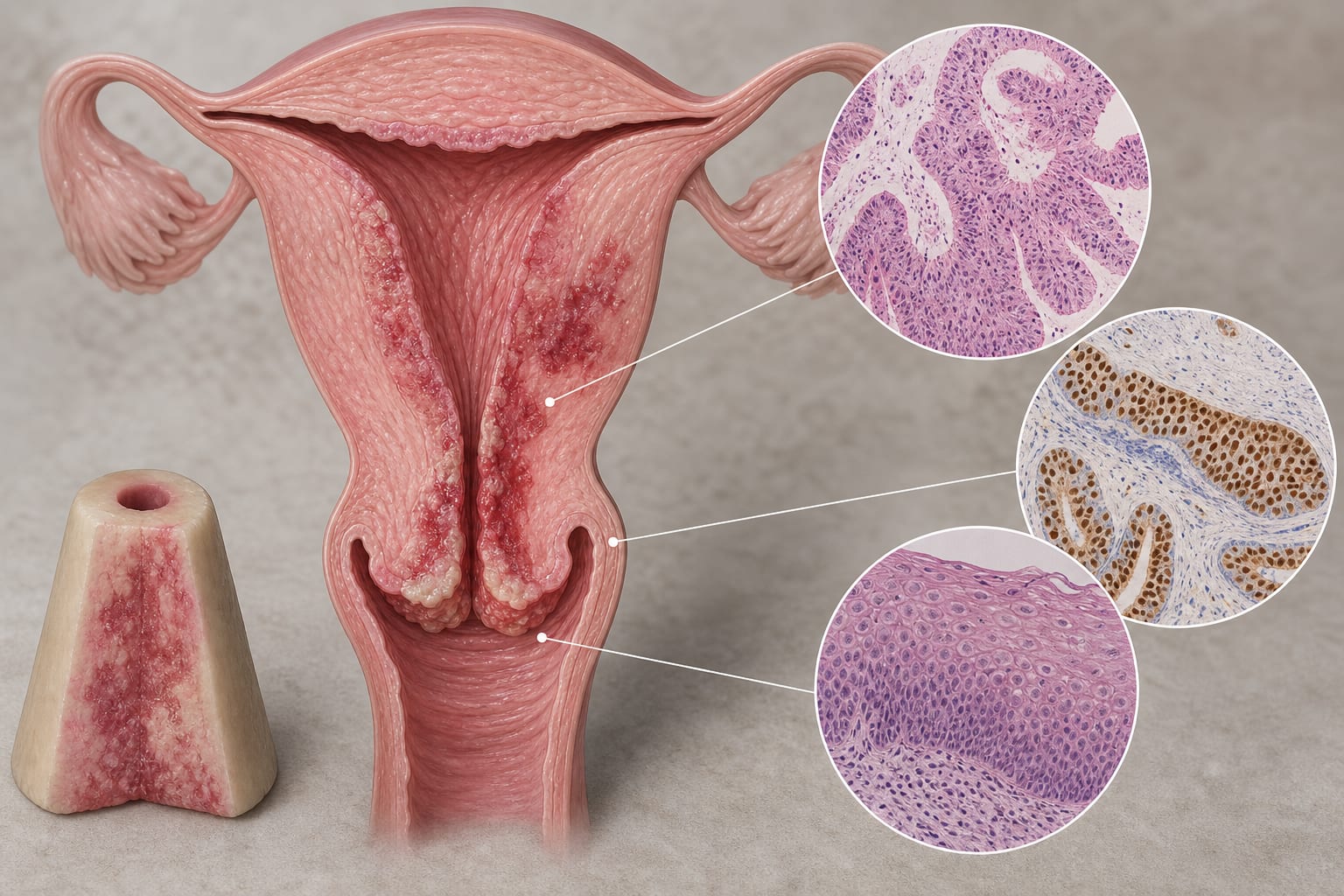
This case study presents a 56-year-old postmenopausal woman diagnosed with microinvasive cervical squamous cell carcinoma (CSCC) that was initially misidentified as a high-grade squamous intraepithelial lesion (HSIL). The findings highlight the diagnostic challenges posed by cervical atrophy.

Background

Microinvasive cervical squamous cell carcinoma is a rare condition, particularly in postmenopausal women, where cervical atrophy may complicate diagnosis. Accurate identification of such lesions is crucial, as misdiagnosis can lead to inadequate treatment.

Data Highlights

No numerical data available in the source material.

Key Findings

  • The patient was initially diagnosed with HSIL during conization, which did not reveal invasive carcinoma.
  • Final pathology after hysterectomy identified a microinvasive squamous cell carcinoma focus of less than 0.5 mm with superficial endometrial spread.
  • Immunohistochemistry indicated a cervical origin of the neoplasm, with diffuse p16 and p40 positivity.
  • There was no lymphovascular space invasion (LVSI) detected in the final pathology.
  • The patient remained disease-free at the 6-month follow-up, with negative HPV testing and no evidence of intraepithelial lesion or malignancy.

Clinical Implications

Immunohistochemistry should be utilized to differentiate between cervical and endometrial origins of squamous neoplasia.

Conclusion

The discrepancy between conization and hysterectomy findings highlights the diagnostic challenges in postmenopausal patients.

Related Resources & Content

  1. Frontiers in Oncology, 2026 -- Malignant transformation of uterine serosal endometriosis to clear cell carcinoma in a postmenopausal patient: a rare case report
  2. Frontiers in Oncology, 2026 -- Case Report: Intramyometrial Uterine Large-Cell Neuroendocrine Carcinoma Mimicking Adenomyosis and Leiomyomas With Rapid Fatal Relapse
  3. Frontiers in Surgery, 2026 -- Case Report: Complete endoscopic submucosal dissection for occult superficial esophageal squamous cell carcinoma concealed by a large esophageal leiomyoma
  4. ESGO/ESTRO/ESP Guidelines for the management of patients with cervical cancer – Update 2023
  5. Colposcopy Standards: Guidelines for Endocervical Curettage at Colposcopy
  6. Frontiers in Immunology — Case Report: Neuroendocrine-marker–negative high-grade neuroendocrine carcinoma mimicking squamous cell carcinoma: an underrecognized diagnostic pitfall
  7. Superficial spreading squamous cell carcinoma of the cervix involving the endometrium: A case report and literature review
  8. ESGO/ESTRO/ESP Guidelines for the management of patients with cervical cancer – Update 2023* - PMC
  9. Colposcopy Standards: Guidelines for Endocervical Curettage at Colposcopy - PMC

Original Source(s)

Related Content