Treatment Intensity in the Frontline Setting for Transplant-Ineligible Patients With Multiple Myeloma - Report - MDSpire
Advertisement
Treatment Intensity in the Frontline Setting for Transplant-Ineligible Patients With Multiple Myeloma
The management of newly diagnosed transplant-ineligible multiple myeloma remains challenging, in part due to the complexity of treatment decisions for frail patients. Recent subgroup analyses provide insight into whether quadruplet therapy may offer advantages over triplet therapy in this population.
Clinical Report: Treatment Intensity in Frontline for Transplant-Ineligible MM Patients
Overview
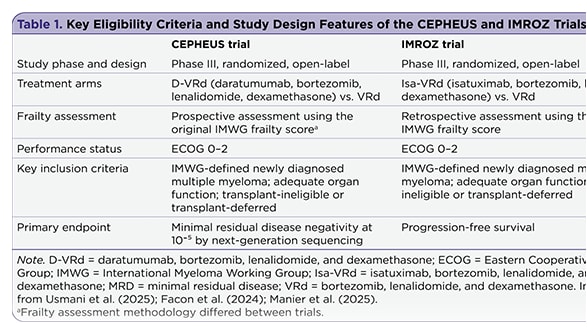
This report discusses the evolving treatment strategies for transplant-ineligible patients with multiple myeloma (MM), highlighting the shift towards quadruplet therapy. The findings from the IMROZ and CEPHEUS trials underscore the efficacy of these intensified regimens in improving patient outcomes.
Background
Multiple myeloma is a complex malignancy with significant morbidity and mortality, particularly among older and frail patients. The introduction of novel therapies has markedly improved survival rates, necessitating a focus on treatment strategies that balance efficacy and tolerability. As the population of newly diagnosed MM patients ages, understanding the implications of treatment intensity becomes increasingly critical.
Data Highlights
No numerical data available in the provided source material.
Key Findings
Quadruplet therapy is now a Category 1 recommendation for transplant-ineligible patients according to NCCN guidelines.
The IMROZ trial demonstrated that isatuximab-VRd significantly improved outcomes in transplant-ineligible patients compared to VRd alone.
CEPHEUS trial results indicated that daratumumab-VRd increased the rate of minimal residual disease negativity compared to VRd.
Approximately 40% of newly diagnosed MM patients are aged 75 years or older, highlighting the need for tailored treatment approaches.
Increased treatment intensity from doublet to quadruplet regimens has been associated with improved overall survival rates.
Clinical Implications
Clinicians should consider quadruplet regimens for transplant-ineligible patients to enhance treatment efficacy while being mindful of the patient's overall health and comorbidities. Individualized treatment plans that account for frailty and potential side effects are essential for optimizing patient outcomes.
Conclusion
The advancements in treatment intensity for transplant-ineligible multiple myeloma patients represent a significant shift in clinical practice, emphasizing the need for tailored approaches to improve patient care.