Optimizing outcomes with less than more: multi-institutional experience of fast-forward fractionation and the impact of dosimetric parameters on toxicity in breast cancer patients - Report - MDSpire
Advertisement
Optimizing outcomes with less than more: multi-institutional experience of fast-forward fractionation and the impact of dosimetric parameters on toxicity in breast cancer patients
Clinical Report: Enhancing Treatment Efficacy with Fewer Sessions
Overview
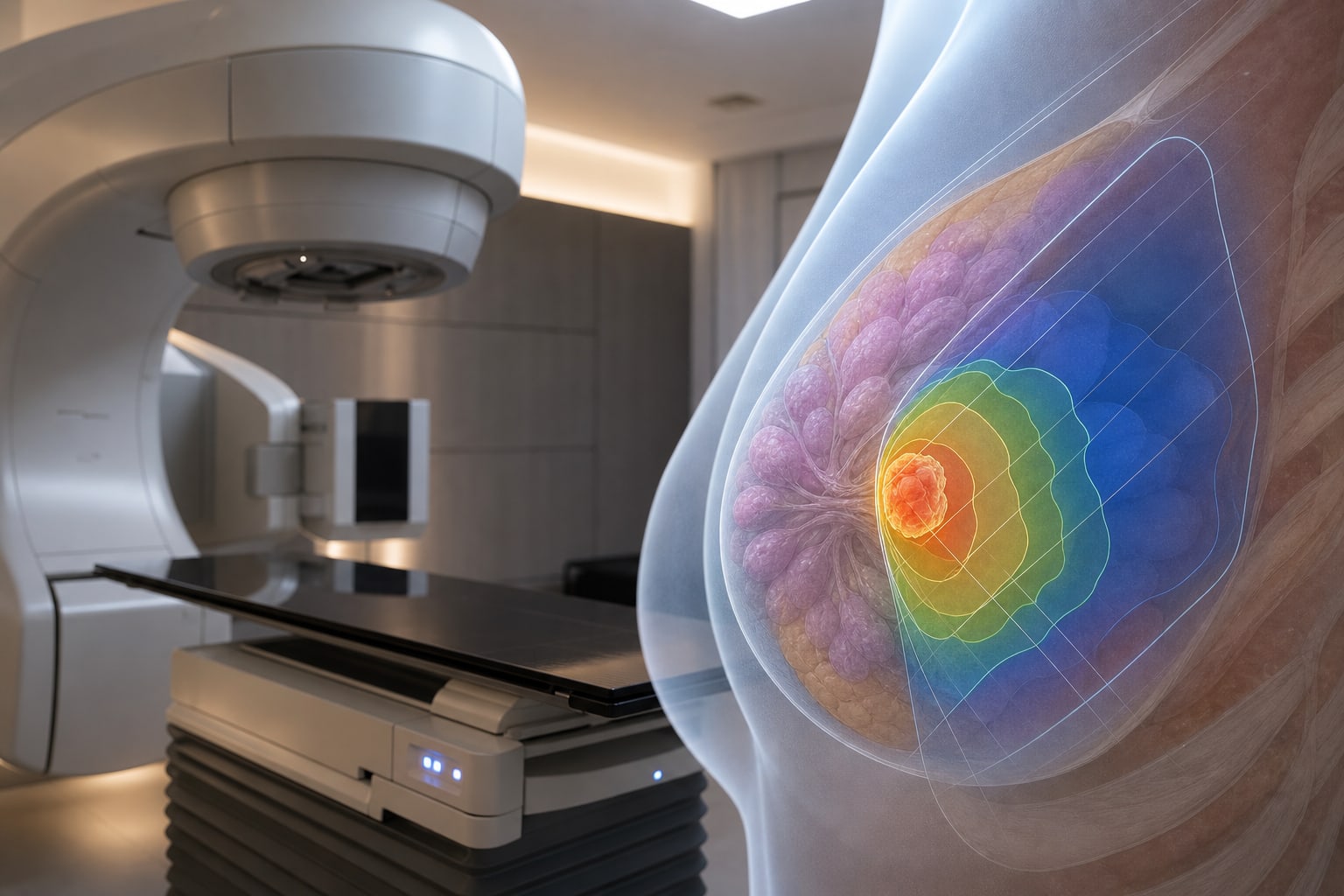
This study evaluates the safety and toxicity of ultra-hypofractionated radiotherapy (RT) in breast cancer patients, demonstrating that 26 Gy in five fractions is well tolerated. Key findings include significant correlations between dosimetric parameters and observed toxicities.
Background
The rising incidence of breast cancer in Saudi Arabia necessitates effective treatment strategies. Recent advancements in radiotherapy, particularly hypofractionation, have shown promise in improving outcomes while minimizing toxicity. Understanding the toxicity profiles associated with these treatments is crucial for optimizing patient care.
Data Highlights
Toxicity
Percentage
Grade III
Breast skin dermatitis
82.35%
5%
Hyperpigmentation
72.9%
N/A
Breast discomfort
30.3%
N/A
Breast hardness
17.6%
N/A
Breast pain (≥5/10)
15%
N/A
Key Findings
Breast skin dermatitis was the most common side effect, affecting 82.35% of patients.
Hyperpigmentation occurred in 72.9% of patients.
15% of patients reported breast pain rated ≥5 out of 10.
Breast pain correlated significantly with larger breast volume and higher V107% values (p=0.013, p=0.012).
Breast skin dermatitis was significantly correlated with breast CTV, BMI, and breast separation (p=0.0001, 0.015, 0.001).
Clinical Implications
The findings suggest that careful consideration of dosimetric factors, such as breast volume and BMI, may help mitigate toxicity in patients undergoing ultra-hypofractionated RT. This information can guide clinicians in treatment planning to enhance patient safety.
Conclusion
Ultra-hypofractionated RT with a 26 Gy in five fractions schedule is a viable option for breast cancer treatment, with manageable toxicity profiles. Further optimization of dosimetric parameters may improve patient outcomes.
by H. Habibullah, M. Alotaibi, H. Almarzouki, Z. Mulla, M. Elbaiomy, R. Alahmadi, A. Ahmed, Y. Bahadur, R. Ujaimi, E. Senan, M. Attar, A. Bamakhramah, H. Altoukhi, H. Muamenah, O. Iskanderani, R. Garout, J. Alturkistani, H. Hijazi, Z. Jastaniah