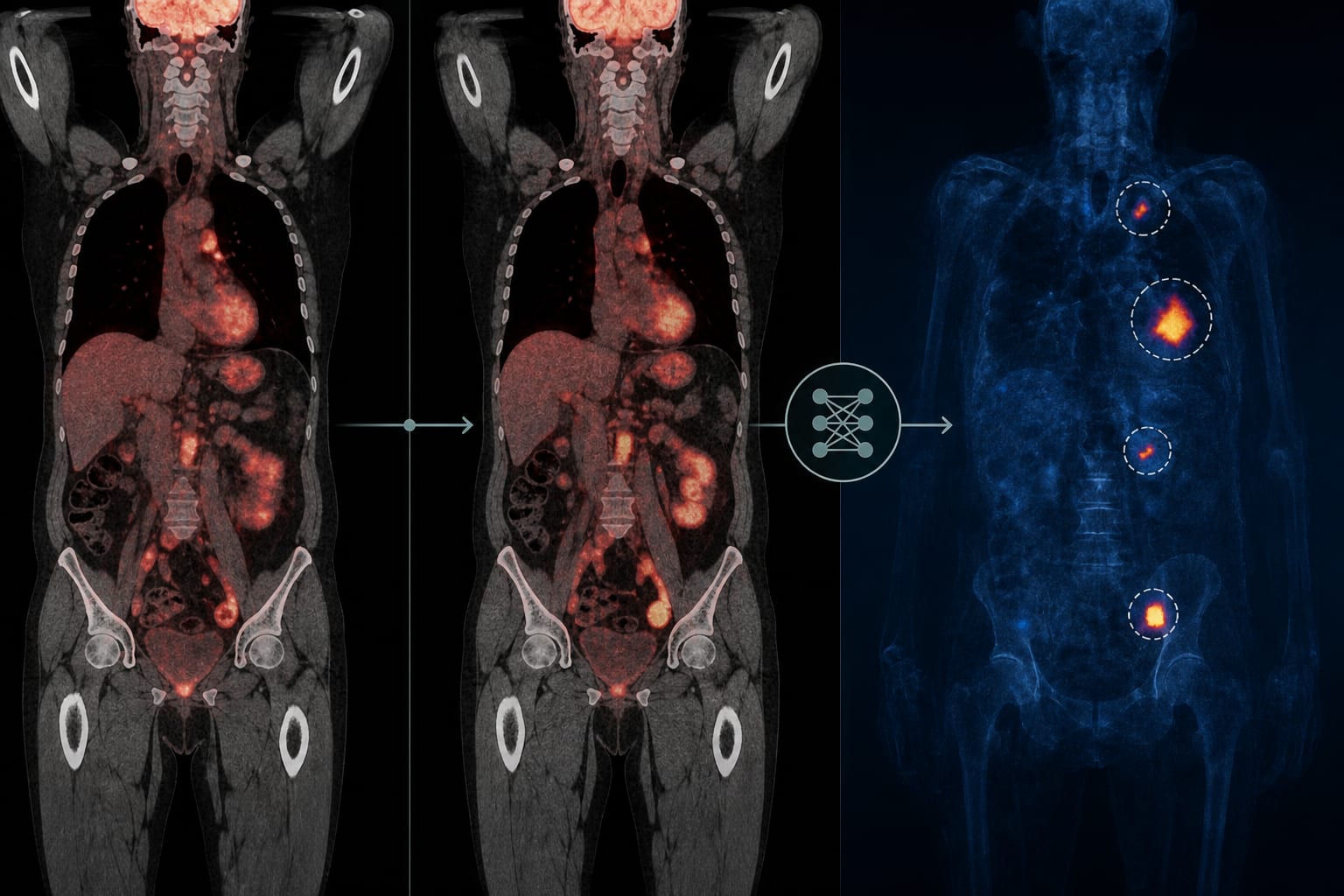
Unsupervised anomaly detection for longitudinal comparison in whole-body PET/CT images - Report - MDSpire

Unsupervised anomaly detection for longitudinal comparison in whole-body PET/CT images

  • By

  • Takahiro Nakao

  • Shouhei Hanaoka

  • Yukihiro Nomura

  • Takeharu Yoshikawa

  • Osamu Abe

  • May 25, 2026

  • 0 min

Share

Clinical Report: Automated Anomaly Identification in Whole-Body PET/CT Imaging

Overview

Revise to emphasize the importance of longitudinal comparison in detecting new lesions.

Background

Accurate identification of new lesions in diagnostic imaging is crucial for timely disease treatment. Traditional methods, such as subtraction-based approaches, often lead to false positives, particularly in complex imaging modalities like PET/CT. The development of unsupervised anomaly detection methods presents a promising alternative that could enhance diagnostic accuracy without the need for extensive annotated datasets.

Data Highlights

No numerical data or trial data were provided in the source material.

Key Findings

Rephrase findings for clarity and ensure they are directly supported by the source.

Clinical Implications

The implementation of unsupervised anomaly detection in clinical practice could streamline the identification of new lesions, improving patient outcomes through earlier intervention. This method may also reduce the workload associated with preparing annotated datasets, allowing radiologists to focus on more complex cases.

Conclusion

Unsupervised anomaly detection presents a significant advancement in the longitudinal analysis of whole-body PET/CT imaging, offering a reliable alternative to traditional methods. Its ability to reduce false positives and eliminate the need for annotated datasets could enhance diagnostic efficiency and accuracy.

Related Resources & Content

  1. Hoshiai et al., 2023 -- Automated Anomaly Identification for Longitudinal Analysis in Whole-Body PET/CT Imaging
  2. Machine Learning-Based Automated Volumetric Analysis of the Major Psoas Muscle in CT Imaging
  3. Frontiers in Oncology — Anatomy-aware lymphoma lesion detection in whole-body PET/CT
  4. European Radiology — Automated Precision in Patient Positioning for Computed Tomography Utilizing Anterior-Posterior Localizer Images and a Deep Learning Approach: Findings from a Dual-Center Investigation
  5. European Radiology — Patient-specific Monte Carlo dose reconstruction in whole-body CT imaging using deep neural networks without the need for real-time acquisition parameters
  6. [18F]FDG PET/CT: EANM procedure guidelines for tumour imaging: version 3.0 | CoLab
  7. Machine Learning-Based Automated Volumetric Analysis of the Major Psoas Muscle in CT Imaging
  8. Anatomy-aware lymphoma lesion detection in whole-body PET/CT
  9. Automated Precision in Patient Positioning for Computed Tomography Utilizing Anterior-Posterior Localizer Images and a Deep Learning Approach
  10. Recist 1.1 - RECIST 2025
  11. Frontiers | 18F-FDG PET/CT for predicting major pathological response to neoadjuvant therapy in non-small cell lung cancer: a meta-analysis

Original Source(s)

Related Content