Deep Learning Synthesis of MRI and PET for Amyloid-β Quantification in Alzheimer’s Disease
Overview
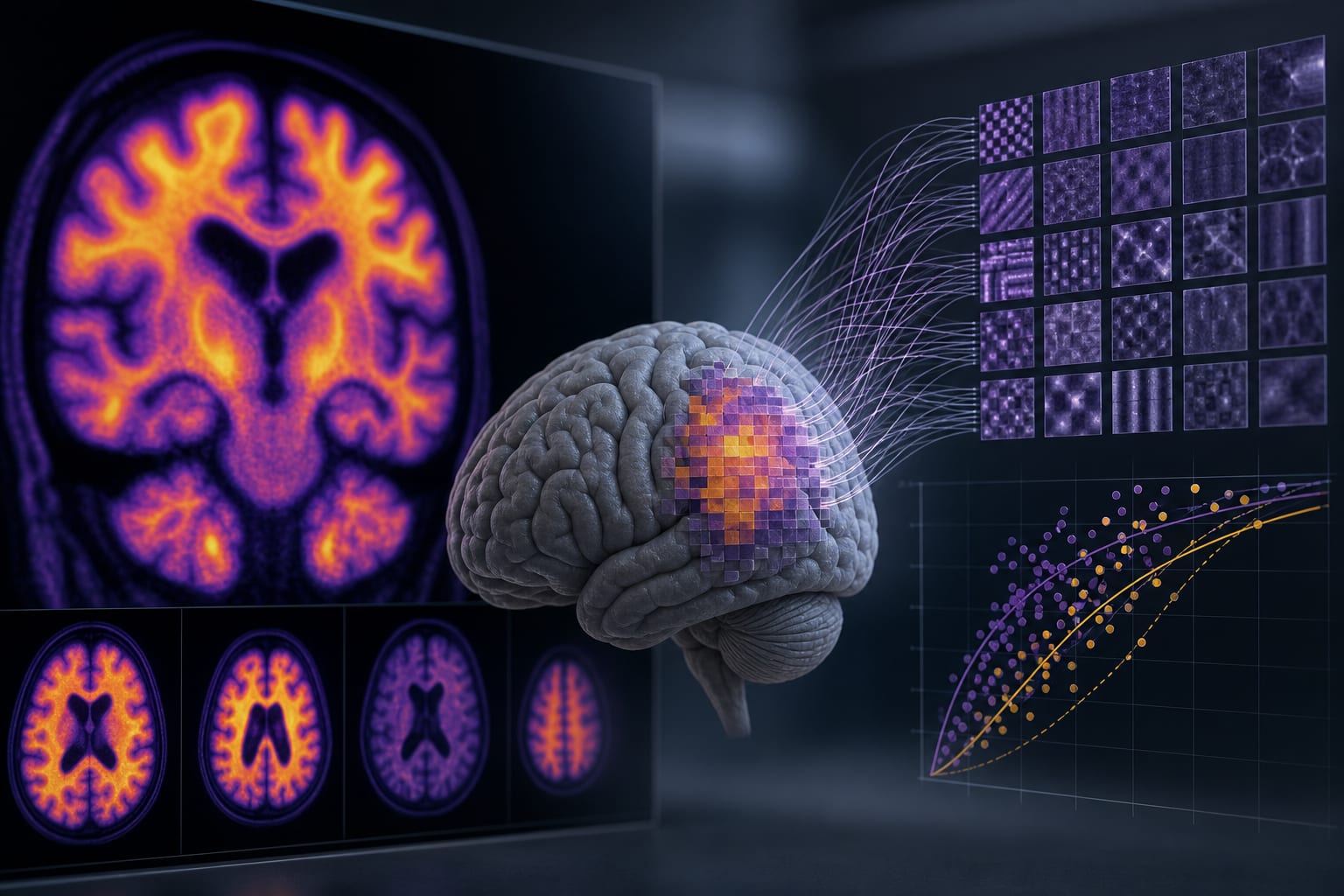
This study developed a generative adversarial network (GAN) model to synthesize amyloid-β (Aβ) PET images from structural MRI, aiming to provide a non-invasive, accessible alternative for quantifying cerebral Aβ burden in Alzheimer’s disease (AD). The model was trained and validated on large multicenter datasets, demonstrating promising similarity and quantitative consistency with real Aβ PET scans.
Background
Alzheimer’s disease is characterized by early and progressive accumulation of amyloid-β plaques, which can be detected years before clinical diagnosis. Current methods to assess Aβ burden include cerebrospinal fluid biomarkers, plasma assays, and PET imaging, each with limitations such as invasiveness, cost, and accessibility. Structural MRI is widely available and has shown associations with Aβ deposition, but lacks direct visualization of Aβ pathology. Deep learning models, particularly GANs, have shown potential in cross-modal image synthesis, enabling the generation of PET-like images from MRI data. This study leverages these advances to synthesize Aβ PET images from MRI to support early diagnosis and monitoring of AD.
Data Highlights
A total of 1009 subjects were included, divided into training, validation, and two external testing sets from multiple centers. The training set comprised 676 participants from the ADNI database with paired 18F-AV45 PET and high-resolution 3D T1-weighted MRI scans acquired within 30 days. External testing sets included 286 participants from Xuanwu Hospital and 47 participants from two additional hospitals. Data encompassed healthy controls, mild cognitive impairment, AD, and other dementia types. Imaging was performed using simultaneous PET/MR 3.0-Tesla systems and Siemens PET/MR scanners, with standardized preprocessing including spatial normalization to MNI space.
Key Findings
The GAN-based model successfully synthesized Aβ PET images from structural MRI with high similarity to real PET scans.
Quantitative analysis showed strong consistency between synthetic and actual Aβ PET standardized uptake value ratios (SUVRs).
The model was validated across multiple independent external datasets, demonstrating robustness and generalizability.
Synthetic Aβ PET images enabled visualization of regional Aβ distribution patterns, potentially improving AD assessment beyond dichotomous Aβ status.
The approach offers a non-invasive, cost-effective alternative to PET imaging, reducing radiation exposure and logistical challenges associated with radiotracer production.
Clinical Implications
The GAN-based synthesis of Aβ PET from MRI could facilitate earlier and more accessible detection of cerebral amyloid pathology, aiding in risk stratification and monitoring of Alzheimer’s disease. This method may serve as a screening tool to identify patients who require confirmatory PET imaging, optimizing resource utilization. Integration of synthetic PET imaging into clinical workflows could enhance diagnostic accuracy while minimizing patient burden.
Conclusion
This study demonstrates the feasibility and clinical potential of deep learning models to generate synthetic Aβ PET images from structural MRI, providing a promising non-invasive tool for quantifying amyloid burden in Alzheimer’s disease. Further validation and longitudinal studies are warranted to establish its role in routine clinical practice.
References
Wang et al 2024 -- Deep Learning-Based Synthesis of MRI and PET for Quantifying Amyloid-β in Alzheimer’s Disease