Cardiac autonomic ganglion ablation for refractory coronary artery spasm after PCI: a case report - Report - MDSpire

Cardiac autonomic ganglion ablation for refractory coronary artery spasm after PCI: a case report

  • By

  • Fuchao Qu

  • Shanshan Zhang

  • Xiufeng Li

  • Lili Chen

  • Jiageng Wang

  • Xiaohua Ma

  • Chenhui Liu

  • Yifei Liu

  • Yuanxin Wang

  • Leisheng Zhang

  • Wenwei Yue

  • June 9, 2026

  • 0 min

Share

Clinical Report: Ablation of Cardiac Autonomic Ganglia in a Patient with Persistent Coronary Artery Spasm Post-PCI

Overview

This case study describes a 45-year-old male with refractory vasospastic angina following PCI, who underwent catheter ablation of cardiac autonomic ganglia. Post-ablation, the patient experienced resolution of chest pain and significantly reduced coronary artery spasm.

Background

Coronary artery spasm can lead to myocardial ischemia and is often challenging to manage, particularly in patients who do not respond to standard pharmacological treatments. Approximately 20% to 30% of patients with variant angina progress to refractory symptoms, necessitating alternative therapeutic approaches. Cardioneuroablation (CNA) has emerged as a potential non-pharmacological intervention for these patients, targeting the autonomic nervous system's role in coronary artery spasm.

Data Highlights

No numerical data or trial data presented in the article.

Key Findings

  • A 45-year-old male patient presented with recurrent nocturnal chest pain post-PCI.
  • Intracoronary ergonovine testing confirmed severe coronary artery spasms.
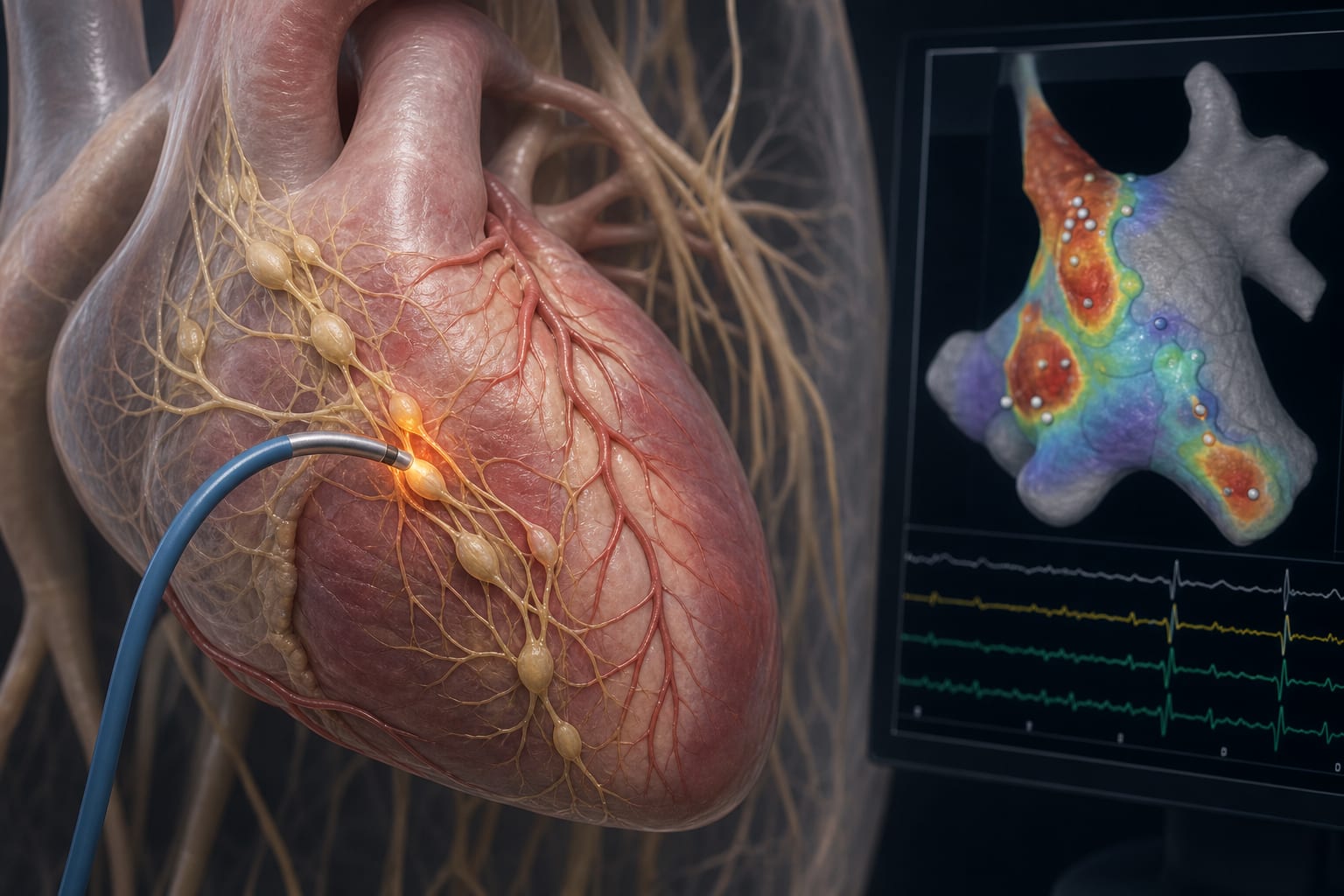
  • Catheter ablation of cardiac autonomic ganglia was performed, guided by three-dimensional electroanatomical mapping.
  • Post-ablation testing showed markedly attenuated coronary artery spasm and resolution of chest pain.
  • At 2-month follow-up, the patient reported complete resolution of angina.

Clinical Implications

This case highlights the potential of cardiac autonomic ganglion ablation as a treatment option for patients with refractory vasospastic angina who exhibit heightened vagal tone. Clinicians may consider this approach in similar cases where standard therapies are ineffective.

Conclusion

Cardiac autonomic ganglion ablation may offer a promising non-pharmacological treatment for patients with refractory coronary artery spasm post-PCI, as evidenced by the favorable outcomes in this case.

Related Resources & Content

  1. 2024 ESC Guidelines for the management of chronic coronary syndromes
  2. Clinical Research in Cardiology — Clinical Outcomes in Patients Exhibiting Dual Conduction Pathways in the Atrioventricular Node: Findings from a Multicenter Observational Study
  3. Clinical Research in Cardiology — Updated Systematic Review on the Effectiveness and Safety of Catheter Ablation in Treating Brugada Syndrome
  4. Clinical Research in Cardiology — Long-term Results Following Multiple Ventricular Tachycardia Ablations in Patients with Non-Ischemic Cardiomyopathy
  5. Clinical Research in Cardiology — Ablation Therapy for the Short-Coupled Variant of Torsade de Pointes
  6. Omitting 50 μg of intracoronary acetylcholine injection in the left coronary artery during spasm provocation test
  7. 2024 ESC Guidelines for the management of chronic coronary syndromes
  8. https://academic.oup.com/ehjcr/article/9/10/ytaf456/8256368

Original Source(s)

Related Content