Acupuncture for post-stroke recovery: a retrospective cohort study on motor function and quality of life - Report - MDSpire

Acupuncture for post-stroke recovery: a retrospective cohort study on motor function and quality of life

  • By

  • Min Su

  • Shiqi Cheng

  • Wei Yang

  • Xun Pan

  • Qiuju Su

  • Peng Yuan

  • May 4, 2026

  • 0 min

Share

Clinical Report: Evaluating the Impact of Combined Acupuncture Techniques on Motor Function

Overview

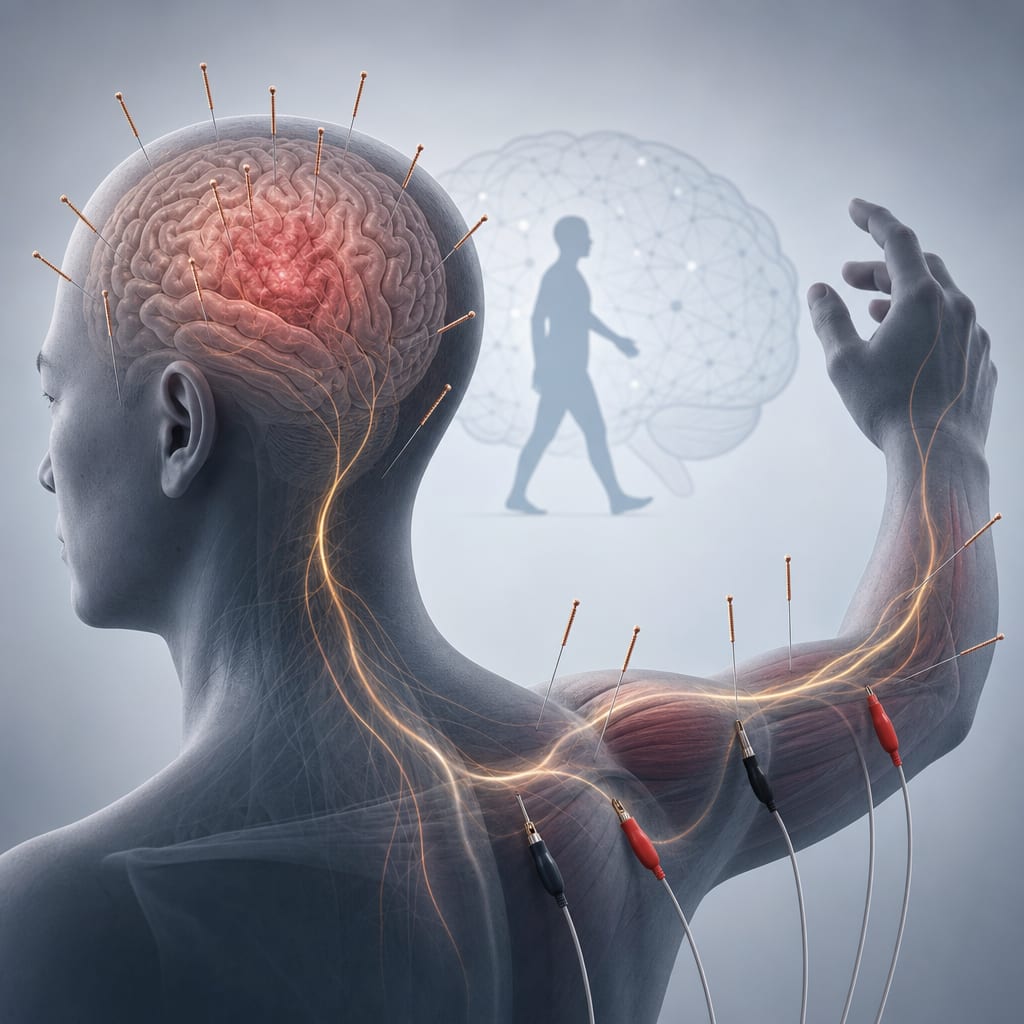
This study demonstrates that combined acupuncture therapy significantly improves motor function and quality of life in post-stroke patients compared to conventional rehabilitation alone. These benefits were sustained at a 12-week follow-up, highlighting the potential of acupuncture as an adjunctive treatment in stroke rehabilitation.

Background

Stroke is a major cause of long-term disability, with many survivors experiencing persistent motor dysfunction. Conventional rehabilitation methods often yield limited functional recovery, particularly in patients with moderate-to-severe impairments. The integration of acupuncture into rehabilitation programs may enhance recovery outcomes and improve patients' quality of life.

Data Highlights

Outcome MeasureAcupuncture Group (n=54)Control Group (n=54)P-value
Fugl-Meyer Assessment (FMA)61.28 ± 11.8552.15 ± 10.42< 0.001
Modified Barthel Index (MBI)73.58 ± 12.3462.04 ± 11.56< 0.001
NIH Stroke Scale (NIHSS)5.52 ± 1.897.62 ± 2.15< 0.001
Stroke-Specific Quality of Life (SS-QOL)181.35 ± 26.48163.52 ± 24.86< 0.001
Favorable functional outcome (mRS 0-2)79.6%53.7%0.003

Key Findings

  • Combined acupuncture therapy significantly improved Fugl-Meyer Assessment scores compared to conventional rehabilitation alone.
  • Patients receiving acupuncture showed greater improvements in the Modified Barthel Index and NIH Stroke Scale scores.
  • Quality of life, as measured by the Stroke-Specific Quality of Life Scale, was significantly higher in the acupuncture group.
  • At 12-week follow-up, improvements in motor function and quality of life were sustained in the acupuncture group.
  • 79.6% of the acupuncture group achieved a favorable functional outcome compared to 53.7% in the control group.

Clinical Implications

The findings suggest that integrating combined acupuncture techniques into post-stroke rehabilitation may enhance motor recovery and improve quality of life for patients. Clinicians should consider acupuncture as a complementary therapy in rehabilitation programs, particularly for patients with significant motor impairments.

Conclusion

Combined acupuncture therapy appears to offer significant benefits in motor function and quality of life for post-stroke patients. Further research through randomized controlled trials is needed to validate these findings.
References

  1. Frontiers in Neurology, 2026 -- Effectiveness and safety of skull base-peripheral acupuncture for post-stroke cognitive impairment: a systematic review and meta-analysis of randomized controlled trials
  2. Frontiers in Neurology, 2026 -- Effectiveness of transcutaneous auricular vagus nerve stimulation in stroke rehabilitation: a systematic review and meta-analysis of randomized clinical trials
  3. Frontiers in Medicine, 2026 -- Effectiveness of different types of exercise therapy in improving post-stroke depression: a systematic review and network meta-analysis
  4. European Stroke Organisation (ESO) guideline on motor rehabilitation - PMC, 2025
  5. Frontiers | Use of acupuncture in stroke and stroke complications: a systematic review and meta-analysis based on sham-controlled trials, 2025
  6. npj Digital Medicine — Affordable AI-Powered Exergame for Stroke Rehabilitation and Upper-Limb Function Evaluation
  7. European Stroke Organisation (ESO) guideline on motor rehabilitation - PMC
  8. Frontiers | Use of acupuncture in stroke and stroke complications: a systematic review and meta-analysis based on sham-controlled trials
  9. Acupuncture and stroke motor rehabilitation: a decade of evidence synthesis via systematic mapping (2015–2024) - PMC

Original Source(s)

Related Content