Towards clinically interpretable machine learning in emergency surgery: feature importance and insights across clinical time points in abdominal pain cases - Report - MDSpire

Towards clinically interpretable machine learning in emergency surgery: feature importance and insights across clinical time points in abdominal pain cases

  • By

  • Jonas Henn

  • Simon Hatterscheidt

  • Svetozar Nesic

  • Sebastian Nowak

  • Wolfgang Block

  • Johannes Röttgen

  • Ingo Gräff

  • Jörg C. Kalff

  • Alois M. Sprinkart

  • Andreas Buness

  • Hanno Matthaei

  • June 16, 2026

  • 0 min

Share

Clinical Report: Enhancing Interpretability of Machine Learning in Emergency Surgery

Overview

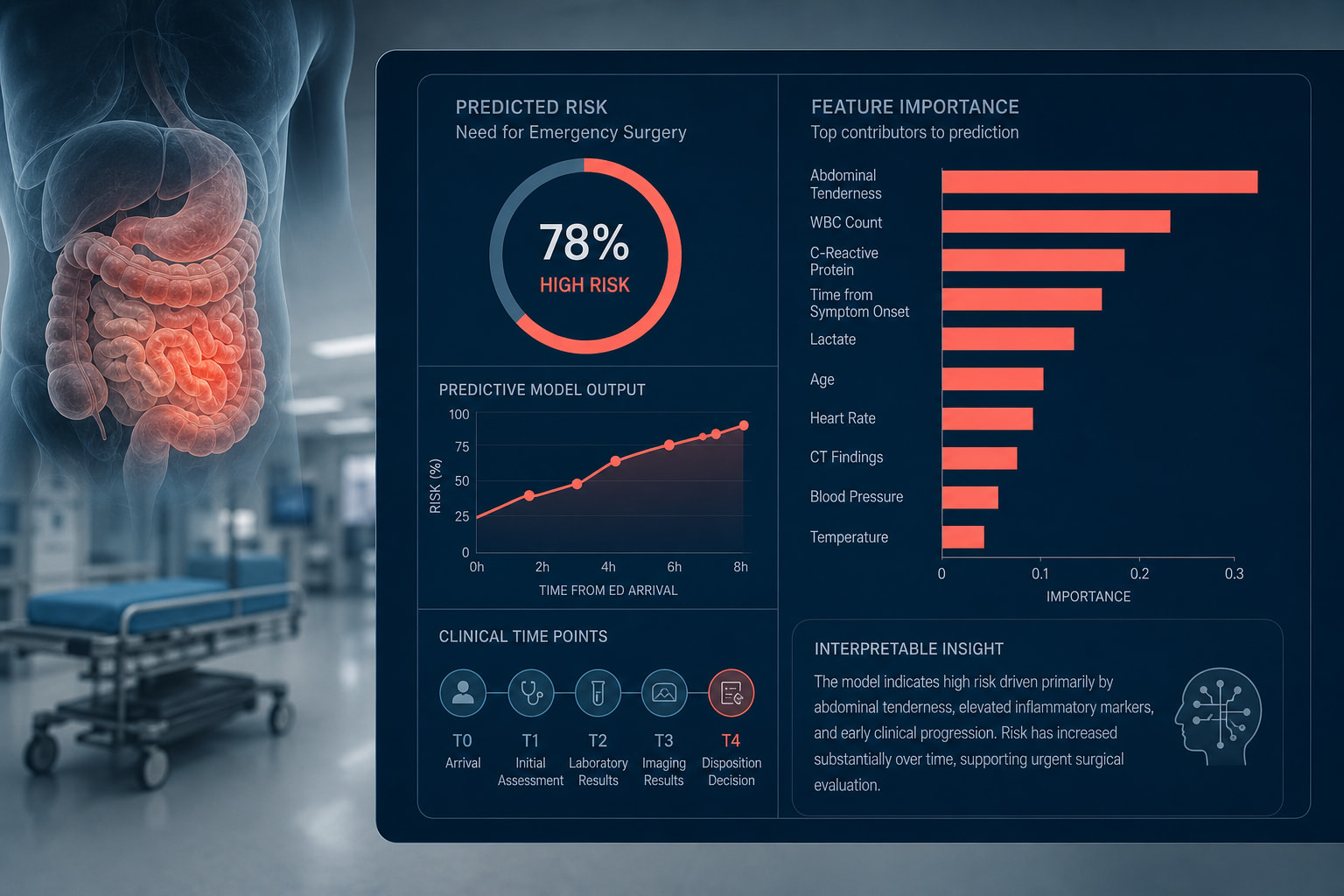
This study evaluates a random-forest classifier for urgent abdominal surgery in acute abdominal pain (AAP) cases, focusing on the significance of feature attribution across clinical time points. The findings highlight the importance of explainable predictions to foster trust and integration of machine learning in clinical decision-making.

Background

The integration of artificial intelligence (AI) and machine learning (ML) in clinical decision-making is gaining traction, particularly in emergency medicine. Acute abdominal pain is a common and critical presentation that necessitates rapid and accurate diagnosis to determine the need for surgical intervention. However, the lack of interpretability in ML models poses a significant barrier to their adoption in clinical practice.

Data Highlights

This study utilized a retrospective cohort of adult patients presenting with AAP to evaluate the performance of a random-forest classifier.

Key Findings

  • The study focused on urgent abdominal surgery decisions made within 24 hours of patient admission.
  • Feature sets were grouped into seven categories to reflect the diagnostic workflow.
  • Sequential clinical time points were considered to enhance model interpretability.
  • Explainable predictions are essential for clinician trust and integration into workflows.
  • Prior studies indicated that ML models can predict surgical conditions with high accuracy, but often neglect the temporal aspect of data acquisition.

Clinical Implications

The findings emphasize the necessity for ML models to provide clear, timepoint-specific explanations to support clinical decision-making in emergency settings. This approach may enhance clinician trust and facilitate the integration of AI tools into routine practice.

Conclusion

The study underscores the importance of combining predictive accuracy with explainable feature importance in ML models for urgent surgical decisions in AAP cases. This dual focus may improve the acceptance and utility of AI in emergency medicine.

Related Resources & Content

  1. JMIR Medical Informatics, 2026 -- Large Language Model Automated Extraction of Clinical Signs and Symptoms From Emergency Department Reports for Machine Learning Prediction Models: Development and Validation Study
  2. Evaluating Trust in AI, 2025 -- Insights on Machine Learning Applications in Surgery and the Role of Explainable Artificial Intelligence (XAI)
  3. npj Digital Medicine, 2026 -- An Interpretable Machine Learning Approach for Predicting Postoperative Risks and Supporting Surgical Decisions in Cranioplasty
  4. 2025 WSES Guidelines on Acute Appendicitis
  5. Utilizing Machine Learning to Enhance Clinical Decision-Making in Abdominal Surgery: A Comprehensive Literature Review
  6. 2025 WSES Guidelines on Acute Appendicitis
  7. Five-Year Follow-up of Antibiotic Therapy for Uncomplicated Acute Appendicitis in the APPAC Randomized Clinical Trial - PMC
  8. Marketing Submission Recommendations for a Predetermined Change Control Plan for Artificial Intelligence-Enabled Device Software Functions | FDA
  9. AI unleashed: A meta-analysis transforming radiological insights in diagnosing abdominal infections - ScienceDirect

Original Source(s)

Related Content