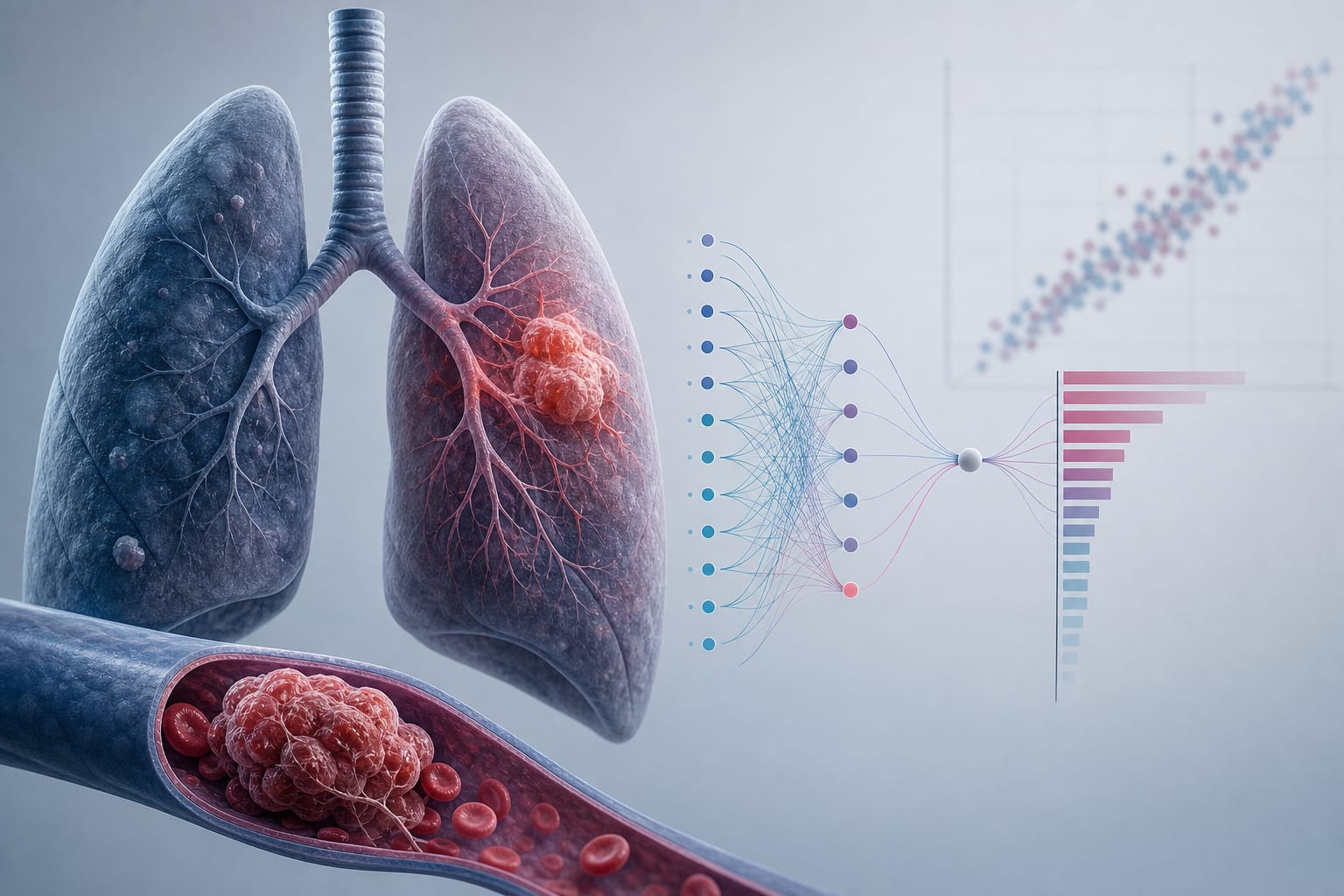
Correction: Validation and Development of an Explainable Machine Learning Approach for Predicting Venous Thromboembolism Risk in Lung Cancer Patients: A Real-World Analysis
-
By
-
Frontiers Production Office
-
September 8, 2026
Correction: Validation and Development of an Explainable Machine Learning Approach
Overview
This correction addresses errors in the reported P-values for anticoagulant and chemotherapy drugs in a study predicting venous thromboembolism (VTE) risk in lung cancer patients. The corrected P-values are now both 1.000, indicating no statistically significant differences between training and validation cohorts.
Background
Venous thromboembolism (VTE) is a significant complication in lung cancer patients. Machine learning approaches offer potential for improved prediction and understanding of VTE risk factors. Ensuring the accuracy of reported data in such studies is crucial.
Data Highlights
The correction pertains specifically to Table 1, which now accurately reflects the P-values for anticoagulant and chemotherapy drugs as 1.000.
Key Findings
- The correction only affects the accuracy of reported P-values in Table 1.
- Both corrected P-values indicate no statistically significant differences between cohorts.
- The model construction and overall conclusions of the original study remain unchanged.
- The study utilizes machine learning for VTE risk prediction in lung cancer patients.
- Statistical interpretation of the baseline characteristics is unaffected by the correction.
Clinical Implications
Accurate reporting is essential for the application of machine learning models in predicting VTE risk in lung cancer patients.
Conclusion
The correction clarifies the statistical analysis without altering the study's conclusions.
Related Resources & Content
- Xia A., Liu J., Song J., et al., Front. Med., 2026 -- Validation and Development of an Explainable Machine Learning Approach for Predicting Venous Thromboembolism Risk in Lung Cancer Patients
- Frontiers in Medicine — Construction and validation of a machine learning-based prediction model for venous thromboembolism in lung transplant recipients supported by ECMO
- Frontiers in Immunology — Explainable machine learning for predicting venous thromboembolism in septic shock patients
- Frontiers in Oncology — Risk prediction models for venous thromboembolism in lung cancer patients after surgery: a systematic review and meta-analysis
- Journal of Hospital Medicine — Comparison of machine learning methods for prediction of venous thromboembolism among hospitalized adults
- NCCN Guidelines Version 3.2025
- Thromboembolism in ALK+ and ROS1+ NSCLC patients: A systematic review and meta-analysis - ScienceDirect
Based on findings from:
Correction: Development and validation of an interpretable machine learning model for venous thromboembolism risk prediction in patients with lung cancer: a real-world study
Frontiers Production Office. Frontiers In Medicine, 2026.
https://www.frontiersin.org/journals/medicine/articles/10.3389/fmed.2026.1953862/full
This content is an AI-generated, fully rewritten summary based on a published scholarly article. It does not reproduce the original text and is not a substitute for the original publication. Readers are encouraged to consult the source for full context, data, and methodology.