From routine full-spine radiographs to decision-oriented Risser stratification: an interpretable deep-learning approach - Report - MDSpire

From routine full-spine radiographs to decision-oriented Risser stratification: an interpretable deep-learning approach

  • By

  • Zexi Wang

  • Yuan Zhang

  • Yixi Wang

  • Feng Xue

  • Yi Yang

  • Wen Zhao

  • June 17, 2026

  • 0 min

Share

Clinical Report: Transitioning from Standard Full-Spine X-Rays to Risser Stratification

Overview

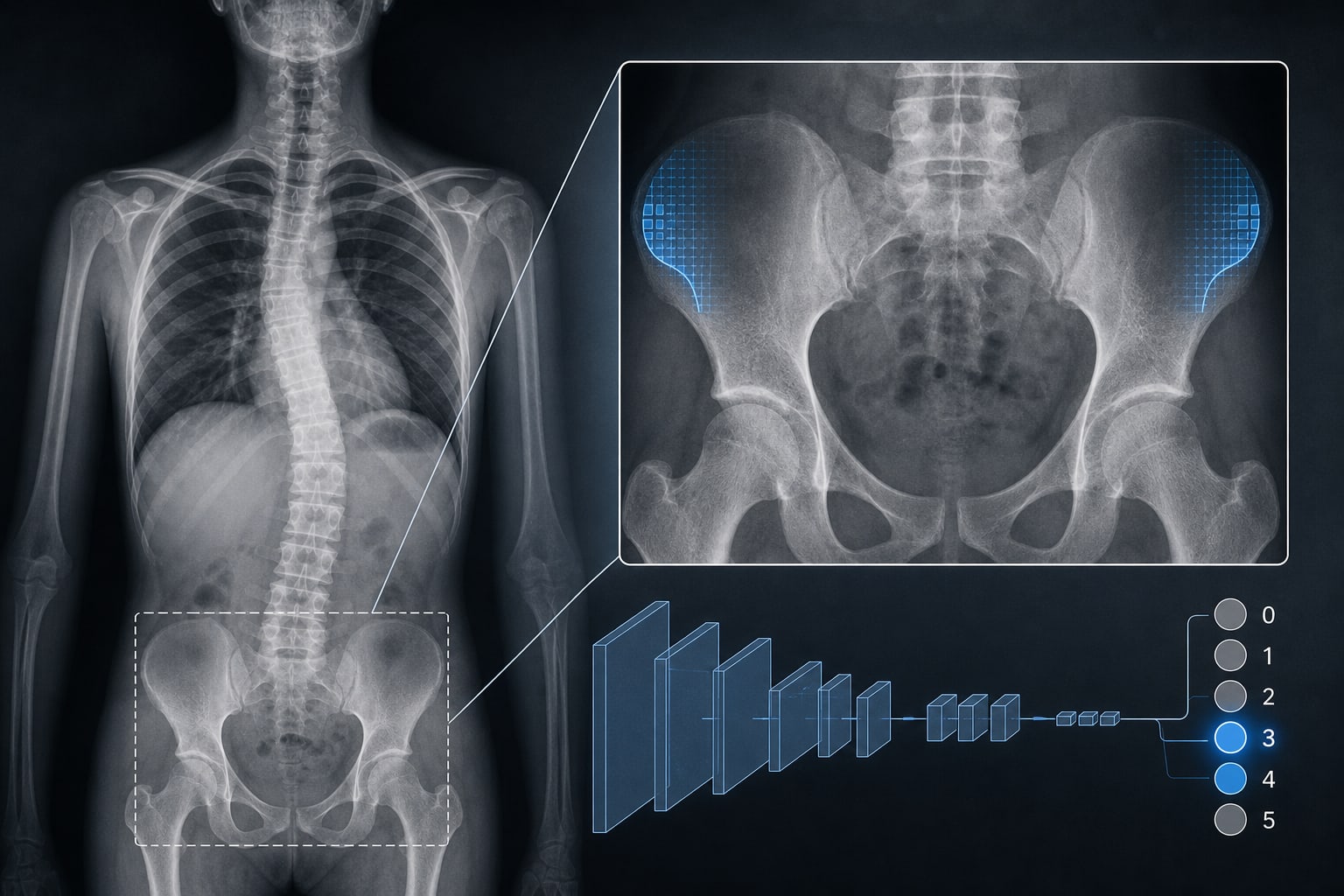
This study presents a deep-learning model for automatic Risser stratification in adolescent idiopathic scoliosis (AIS) using full-spine radiographs. The model demonstrated high accuracy and improved reading efficiency, potentially enhancing clinical decision-making in AIS management.

Background

Accurate assessment of skeletal maturity is vital for managing adolescent idiopathic scoliosis (AIS), as it influences treatment decisions and risk stratification. Risser staging, a common method for evaluating skeletal maturity, often suffers from reproducibility issues in clinical practice. This study addresses these challenges by employing a deep-learning approach to improve the reliability and efficiency of Risser stratification.

Data Highlights

MetricValue
AUC0.938
Accuracy0.875
Cohen's Kappa0.748
Mean Reading Time (unaided)34.7–43.2 s
Mean Reading Time (aided)25.0–31.8 s

Key Findings

  • The deep-learning model achieved an AUC of 0.938 for Risser stratification.
  • Accuracy of the model was reported at 87.5% with a Cohen's kappa of 0.748.
  • Model assistance reduced reading time by 9.7–11.8 seconds per case.
  • Improved agreement with expert reference was noted, especially among junior surgeons.
  • Exploratory six-class Risser staging showed lower performance compared to binary stratification.

Clinical Implications

The deep-learning model provides a reliable and efficient method for Risser stratification, which can enhance clinical decision-making in AIS management. By reducing reading time and improving accuracy, this approach may facilitate timely interventions and better patient outcomes.

Conclusion

The study demonstrates that an interpretable deep-learning model can effectively stratify skeletal maturity in AIS using standard radiographs, potentially transforming routine clinical practice.
Related Resources & Content

  1. European Radiology, 2025 -- Utilization of Multi-Scale Feature Analysis and Interpretable Machine Learning for Evaluating Chest X-Ray Positioning in a Comprehensive Learning Framework
  2. npj Digital Medicine, 2026 -- Hierarchical deep learning pipeline for robust cervical parameter measurement in radiographs with C7 obscuration
  3. Automating C-arm Alignment for Standard Imaging Views in Orthopedic Procedures, 2020
  4. European Radiology, 2026 -- Diagnostic accuracy of deep learning vs. human raters for detecting osteoporotic vertebral compression fractures in routine CT scans
  5. AAOS, 2025 -- Screening for the Early Detection of Idiopathic Scoliosis in Adolescents
  6. Effects of Bracing in Adolescents with Idiopathic Scoliosis - PMC, 2013
  7. Deep learning-based fully automatic Risser stage assessment model using abdominal radiographs - PubMed, 2023
  8. https://www.aaos.org/contentassets/1cd7f41417ec4dd4b5c4c48532183b96/1122-screening-for-the-early-detection-of-idiopathic-scoliosis-in-adolescents1.pdf
  9. Effects of Bracing in Adolescents with Idiopathic Scoliosis - PMC
  10. Deep learning-based fully automatic Risser stage assessment model using abdominal radiographs - PubMed

Original Source(s)

Related Content