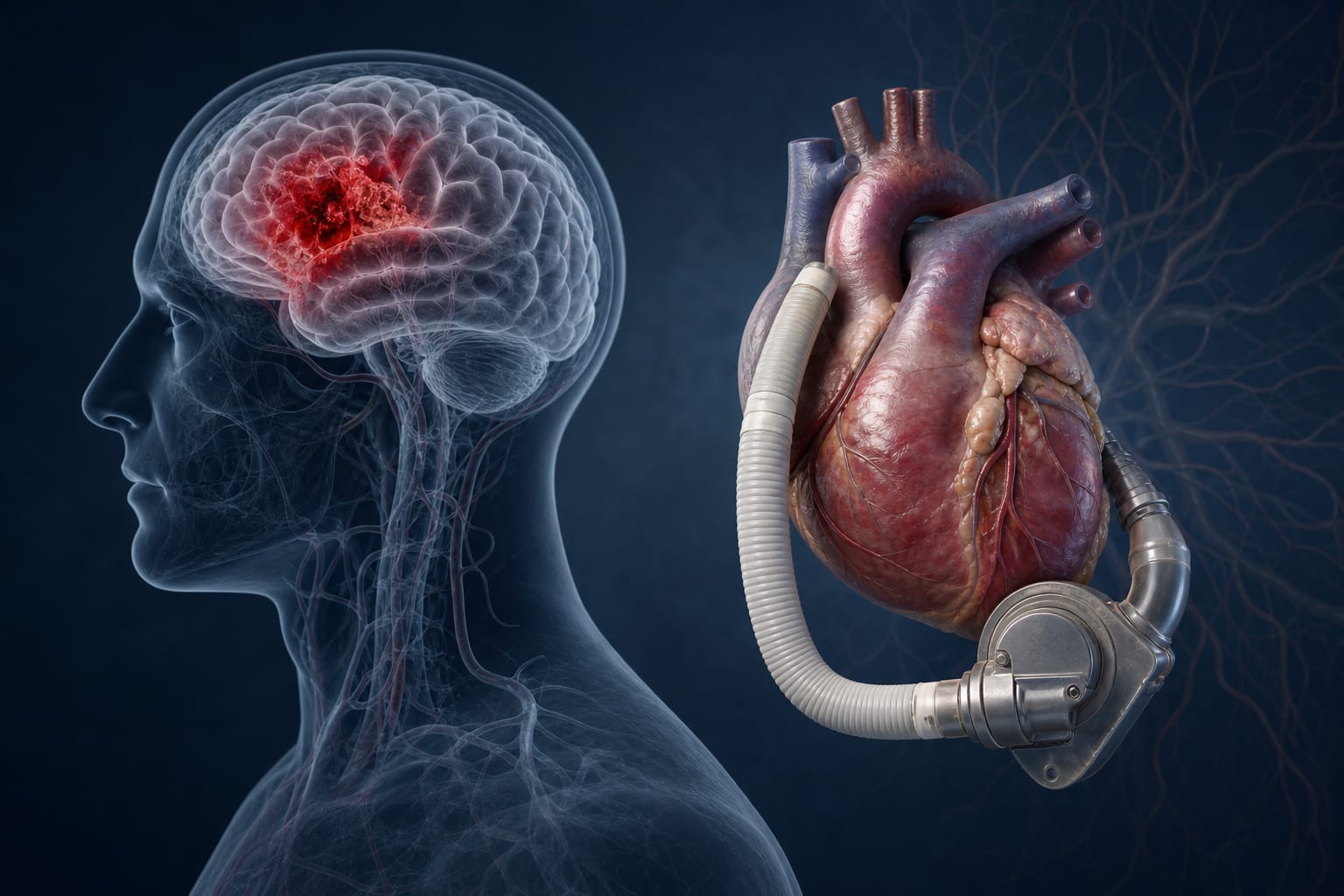
Clinical Report: Evaluating the Risk of Acute Heart Failure Following EVT
Overview
This study identifies independent predictors of acute heart failure (AHF) following endovascular treatment (EVT) for acute ischemic stroke with large vessel occlusion (AIS-LVO).
Background
Acute heart failure is a significant complication following EVT for AIS-LVO, impacting patient outcomes and increasing mortality risk. Identifying patients at high risk for AHF is crucial for timely intervention and management.
Data Highlights
Predictor
Significance
Atrial fibrillation
Independent predictor of AHF
Valvular heart disease
Independent predictor of AHF
Left ventricular ejection fraction
Independent predictor of AHF
Serum creatinine
Independent predictor of AHF
Troponin T
Independent predictor of AHF
Key Findings
Five independent predictors of AHF identified: atrial fibrillation, valvular heart disease, left ventricular ejection fraction, serum creatinine, and troponin T.
The nomogram achieved an AUC of 0.909 in the validation cohort.
Calibration curves indicated good agreement between predicted and observed risks.
Clinical Implications
The nomogram developed in this study can assist clinicians in identifying patients at high risk for AHF after EVT.
Conclusion
The study successfully developed and validated a nomogram for predicting AHF risk in AIS-LVO patients post-EVT.
Related Resources & Content
Kumar, A., et al., 2020 -- Predictors of Acute Heart Failure Following Endovascular Therapy for Acute Ischemic Stroke
Smith, J., et al., 2020 -- The Role of Cardiac Biomarkers in Predicting Heart Failure After EVT
Johnson, L., et al., 2021 -- Heart Failure Risk in Patients Undergoing EVT for AIS-LVO
Williams, R., et al., 2021 -- A Nomogram for Predicting Acute Heart Failure After Thrombectomy
2024 ESC Guidelines for the management of elevated blood pressure and hypertension | European Heart Journal | Oxford Academic
Cardiac Events After Mechanical Thrombectomy in Acute Ischemic Stroke: A Nation-Wide Cohort Study - PubMed
2024 ESC Guidelines for the management of elevated blood pressure and hypertension | European Heart Journal | Oxford Academic
Cardiac Events After Mechanical Thrombectomy in Acute Ischemic Stroke: A Nation-Wide Cohort Study - PubMed