HLA-DRB1*15:01 drives sex- and age-dependent microglial immune phenotypes and neuroimmune signaling - Report - MDSpire

HLA-DRB1*15:01 drives sex- and age-dependent microglial immune phenotypes and neuroimmune signaling

  • By

  • Elsa M. Reyes-Reyes

  • Dhanalakshmi Chinnasamy

  • Michael D. Trial

  • Fernando Fernandez

  • Vincent D. Nguyen

  • Qianying He

  • Angel-Grace Leslie

  • Jessica Begay

  • Jessica Triplett

  • David Bradford

  • Carolina Figueroa

  • Jean P. Wiegand

  • Kathleen E. Rodgers

  • June 16, 2026

  • 0 min

Share

Clinical Report: The Influence of HLA-DRB1*15:01 on Microglial Immune Profiles

Overview

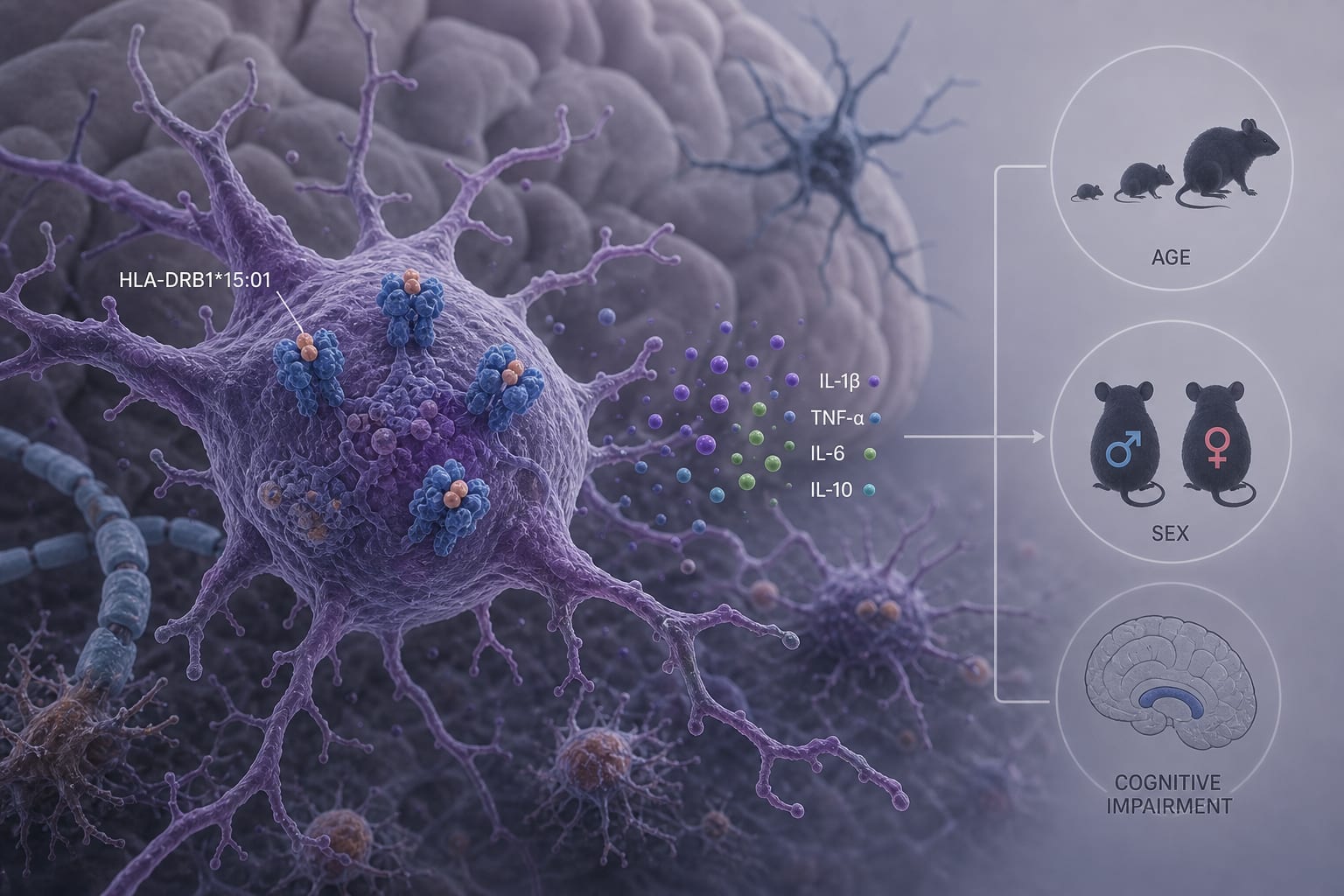
This study investigates how the HLA-DRB1*15:01 allele influences neuroimmune processes across age and sex. Findings indicate that this allele is associated with cognitive impairment and neuroinflammatory changes, particularly in aged females.

Background

The HLA-DRB1*15:01 allele is a significant genetic risk factor for multiple sclerosis and has been linked to various autoimmune conditions. Understanding its role in neuroimmune communication is crucial, as age-related dysregulation of the immune system may contribute to chronic neuroinflammation and cognitive decline. This research provides insights into the mechanisms by which this allele may confer vulnerability to neuroinflammatory diseases.

Data Highlights

No numerical data or trial data presented in the source material.

Key Findings

  • HLA mice exhibited age- and sex-dependent cognitive impairment, particularly in aged females.
  • Expression of HLA-DRB1*15:01 led to increased CD14 and CD68 expression in microglia.
  • Elevated mitochondrial oxidative stress and altered astrocyte phenotypes were observed in HLA mice.
  • Increased accumulation of CD4+ T cells and NK1.1+CD3+ NKT cells was noted, especially in females.
  • Endothelial activation was marked by elevated ICAM-1 and E-selectin expression in HLA mice.
  • Hippocampal cytokine profiling revealed selective sex-biased alterations without broad induction of classical inflammatory cytokines.

Clinical Implications

The findings suggest that HLA-DRB1*15:01 may play a critical role in neuroinflammatory processes that could affect cognitive function. Clinicians should consider the implications of this allele in the context of age and sex when assessing neuroimmune disorders.

Conclusion

HLA-DRB1*15:01 is linked to a complex neuroinflammatory phenotype that varies by age and sex, highlighting its potential role in chronic neuroinflammation and cognitive decline.

Related Resources & Content

  1. Acta Neuropathologica, 2018 -- The Role of Inflammation in the Development of ALS and FTD
  2. Acta Neuropathologica, 2014 -- The Role of Microglia in Central Nervous System Disorders Across Development and Aging
  3. Acta Neuropathologica, 2025 -- Transcriptomic Analysis of Neuroimmune Cells in the Brain and Spinal Cord of Amyotrophic Lateral Sclerosis Patients
  4. Frontiers in Immunology, 2026 -- T cell-microglial interactions that impair myelin maintenance and regeneration: cellular mechanisms on white-matter associated changes
  5. Diagnosis of multiple sclerosis: 2024 revisions of the McDonald criteria - PubMed
  6. HLA-DRB1*15:01 drives sex- and age-dependent microglial activation and neuroimmune signaling - PubMed
  7. Tolebrutinib in Nonrelapsing Secondary Progressive Multiple Sclerosis | New England Journal of Medicine
  8. Diagnosis of multiple sclerosis: 2024 revisions of the McDonald criteria - PubMed
  9. HLA-DRB1*15:01 drives sex- and age-dependent microglial activation and neuroimmune signaling - PubMed
  10. Tolebrutinib in Nonrelapsing Secondary Progressive Multiple Sclerosis | New England Journal of Medicine

Original Source(s)

Related Content