Clinical Report: Development of a Multi-Epitope Vaccine for Clostridium perfringens in Yaks
Overview
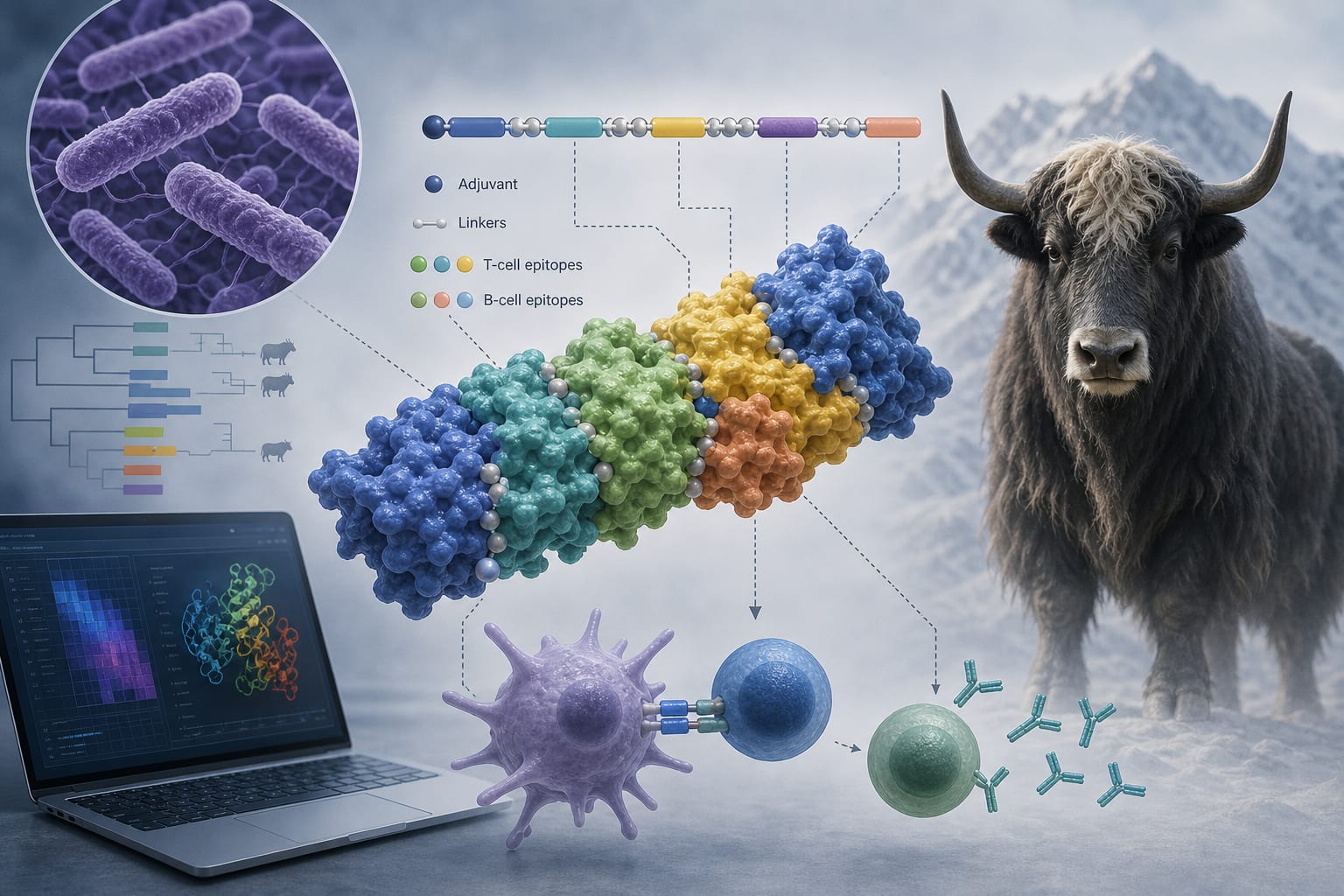
This study presents the development of a novel multi-epitope vaccine candidate for Clostridium perfringens in yaks, utilizing immunoinformatics techniques. The vaccine demonstrated high antigenicity and structural stability.
Background
Clostridium perfringens is a significant pathogen causing enterotoxemia in yaks, leading to considerable economic losses in the Qinghai-Tibet Plateau. Traditional vaccines have shown limited efficacy and protective breadth.
Data Highlights
Parameter
Value
VaxiJen score
0.9092
Binding affinity with TLR2
-1024.6 kcal/mol
Binding affinity with TLR4
-1104.4 kcal/mol
Average RMSD TLR4 complex
0.1971 ± 0.0377 nm
Average RMSD TLR2 complex
0.2692 ± 0.0420 nm
Key Findings
Five core virulence proteins were identified from genomic data.
Ten cytotoxic T lymphocyte (CTL) epitopes, five helper T lymphocyte (HTL) epitopes, and five B-cell epitopes were predicted and selected.
The final multi-epitope vaccine construct consisted of 352 amino acids and included the adjuvant human β-defensin-3.
Molecular docking showed strong binding affinity with TLR2 and TLR4.
In silico cloning indicated potential for efficient expression in E. coli.
Clinical Implications
Further experimental validation is necessary to confirm the efficacy of this vaccine in vivo.
Conclusion
The study successfully designed a multi-epitope vaccine against C. perfringens in yaks.