Development and validation of a uric acid-inflammation-metabolism score for predicting osteoarthritis risk: evidence from NHANES 2007–2018 and an external Chinese cohort - Report - MDSpire
Conexiant’s news site is now MDSpire News. Learn more
Advertisement
Creation and assessment of a Uric Acid-Inflammation-Metabolism score for predicting the likelihood of osteoarthritis: findings from NHANES 2007–2018 and a validation cohort from China
Clinical Report: Uric Acid-Inflammation-Metabolism Score for Osteoarthritis
Overview
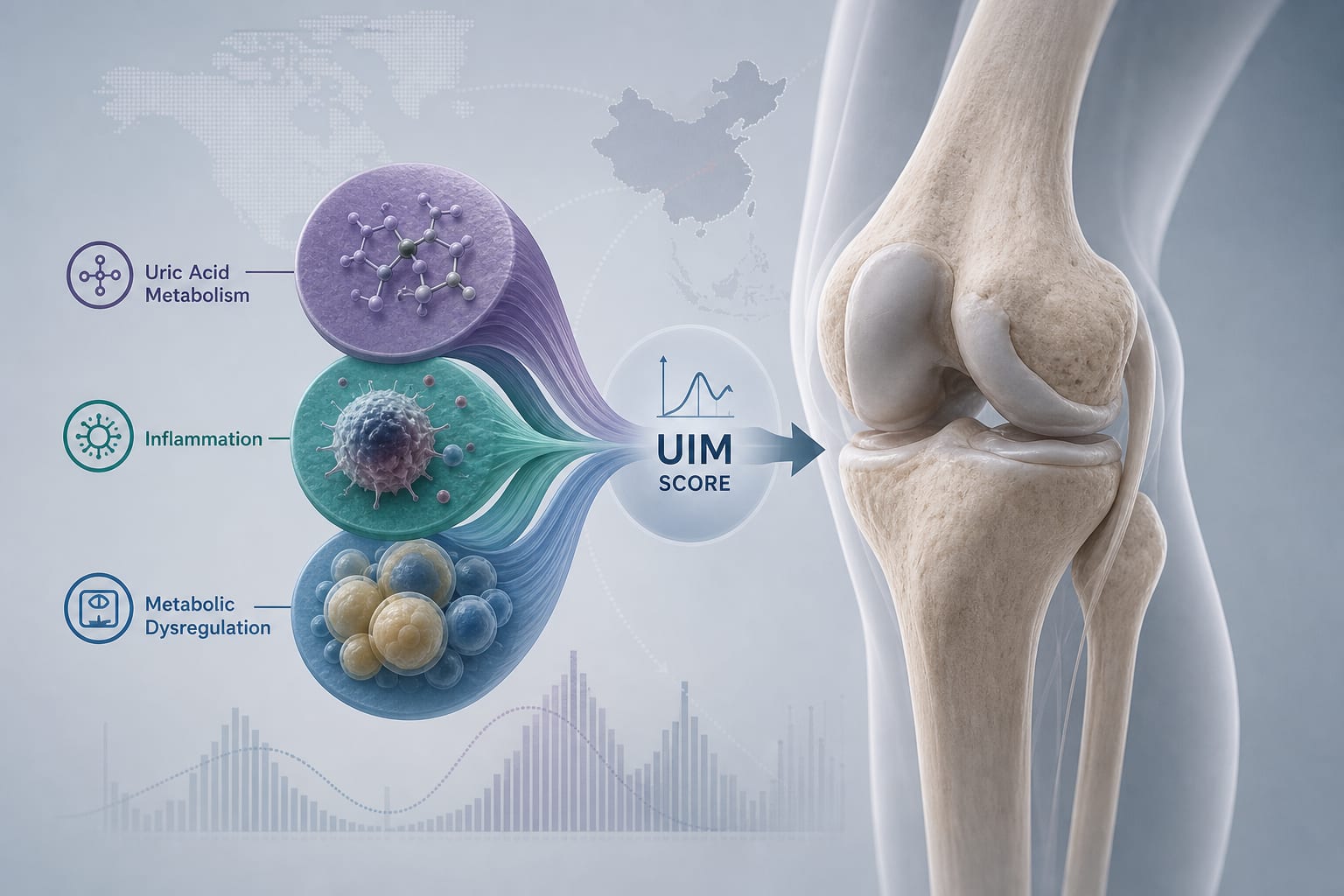
Expand on the integration process of uric acid metabolism, inflammation, and metabolic disturbance.
Background
Osteoarthritis (OA) is a leading cause of disability, affecting over 528 million people globally. Current diagnostic tools often fail to identify OA until significant joint damage has occurred, highlighting the need for effective risk assessment methods. The UIM score aims to address this gap by combining multiple biological dimensions associated with OA pathogenesis.
Data Highlights
Variable
Contribution to UIM Score
Uric Acid
70.50%
Metabolic Disturbance
26.92%
Inflammation
2.58%
Key Findings
The UIM score was developed using data from NHANES 2007–2018 and validated in a cohort from Anhui Provincial Hospital.
Participants in the highest quartile of the UIM score had a 2.63-fold increased risk of OA compared to those in the lowest quartile.
The UIM score achieved an area under the curve (AUC) of 0.707, indicating good predictive performance.
A significant J-shaped nonlinear relationship was observed between UIM score and OA risk.
High inflammation and high metabolic disturbance exhibited a significant additive antagonistic interaction.
External validation confirmed the robustness and generalizability of the UIM score across different populations.
Clinical Implications
The UIM score provides a practical tool for clinicians to stratify OA risk based on metabolic and inflammatory factors. Incorporating this score into clinical practice may enhance early identification and intervention strategies for patients at risk of OA.
Conclusion
The UIM score represents a significant advancement in OA risk prediction, integrating multiple biological dimensions to improve clinical assessment and management of osteoarthritis.