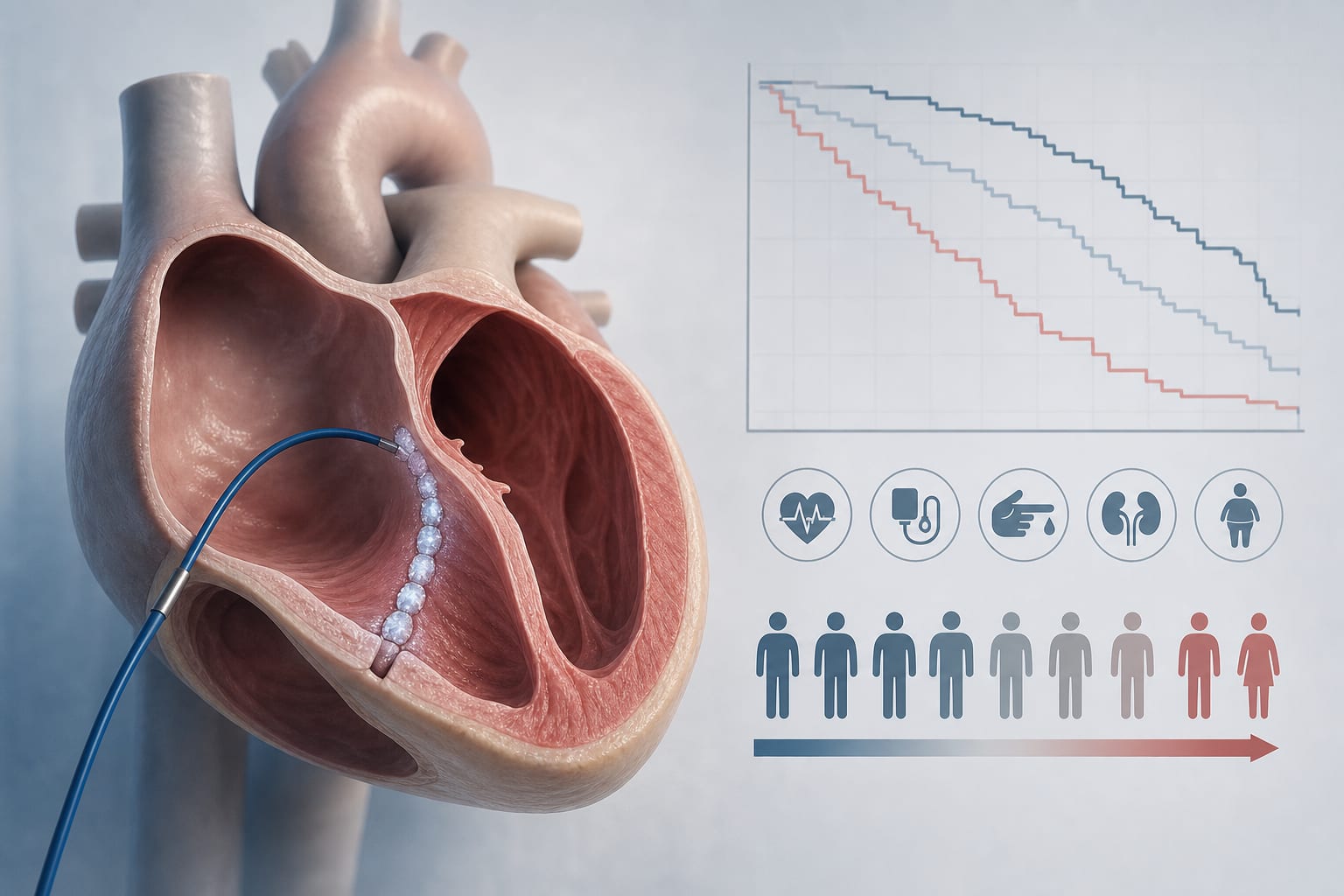
CHA2DS2-VA and non-CHA2DS2-VA components as predictors of mortality after cavotricuspid isthmus ablation: a clinical tool for long-term risk stratification - Report - MDSpire
Advertisement
Evaluating CHA2DS2-VA and Non-CHA2DS2-VA Factors as Indicators of Mortality Following Cavotricuspid Isthmus Ablation: A Tool for Long-Term Risk Assessment
Clinical Report: Evaluating CHA2DS2-VA and Non-CHA2DS2-VA Factors as Indicators of Mortality Following Cavotricuspid Isthmus Ablation
Overview
This study evaluates the CHA₂DS₂-VA score and non-CHA₂DS₂-VA comorbidities as predictors of all-cause mortality after cavotricuspid isthmus (CTI) ablation for typical atrial flutter (AFL).
Background
Typical atrial flutter (AFL) is a common cardiac arrhythmia associated with significant morbidity and mortality. While CTI ablation is an effective treatment, long-term outcomes can vary based on individual risk factors.
Data Highlights
CHA₂DS₂-VA Score
Annual Mortality Rate
<3
1.4%
≥3
9.9%
Key Findings
27% of patients died during a mean follow-up of 1771 ± 635 days.
Mortality increased with higher CHA₂DS₂-VA scores (log-rank p < 0.001).
A CHA₂DS₂-VA score ≥3 was identified as the optimal threshold for mortality prediction.
The CHA₂DS₂-VA score showed good discriminative ability (c-index = 0.73).
Pulmonary disease and obstructive sleep apnoea were independent predictors of long-term survival.
Female sex was not significantly associated with mortality.
Clinical Implications
The CHA₂DS₂-VA score can be an independent predictor of long-term mortality following CTI ablation for AFL.
Conclusion
The CHA₂DS₂-VA score serves as a predictor of all-cause mortality after CTI ablation for typical AFL.
by Kamilla Luca Dávid, Előd János Zsigmond, Manuella Bogdan, Balázs Polgár, Nikolett Vigh, Zalán Gulyás, Judit Papp, Emese Tóth-Zsámboki, Gábor Zoltán Duray