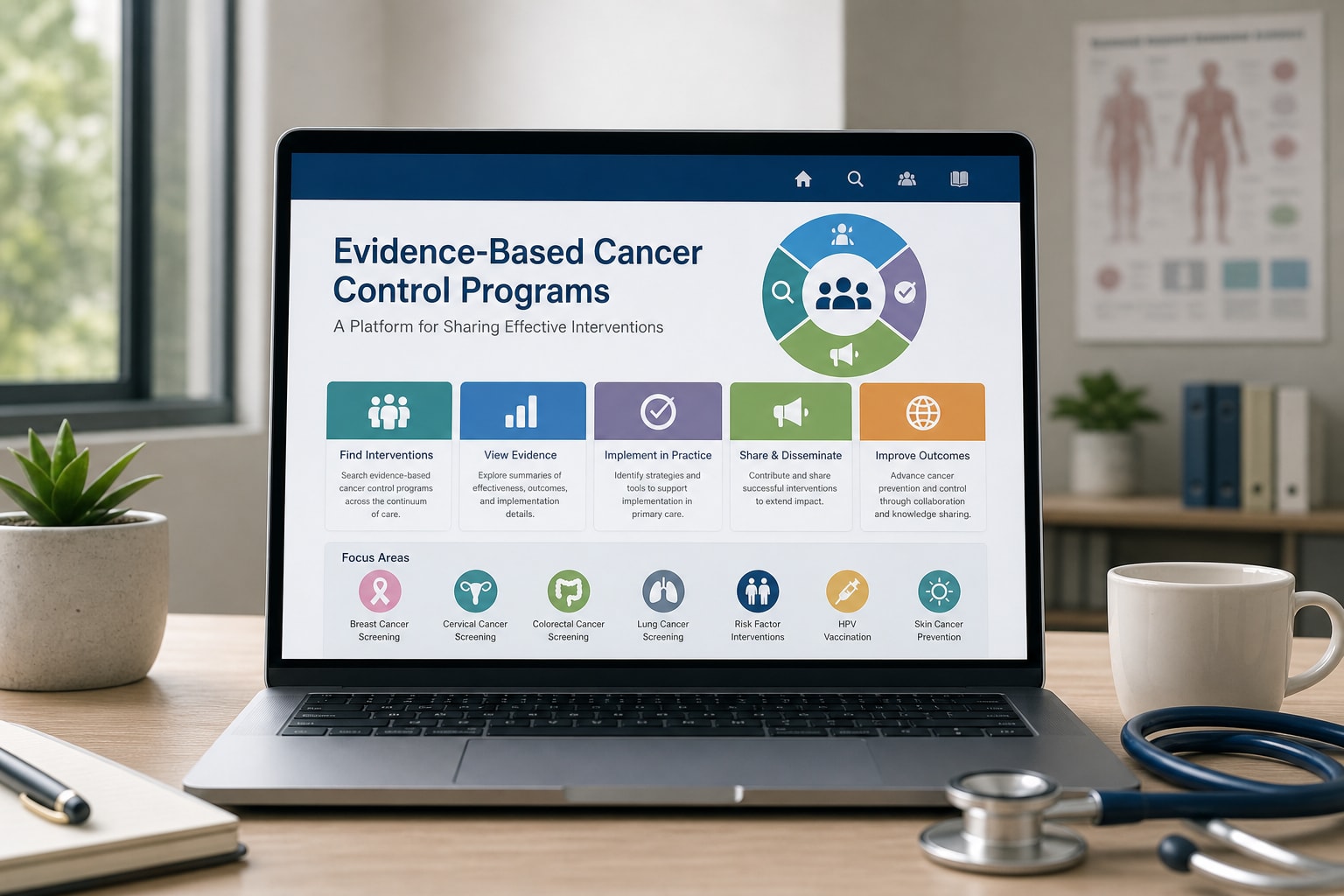
The Evidence-Based Cancer Control Programs Website: A Platform for Sharing Effective Interventions
-
By
-
Aubrey Villalobos
-
Jennifer Damonte
-
David A. Chambers
-
October 23, 2026
Clinical Report: The Evidence-Based Cancer Control Programs Website
Overview
The National Cancer Institute’s Evidence-Based Cancer Control Programs (EBCCP) website is a searchable repository intended to make tested cancer prevention and control interventions and implementation materials accessible to clinical and community practitioners. Its review process evaluates study quality, intervention impact, dissemination capability, and implementation-related characteristics; the supplied article reports 177 active and 61 archived programs as of September 2026.
Background
Modifiable risk factors account for approximately 40% of cancer cases, while screening can prevent or detect several cancers early. The source reports that newly developed evidence-based interventions take approximately 15 years to reach 50% uptake in practice, limiting their reach and impact. Primary care is positioned to deliver prevention and screening interventions through trusted clinician communication, continuity of care, and team-based infrastructure. EBCCP was established to support dissemination by providing access to interventions and materials intended for implementation.
Data Highlights
| Measure | Reported information |
|---|---|
| Estimated time for new evidence-based interventions to reach 50% practice uptake | Approximately 15 years |
| Share of cancer cases attributed to modifiable risk factors | Approximately 40% |
| EBCCP programs as of September 2026 | 177 active; 61 archived |
| EBCCP topic areas | 15 |
| Eligibility study publication window | Within the preceding 10 years |
Key Findings
- NCI introduced the Research-Tested Intervention Programs (RTIPs) resource in 2003; it was renamed Evidence-Based Cancer Control Programs (EBCCP) in 2020.
- EBCCP’s central function is a searchable database of cancer control interventions, with materials intended to support implementation in clinical and community settings.
- Program areas are informed by published U.S. federal guidelines and recommendations; where no federal statement exists, systematic reviews and meta-analyses guide inclusion.
- Eligibility requires published, peer-reviewed, statistically significant primary outcomes from an experimental or quasi-experimental study completed within the preceding 10 years, as well as intervention materials suitable for U.S. settings.
- NCI identifies candidate interventions through developer submissions and ongoing literature scans, then arranges external review of research integrity, impact, dissemination capability, reach, effectiveness, adoption, implementation, and written-material readability.
- Before posting, NCI works with study teams to prepare a program summary that includes implementation guidance; the supplied article reports 177 active and 61 archived programs across 15 topic areas as of September 2026.
Clinical Implications
The source describes primary care as a setting with potential to deliver cancer prevention and control interventions through clinician communication, repeated visits, and existing care teams. EBCCP provides practitioners with access to reviewed programs and implementation materials; the source does not establish that use of the website itself improves clinical outcomes.
Conclusion
EBCCP is an NCI dissemination platform for reviewed cancer control interventions, designed to make program evidence and implementation materials accessible to practitioners. Its eligibility and review processes, together with its searchable program collection, are the principal features described in the supplied article.
Related Resources & Content
- BMC Primary Care, Springer Nature, 2026 -- The Evidence-Based Cancer Control Programs website – a strategy for disseminating effective interventions
- U.S. Preventive Services Task Force, 2024 -- Recommendation: Breast Cancer: Screening
- National Cancer Institute, 2022 -- Integrating Tobacco Treatment Into Oncology Care: Reach and Effectiveness of Evidence-Based Tobacco Treatment Across National Cancer Institute–Designated Cancer Centers
- ASCO Publications — An Evidence-Based National Cancer Control Program (NCCP) Quality Assessment Checklist
- ASCO Publications — An Evidence-Based National Cancer Control Program (NCCP) Quality Assessment Checklist
- ASCO Publications — Implementing Evidence-Based Tobacco Treatment Interventions in Oncology to Achieve Optimal Outcomes
- The Evidence-Based Cancer Control Programs website – a strategy for disseminating effective interventions
- Recommendation: Breast Cancer: Screening
- The Evidence-Based Cancer Control Programs website – a strategy for disseminating effective interventions | BMC Primary Care | Springer Nature Link
- Recommendation: Breast Cancer: Screening | United States Preventive Services Taskforce
- Reduced Lung-Cancer Mortality with Low-Dose Computed Tomographic Screening | New England Journal of Medicine
Based on findings from:
The Evidence-Based Cancer Control Programs website – a strategy for disseminating effective interventions
Aubrey Villalobos, Jennifer Damonte, David A. Chambers. Bmc Primary Care, 2026.
https://link.springer.com/article/10.1186/s12875-026-03591-0
This content is an AI-generated, fully rewritten summary based on a published scholarly article. It does not reproduce the original text and is not a substitute for the original publication. Readers are encouraged to consult the source for full context, data, and methodology.