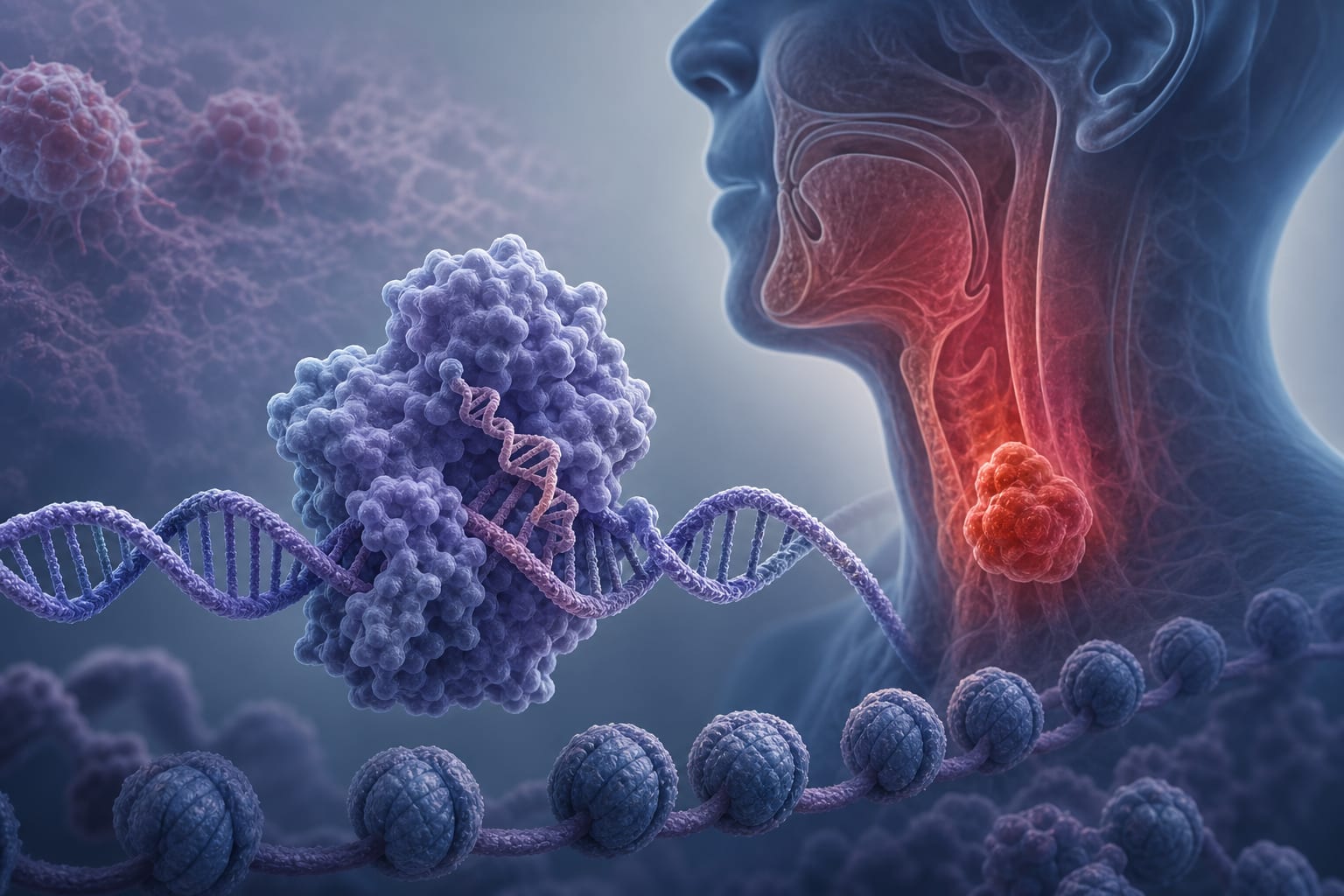
Clinical Report: Deprivation Tied to Lower HNC-Specific QOL
Overview
Patients with head and neck cancer from socioeconomically disadvantaged neighborhoods reported significantly lower pretreatment quality-of-life scores compared to those from less disadvantaged areas.
Background
Understanding the relationship between socioeconomic factors and quality of life (QOL) in head and neck cancer patients is crucial for addressing disparities in care. This study provides insights into how neighborhood deprivation may affect QOL even before treatment begins.
Data Highlights
| Measure | Score |
|---|---|
| Mean age of cohort | 62.5 years |
| Percentage of male patients | 72% |
| Percentage with stage III to IV disease | 52% |
| Mean FACT-HN score | 27.7 |
| Adjusted difference in QOL scores (most vs least disadvantaged) | −3.62 points (95% CI: −6.23 to −1.01) |
Key Findings
- Patients in the most disadvantaged neighborhoods had lower head and neck cancer-specific well-being scores compared to those in the least disadvantaged neighborhoods.
- The adjusted difference in scores was −3.62 points, indicating a significant disparity.
- Unadjusted analyses showed that greater neighborhood disadvantage was linked to lower ability to eat preferred foods and swallow easily.
- Patients from more disadvantaged areas reported higher tobacco product use.
- The study's cross-sectional design limits the ability to infer causation between neighborhood deprivation and QOL.
- Findings may not be generalizable due to the single-institution study design and demographic limitations.
Clinical Implications
Healthcare providers should consider the socioeconomic context of patients when assessing quality of life in head and neck cancer. Understanding these disparities may help in tailoring supportive care and interventions to improve patient outcomes.
Conclusion
The study reveals significant associations between neighborhood socioeconomic status and quality of life in head and neck cancer patients.
Related Resources & Content
- JAMA Otolaryngology–Head & Neck Surgery, 2023 -- Patient-Reported Quality of Life and Socioeconomic Disadvantage Among Patients With Head and Neck Cancer
- JAMA Network Open, 2025 -- Neighborhood Deprivation and Biological and Psychosocial Outcomes for Head and Neck Cancer
- PMC, 2023 -- Deprivation Indices in Head and Neck Cancer: A Scoping Review
- Journal of Neuro-Oncology — Psychosocial Well-Being and Influencing Factors on Health-Related Quality of Life in Children with Neurofibromatosis Type 1 and Cognitive Challenges
- Frontiers in Neurology — Quality of Life and Its Influencing Factors in Patients with neuromyelitis optica spectrum disorder
- Frontiers in Neurology — Physical disability, cognition, and depression as determinants of quality of life in multiple sclerosis: a cross-sectional study
- Impact of Post-Surgical Hypoparathyroidism on Quality of Life Following Thyroid and Parathyroid Operations
- What the newest evidence shows about deprivation and pretreatment QOL in HNC
- NCCN Guidelines Insights: Head and Neck Cancers, Version 2.2025
- Neighborhood Deprivation and Biological and Psychosocial Outcomes for Head and Neck Cancer | Oncology | JAMA Network Open | JAMA Network
- Deprivation Indices in Head and Neck Cancer: A Scoping Review - PMC
- Oropharyngeal Cancer Treatment (PDQ®) - NCI
- Social Determinants of Health and Cancer Care: An ASCO Policy Statement | JCO Oncology Practice
- Self-Perceived Hearing Outcomes with Radiation and Cisplatin or Radiation and Cetuximab for Patients with HPV-Positive Oropharyngeal Cancer – Results from NRG/RTOG 1016 - PMC
- Intensity-modulated radiation therapy (IMRT) matches proton therapy in patient-reported outcomes for oropharyngeal cancer - American Society for Radiation Oncology (ASTRO)
- Health-related quality of life outcomes from KEYNOTE-412: chemoradiotherapy with or without pembrolizumab in participants with head and neck squamous cell carcinoma
This content is an AI-generated, fully rewritten summary based on a published scholarly article. It does not reproduce the original text and is not a substitute for the original publication. Readers are encouraged to consult the source for full context, data, and methodology.