Multi-modal deep learning model for bipolar depression adolescents with verbal auditory hallucinations - Report - MDSpire

Multi-modal deep learning model for bipolar depression adolescents with verbal auditory hallucinations

  • By

  • Qinnaer Bolatijiang

  • Shaohong Zou

  • Cheng Zhang

  • Chengji Wang

  • Jianliang Zhang

  • June 19, 2026

  • 0 min

Share

Clinical Report: Development of a Multi-faceted Deep Learning Approach for Classifying Adolescents with Bipolar Depression Experiencing Verbal Auditory Hallucinations

Overview

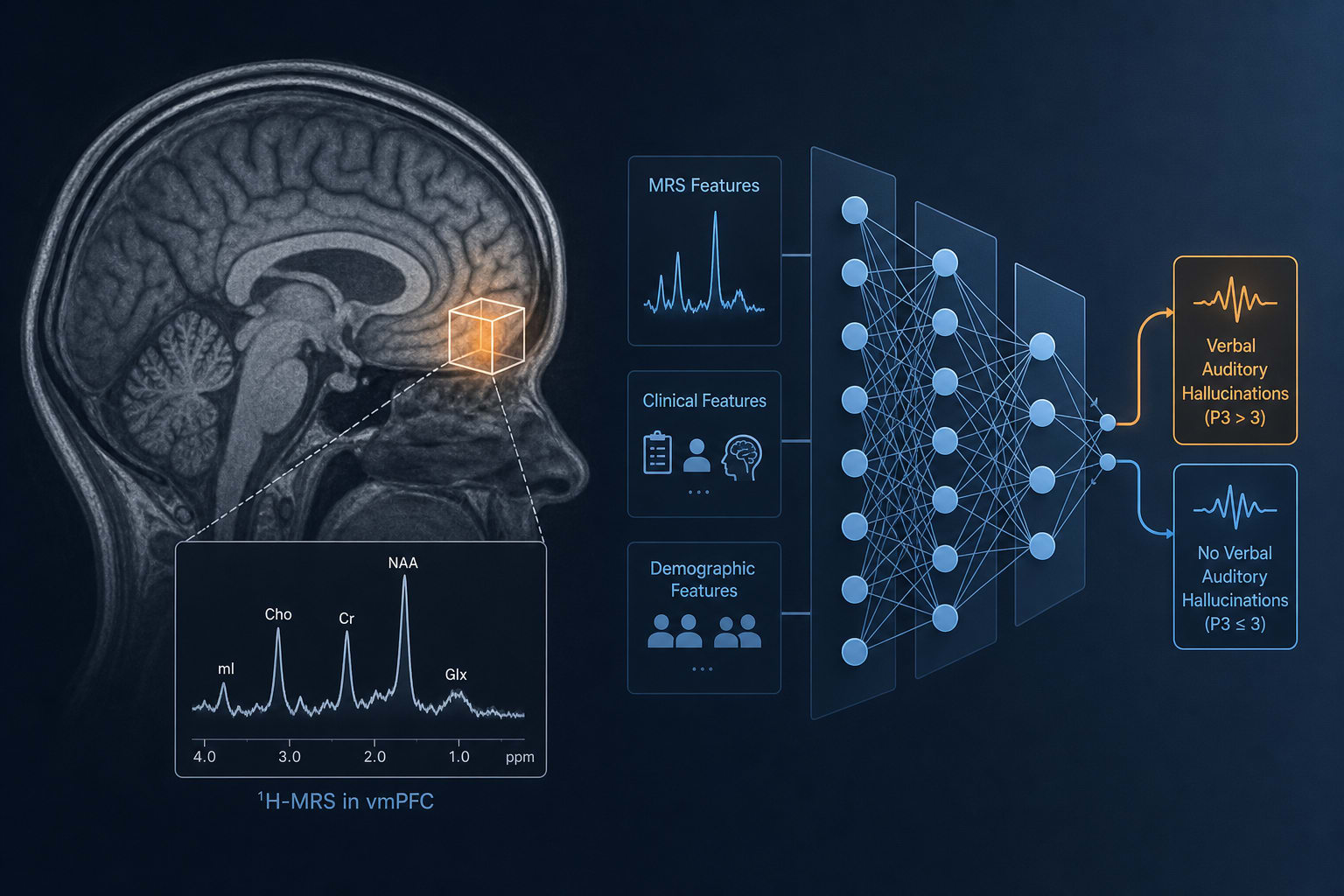
This study presents a multimodal deep learning model aimed at classifying adolescents with bipolar depression who experience verbal auditory hallucinations. The model achieved a classification accuracy of 71.43%.

Background

Bipolar disorder (BD) is a significant mental health condition affecting a notable portion of the global population, particularly adolescents. The presence of psychotic symptoms, such as auditory verbal hallucinations (AVHs), complicates the clinical picture and is associated with poorer outcomes. Understanding and accurately classifying these symptoms is crucial.

Data Highlights

The study analyzed 47 untreated adolescent bipolar depression patients, categorizing them based on the presence of AVHs. The model achieved a classification accuracy of 71.43% with balanced performance metrics.

Key Findings

  • The model utilized a multimodal Transformer-based framework for classification.
  • Patients were divided into hallucination and non-hallucination groups based on PANSS P3 scores.
  • Classification performance metrics included precision, recall, and F1-score, all reaching 0.75.
  • Key mechanisms in the model included bidirectional cross-attention and dynamic expert mixing.
  • Magnetic Resonance Spectroscopy (MRS) was employed to derive features for model training.

Clinical Implications

The findings indicate that advanced deep learning models can integrate diverse clinical and imaging data to classify adolescents with bipolar depression.

Conclusion

The study demonstrates the feasibility of using a multimodal deep learning approach to classify adolescents with bipolar depression experiencing AVHs.

Related Resources & Content

  1. BMC Psychiatry (Springer), 2025 -- Utilizing Voice-Activated Machine Learning for Efficient Screening of Bipolar Disorder and Major Depressive Disorder in Youth: A Reliable and Simple Diagnostic Approach
  2. BMC Psychiatry (Springer), 2025 -- Mood states recognition based on Mandarin speech and deep learning in patients with bipolar disorder
  3. Frontiers in Digital Health -- Personalized vs. population-based speech models for multi-dimensional mental health prediction
  4. NICE -- Recommendations | Bipolar disorder: assessment and management | Guidance
  5. WHO -- Bipolar disorder
  6. BMC Psychiatry (Springer) — Diagnostic accuracy of traditional and deep learning methods for detecting depression based on speech features: a systematic review and meta-analysis
  7. Characteristics of people with bipolar disorder I with and without auditory verbal hallucinations
  8. Recommendations | Bipolar disorder: assessment and management | Guidance | NICE
  9. Update information | Bipolar disorder, psychosis and schizophrenia in children and young people | Quality standards | NICE
  10. Bipolar disorder
  11. Machine learning for classification of pediatric bipolar disorder with and without psychotic symptoms based on thalamic subregional structural volume | BMC Psychiatry | Springer Nature Link
  12. Functional brain abnormalities in adolescents and young adults with bipolar depression with mixed features: Insights from resting-state fMRI - PubMed
  13. Machine learning for the diagnosis accuracy of bipolar disorder: a systematic review and meta-analysis - PMC
  14. Accuracy of Machine Learning Models in Predicting Clinical Outcomes in Bipolar Disorder: A Systematic Review
  15. Links between auditory verbal hallucinations and auditory emotional perception: A systematic review - PubMed

Original Source(s)

Related Content