Targeted lipid metabolism screening uncovers regulatory effects on the STING immune response in mevalonate, eicosanoid and fatty acid pathways - Report - MDSpire

Targeted lipid metabolism screening uncovers regulatory effects on the STING immune response in mevalonate, eicosanoid and fatty acid pathways

  • By

  • Sofia Skobelkina

  • Ella L Brunsting

  • Darren J. Perkins

  • July 9, 2026

  • 0 min

Share

Clinical Report: Lipid Metabolism Assessment Reveals Regulatory Influence on the STING Immune Pathway

Overview

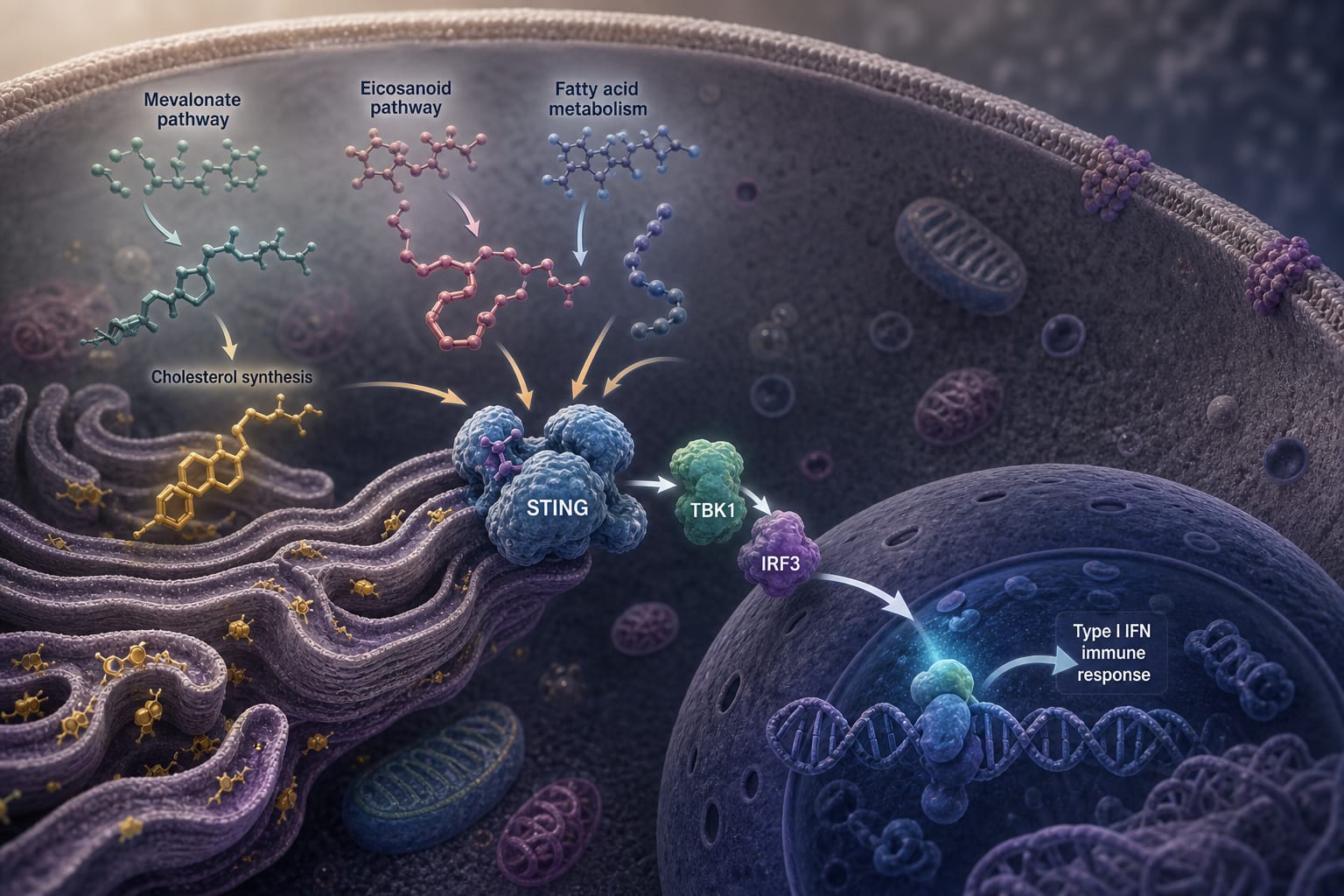
This study investigates the regulatory role of lipid metabolism on the STING immune pathway, revealing that perturbations in lipid pathways can significantly modulate STING-dependent signaling.

Background

The cGAS/STING pathway is crucial for immune responses, particularly in type I interferon signaling. Recent research indicates that STING is sensitive to lipid metabolism, particularly cholesterol synthesis.

Data Highlights

No numerical data or trial data provided in the source material.

Key Findings

  • STING integrates information about cellular lipid biosynthesis into the innate immune response.
  • Positive and negative perturbations in lipid metabolic pathways can modulate STING signaling.
  • Cholesterol synthesis impacts STING activation, linking metabolic health to immune responses.
  • Existing lipid-lowering therapies may have unrecognized immunomodulatory effects.
  • STING plays a critical role in anti-tumor immune responses and is a target for therapeutic activation in tumors.

Clinical Implications

The findings highlight the potential for lipid metabolic therapies to influence immune responses via the STING pathway.

Conclusion

This research underscores the importance of lipid metabolism in regulating the STING immune pathway.
Related Resources & Content

  1. Frontiers in Immunology, 2026 -- Fatty Acid Metabolism and Lipid Channeling in Macrophages: Mechanisms of Inflammation, Resolution, and Lipotoxicity
  2. Frontiers in Endocrinology, 2026 -- Interactions Between Lipid Metabolism and MAFLD: Mechanisms and Treatment Approaches
  3. Journal of Gastroenterology -- Pathways Leading to Triglyceride Build-Up in Non-Alcoholic Fatty Liver Disease
  4. The Journal of Clinical Endocrinology & Metabolism — The Profile of Endocannabinoidome Mediators in Human Feces Is Primarily Influenced by Diet and Gut Microbiota
  5. International multidisciplinary consensus on the definition and clinical approach for monogenic inflammatory immune dysregulation disorders
  6. Guidance Documents | American College of Rheumatology
  7. Human inborn errors of immunity: 2024 Update on the classification from the International Union of Immunological Societies
  8. Juvenile-onset Systemic Lupus Erythematosus: Recent Advances in Pathogenesis and Treatment | Current Rheumatology Reports | Springer Nature Link
  9. Regulation of STING activation by phosphoinositide and cholesterol | Nature
  10. Defining STING–sterol interactions with chemoproteomics - RSC Chemical Biology (RSC Publishing)
  11. Targeted Lipid Metabolism Screening Uncovers Regulatory Effects on the STING Immune Response in Mevalonate, Eicosanoid and Fatty Acid Pathways - PMC
  12. The COX2-PGE2-PKA Axis Suppresses Antiviral Immunity by Inhibiting mtDNA-Dependent STING Activation - PMC
  13. Regulation of cGAS–STING signalling and its diversity of cellular outcomes | Nature Reviews Immunology
  14. Systemic third generation allosteric STING agonist CRD3874-SI, a novel immunotherapy, in patients with advanced solid tumors: Results from a single-agent phase I study. | Journal of Clinical Oncology
  15. Phase I dose-escalation and pharmacodynamic study of STING agonist E7766 in advanced solid tumors - PMC
  16. Integrating STING activation with programmed death-ligand 1 inhibition: Novel approaches for cancer treatment - ScienceDirect
  17. Frontiers | The cGAS–STING pathway in cancer immunotherapy: prognostic value and therapeutic potential

Original Source(s)

Related Content