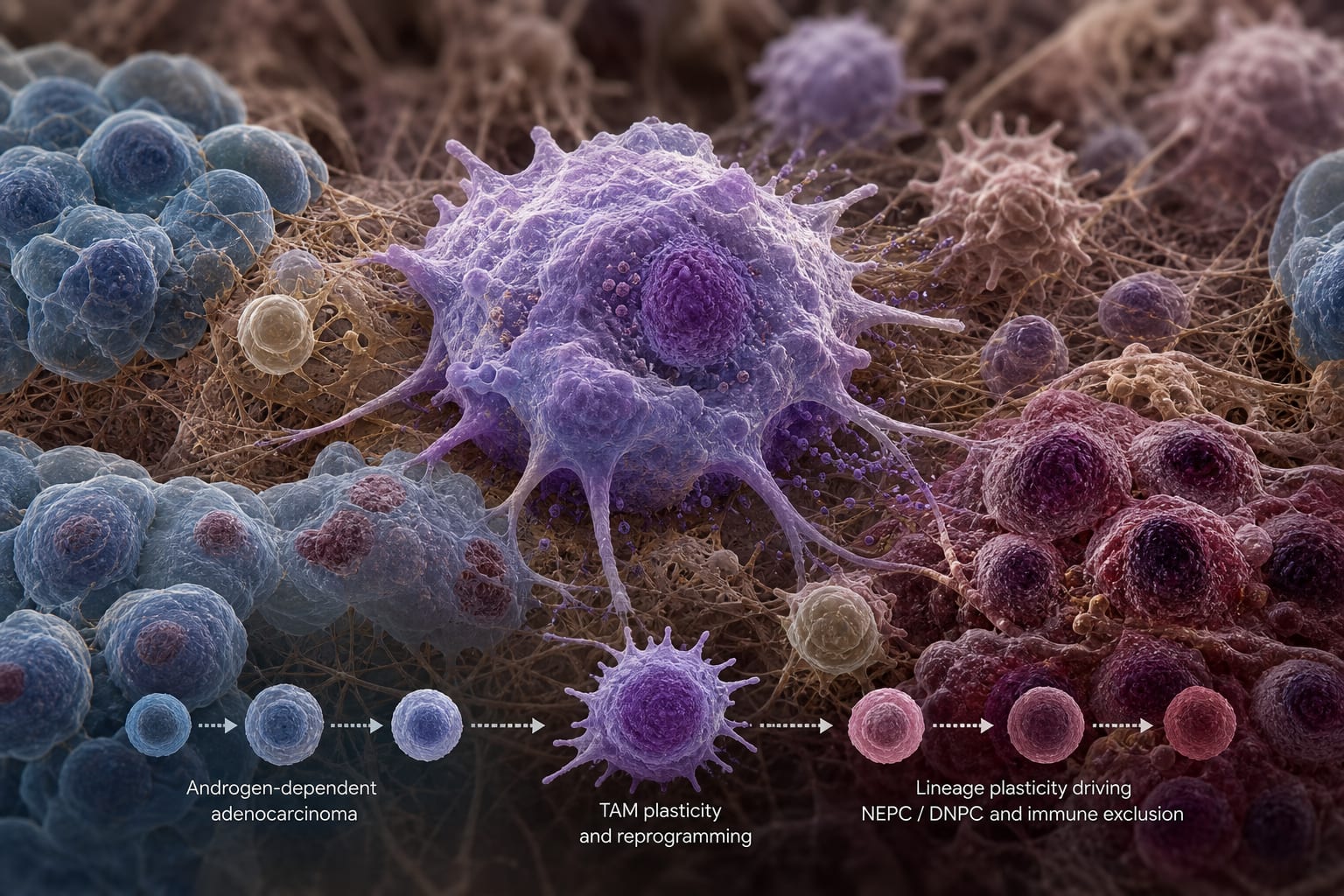
Tumor-associated macrophages and lineage plasticity in prostate cancer: from established myeloid programs to emerging spatial hypotheses
-
By
-
Jia Li
-
Jinling Li
-
Yuechao Zhao
-
Yuanqi Yu
-
Xiaolu Cui
-
July 13, 2026
Macrophages in Tumors and Lineage Flexibility in Prostate Cancer
Overview
This review discusses the role of tumor-associated macrophages (TAMs) in influencing lineage plasticity in prostate cancer, particularly in the context of therapy resistance. It highlights emerging evidence linking TAM heterogeneity to aggressive disease states such as neuroendocrine prostate cancer (NEPC) and double-negative prostate cancer (DNPC).
Background
Prostate cancer is a leading cause of cancer-related morbidity and mortality in men. Despite advancements in treatment, including androgen receptor signaling inhibitors, resistance often develops, leading to challenging disease states that are less responsive to conventional therapies. Understanding the role of the tumor microenvironment, particularly TAMs, is crucial for addressing therapy resistance.
Data Highlights
No numerical data or trial data presented in the article.
Key Findings
- TAMs exhibit significant heterogeneity and can influence tumor-cell state transitions and immune exclusion.
- Established myeloid programs include SPP1+/TREM2+ macrophage states and pathways such as IL-6/STAT3 and TGF-beta.
- Emerging frameworks suggest that PLAC8+ TAMs may be linked to ARSI-induced DNPC-like remodeling.
- Spatial transcriptomic technologies reveal non-random neighborhoods involving TAMs and other tumor microenvironment components.
- The proposed TNFAIP8L2-integrin/PI3K-Akt/beta-catenin/FOSL1-HMGA1 cascade requires further validation.
Clinical Implications
The findings indicate the potential for TAMs to be a focus in managing therapy-resistant prostate cancer, emphasizing the need for independent cohort validation and biomarker-guided clinical testing.
Conclusion
The review highlights the role of TAMs in prostate cancer lineage plasticity and therapy resistance, emphasizing the importance of validating proposed mechanisms.
Related Resources & Content
- Author(s)/Org, Source, Year -- Title
- Author(s)/Org, Source, Year -- Title
- Author(s)/Org, Source, Year -- Title
- Frontiers in Oncology — Spatial distribution and prognostic value of tumor-associated macrophages in head and neck squamous cell carcinomas
- EAU Guidelines on Prostate Cancer 2026
- 2025 Canadian Urological Association Guideline
- https://d56bochluxqnz.cloudfront.net/documents/full-guideline/EAU-EANM-ESTRO-ESUR-ISUP-SIOG-Guidelines-on-Prostate-Cancer-2025_updated.pdf
- Systemic Therapy in Patients With Metastatic Castration-Resistant Prostate Cancer: ASCO Guideline Update | Journal of Clinical Oncology
- Lutetium-177–PSMA-617 for Metastatic Castration-Resistant Prostate Cancer | New England Journal of Medicine
- 177Lu-PSMA-617 versus a change of androgen receptor pathway inhibitor therapy for taxane-naive patients with progressive metastatic castration-resistant prostate cancer (PSMAfore): a phase 3, randomised, controlled trial - PubMed
- Health-related quality of life, pain, and symptomatic skeletal events with [177Lu]Lu-PSMA-617 in patients with progressive metastatic castration-resistant prostate cancer (PSMAfore): an open-label, randomised, phase 3 trial - PubMed
- Final overall survival and safety analyses of the phase III PSMAfore trial of [177Lu]Lu-PSMA-617 versus change of androgen receptor pathway inhibitor in taxane-naive patients with metastatic castration-resistant prostate cancer - PubMed
- FDA Expands Pluvicto’s Metastatic Castration-Resistant Prostate Cancer Indication - ASCO
- PD23-02 PROSTATE-SPECIFIC ANTIGEN ENDPOINTS IN THE PHASE 3 PSMADDITION STUDY OF [177LU]LU-PSMA-617 (177LU-PSMA-617) COMBINED WITH ADT AND ARPI IN PATIENTS WITH PSMA-POSITIVE (PSMA+) METASTATIC HORMONE-SENSITIVE PROSTATE CANCER (MHSPC) | Journal of Urology
- Phase III trial of [177Lu]Lu-PSMA-617 combined with ADT + ARPI in patients with PSMA-positive metastatic hormone-sensitive prostate cancer (PSMAddition) - UROONCO Prostate Cancer
- Management of Patients with Advanced Prostate Cancer. Report from the 2024 Advanced Prostate Cancer Consensus Conference (APCCC) - UCL Discovery
- Integrative single-cell and spatial transcriptomics with explainable AI reveal lethal prognostic axis in prostate cancer | npj Digital Medicine
- Integrated single-cell and spatial transcriptomic profiling decodes lineage plasticity and immune microenvironment remodeling in prostate cancer progression - PMC
- Single cell and spatial transcriptomics highlight the interaction of club-like cells with immunosuppressive myeloid cells in prostate cancer | Nature Communications
This content is an AI-generated, fully rewritten summary based on a published scholarly article. It does not reproduce the original text and is not a substitute for the original publication. Readers are encouraged to consult the source for full context, data, and methodology.