Holding vs Continuing GLP-1/GIP Agonists Before Upper Endoscopy: The OCULUS Randomized Clinical Trial - Report - MDSpire

Holding vs Continuing GLP-1/GIP Agonists Before Upper Endoscopy: The OCULUS Randomized Clinical Trial

  • By

  • Akram I. Ahmad

  • Samita Garg

  • Jeffrey Jacobs

  • Zaid Ansari

  • Tasneem Jamal Al-Din

  • Ashraf Almomani

  • Sara Valencia

  • John Vargo

  • Arjun Chatterjee

  • Hassan Siddiki

  • Liang Hong

  • Michael A. Nicolas

  • Alaina Miller

  • Tilak Shah

  • May 1, 2026

  • 0 min

Share

Comparison of Discontinuing versus Continuing GLP-1/GIP Agonists Prior to Upper Endoscopy

Overview

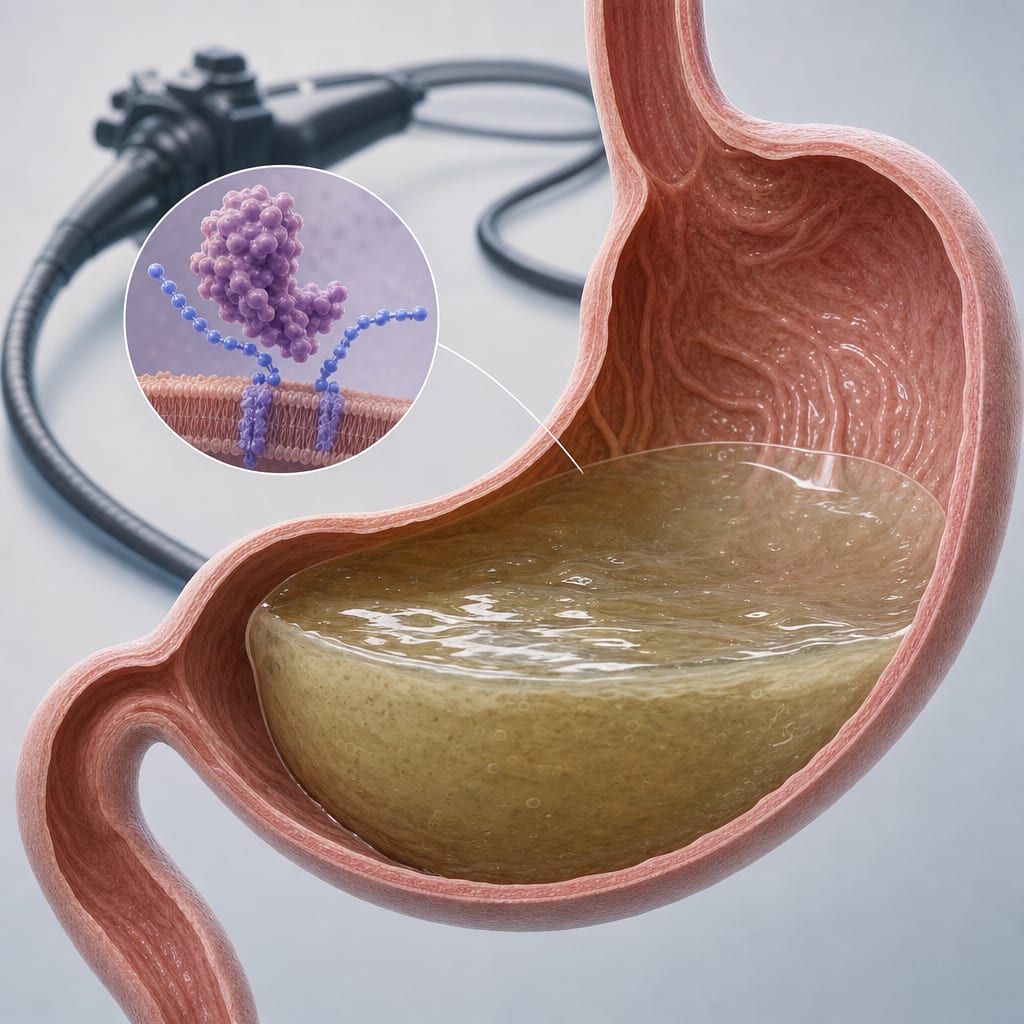
The OCULUS trial evaluated the impact of continuing versus holding GLP-1/GIP agonists before upper endoscopy. Results indicated that continuing these medications led to a higher rate of clinically significant residual gastric volume, yet no aspiration events occurred.

Background

GLP-1 and GIP agonists are increasingly used for managing type 2 diabetes and related conditions, with their effects on gastric emptying raising concerns during sedation for procedures like endoscopy. Current guidelines recommend holding these medications before procedures, but evidence supporting this practice is limited. The OCULUS trial aims to provide high-quality data to inform clinical decision-making regarding the management of these medications in the perioperative setting.

Data Highlights

OutcomeContinue GroupHold Group
Clinically Significant Residual Gastric Volume25%3%

Key Findings

  • Continuing GLP-1/GIP agonists increased clinically significant residual gastric volume compared to holding one dose.
  • Approximately 25% of patients in the continue group had significant residual volume versus 3% in the hold group.
  • No aspiration or escalation events occurred during the trial.
  • Symptom screening was ineffective in predicting retained gastric contents.
  • No primary-outcome events were observed when upper endoscopy was paired with colonoscopy after a clear-liquid diet.

Clinical Implications

Clinicians should consider the findings of the OCULUS trial when making decisions about GLP-1/GIP agonist management prior to endoscopic procedures. Individualized patient assessment may be necessary, particularly in light of the potential for increased residual gastric volume with continued medication use.

Conclusion

The OCULUS trial provides important insights into the management of GLP-1/GIP agonists before upper endoscopy, suggesting that continuing these medications may not pose significant risks of aspiration, but could lead to increased residual gastric volume.

References

  1. JAMA Internal Medicine, 2026 -- Holding vs Continuing GLP-1/GIP Agonists Before Upper Endoscopy: The OCULUS Randomized Clinical Trial
  2. JAMA Internal Medicine — Error in the Visual Abstract
  3. The New Gastroenterologist — The Role of GLP-1 Receptor Agonists in Endoscopic Procedures
  4. The New Gastroenterologist — Comparative Gastrointestinal Risk of GLP-1 Receptor Agonists and Tirzepatide
  5. New Multi-Society GLP-1 Clinical Practice Guidance Released
  6. The New Gastroenterologist — Key Gastrointestinal Adverse Effects of GLP-1 Receptor Agonists: What Prescribers Need to Consider
  7. New Multi-Society GLP-1 Guidance
  8. OCULUS Randomized Clinical Trial Overview
  9. Glucagon-like peptide-1 receptor agonists before upper gastrointestinal endoscopy and risk of pulmonary aspiration or discontinuation of procedure: cohort study | The BMJ

Original Source(s)

Related Content