Influencing factors of peripheral blood indicators on 30-day mortality risk in children with hemophagocytic lymphohistiocytosis based on weighted quantile sum regression: a single-center retrospective cohort study - Report - MDSpire
Advertisement
Influencing factors of peripheral blood indicators on 30-day mortality risk in children with hemophagocytic lymphohistiocytosis based on weighted quantile sum regression: a single-center retrospective cohort study
Factors Affecting Peripheral Blood Metrics and Their Impact on 30-Day Mortality in Pediatric Hemophagocytic Lymphohistiocytosis
Overview
This study investigates the impact of peripheral blood parameters on 30-day mortality risk in pediatric patients with hemophagocytic lymphohistiocytosis (HLH). It identifies significant predictors.
Background
Hemophagocytic lymphohistiocytosis (HLH) is a severe immune dysregulation syndrome in children, often leading to high mortality rates in the acute phase. Despite advancements in treatment, a significant proportion of patients still face early mortality due to complications. Understanding the role of peripheral blood parameters in predicting outcomes is crucial.
Data Highlights
Parameter
Weight (%)
MCH
62.6
HCT
29.8
Key Findings
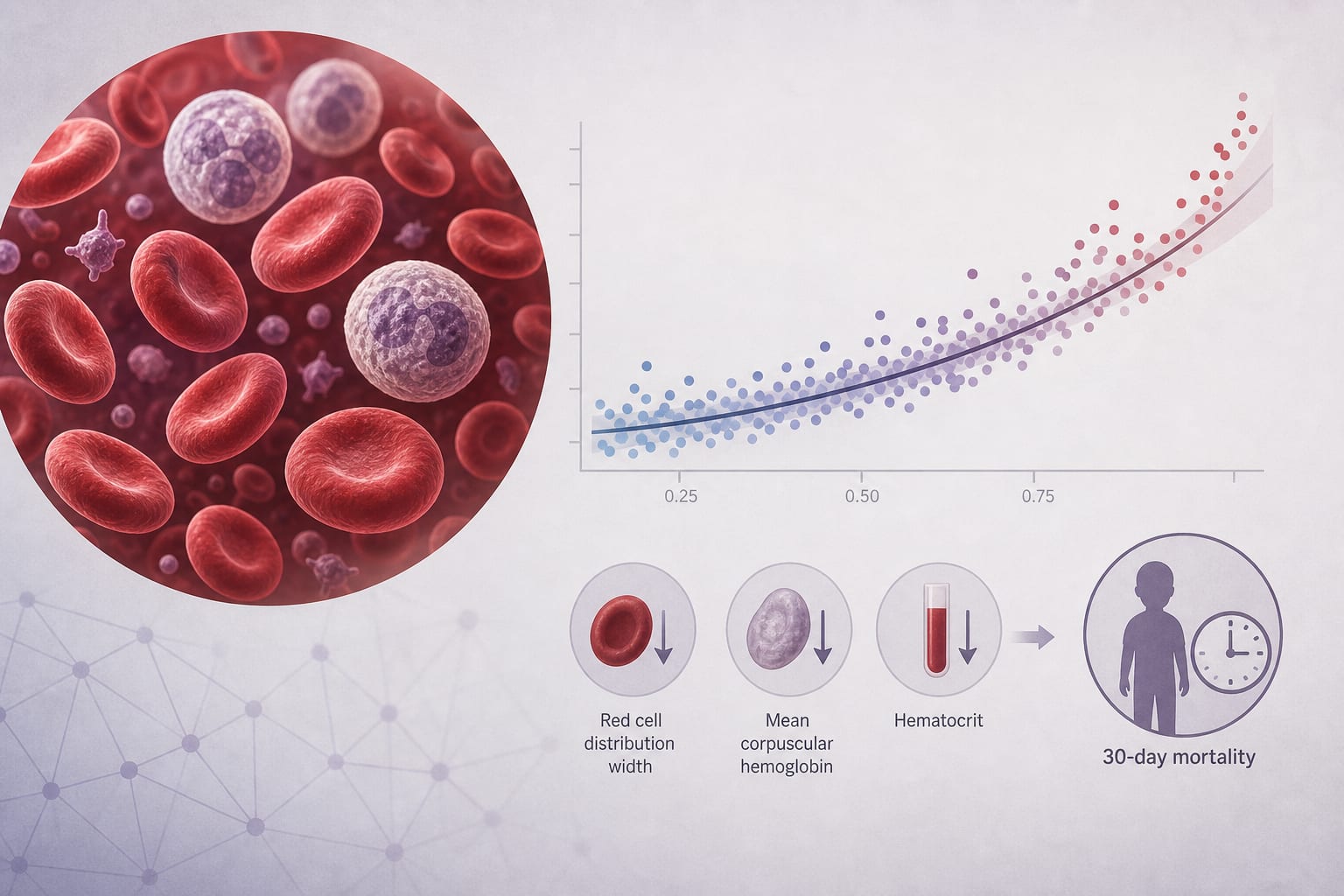
Red blood cell distribution width (RDW), mean corpuscular hemoglobin (MCH), hematocrit (HCT), and hemoglobin (Hb) were significantly associated with early mortality risk.
The weighted quantile sum regression model indicated a significant joint protective effect of peripheral blood parameters against 30-day mortality risk (β = −0.936, P = 0.012).
MCH and HCT exhibited the highest relative weights in predicting mortality risk.
The area under the curve (AUC) of the combined predictive model improved to 0.728.
Decision curve analysis confirmed the combined model's clinical net benefit across various threshold probabilities.
Clinical Implications
The findings indicate that abnormalities in peripheral blood parameters, particularly MCH and HCT, may serve as early warning indicators for mortality risk in pediatric HLH.
Conclusion
The study highlights the importance of peripheral blood metrics in predicting early mortality in pediatric HLH.
Two genetic subtypes of childhood B-cell acute lymphoblastic leukemia (B-ALL) have long been associated with inferior treatment outcomes: Philadelphia chromosome-positive (Ph+) and ABL-class Philadelphia chromosome-like (Ph-like) B-ALL.