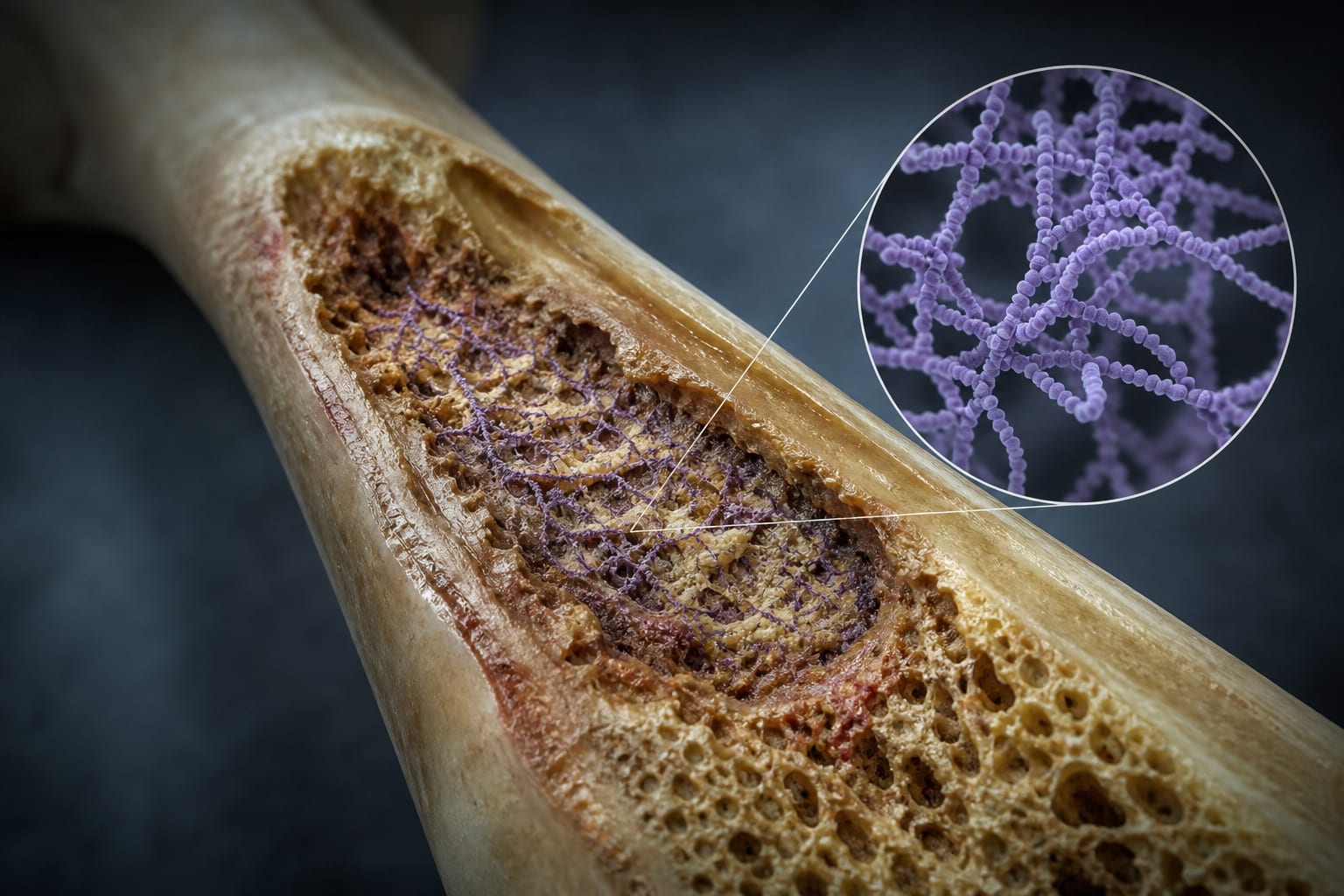
Clinical Report: Chronic Osteomyelitis of the Fibula Associated with Schaalia turicensis
Background
Chronic osteomyelitis can follow trauma or surgical intervention and may lead to persistent infection, progressive bone destruction, and substantial morbidity. Effective management depends on targeted antimicrobial therapy and appropriate surgical debridement. Accurate pathogen identification is critical, and viable deep-tissue specimens from the site of infection are preferred because superficial samples may reflect colonizing flora rather than the organisms responsible for deep-seated infection.
Data Highlights
The literature review included 14 cases of primary actinomycotic osteomyelitis of the extremities.
Thirteen of 14 patients (92.9%) were male, and ages ranged from 22 to 82 years.
The most commonly involved sites were the foot (4 cases), hand (3 cases), and tibia/fibula (3 cases).
Diagnostic delays ranged from 1 month to 16 years, with a median exceeding 6 months.
In the reported case, mNGS identified 2,245 reads mapping to S. turicensis, representing 35.98% relative abundance among 6,240 total microbial reads.
Key Findings
Chronic osteomyelitis may involve low-virulence pathogens such as S. turicensis and can be difficult to diagnose because of indolent progression and nonspecific clinical manifestations.
Deep-tissue sampling is important for accurate pathogen identification because superficial cultures may yield misleading results.
mNGS can complement conventional culture in detecting fastidious, slow-growing, or culture-resistant organisms.
In this case, mNGS of intraoperative tissue identified S. turicensis and prompted initiation of intravenous penicillin G.
Conventional culture 6 days later identified Actinomyces species and methicillin-resistant Staphylococcus epidermidis (MRSE), after which therapy was changed to oral clindamycin, followed by clinical improvement and discharge.
Clinical Implications
Clinicians evaluating chronic osteomyelitis should prioritize viable deep-tissue sampling and consider combining conventional culture with molecular methods such as mNGS, particularly when low-virulence, fastidious, or slow-growing pathogens are suspected. Surgical debridement and targeted antimicrobial therapy should be integrated into management.
Conclusion
This case highlights the diagnostic challenge posed by S. turicensis in chronic fibular osteomyelitis and the value of meticulous deep-tissue sampling combined with mNGS, culture, and histopathologic assessment. The authors emphasize coordinated surgical debridement and targeted antimicrobial therapy in the management of chronic bone infections caused by low-virulence pathogens.
Related Resources & Content
Gao Q, Liu Q, Zhang G, Lu Y, Li Y, Tang M, et al. “Identification of pathogen composition in a Chinese population with iatrogenic and native vertebral osteomyelitis by using mNGS.” Annals of Medicine. 2024;56:2337738.
Lourtet-Hascoët J, Bonnet E, Spera AM, Ascione T, Chan M, Esposito S, et al. “Fracture-related infections: current status and perspectives from the International Society of Antimicrobial Chemotherapy.” Antibiotics. 2025;14:1095.
Cronin JT, Richards BW, Skedros JG. “Schaalia (formerly Actinomyces) turicensis infection following open rotator cuff repair.” Cureus. 2023;15:e34242.
Könönen E, Wade WG. “Actinomyces and related organisms in human infections.” Clinical Microbiology Reviews. 2015;28:419–442.
Ryu DJ, Jeon YS, Kwon HY, Choi SJ, Roh TH, Kim MK. “Actinomycotic osteomyelitis of a long bone in an immunocompetent adult: a case report and literature review.” BMC Musculoskeletal Disorders. 2019;20:185.