Efficacy and safety of neoadjuvant chemotherapy with immunotherapy versus chemotherapy alone in esophageal squamous cell carcinoma: a meta-analysis based on randomized controlled trials - Report - MDSpire
Advertisement
Efficacy and safety of neoadjuvant chemotherapy with immunotherapy versus chemotherapy alone in esophageal squamous cell carcinoma: a meta-analysis based on randomized controlled trials
Clinical Report: Neoadjuvant Chemotherapy Combined with Immunotherapy in ESCC
Overview
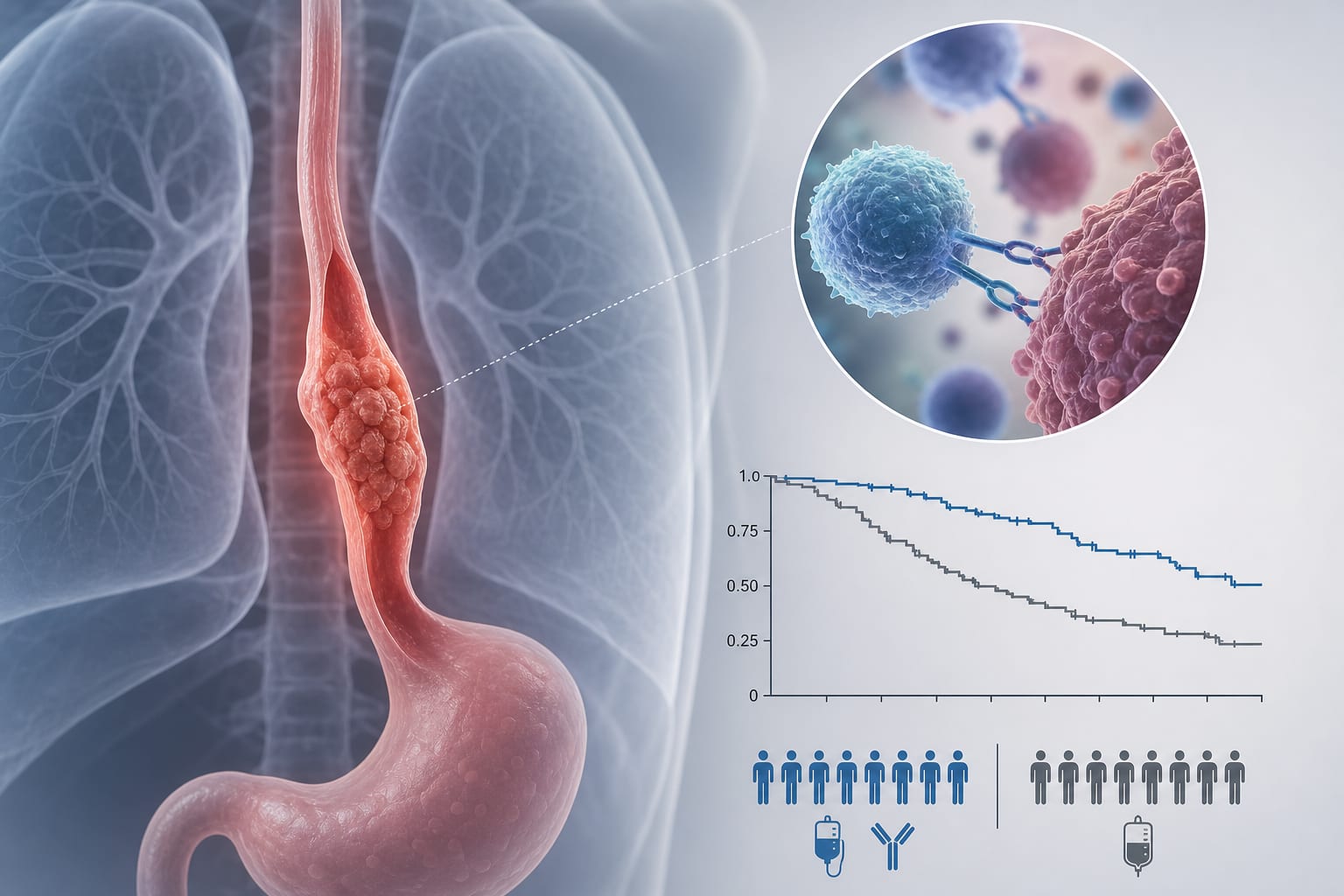
This meta-analysis evaluates the efficacy of neoadjuvant chemoimmunotherapy (NIC) compared to neoadjuvant chemotherapy (NC) in patients with resectable esophageal squamous cell carcinoma (ESCC). NIC significantly improved major and pathological complete response rates, along with other perioperative benefits.
Background
Esophageal squamous cell carcinoma (ESCC) is a highly aggressive cancer with poor long-term prognosis, particularly in East Asia. Neoadjuvant chemotherapy has been the standard treatment to enhance resectability, but its effectiveness has been limited. The integration of immune checkpoint inhibitors into neoadjuvant treatment strategies has emerged as a promising approach to improve patient outcomes.
Data Highlights
Outcome
NIC
NC
Odds Ratio (OR) / Hazard Ratio (HR)
p-value
Major Pathological Response (MPR)
42.8%
22.2%
2.40
0.0007
Pathological Complete Response (pCR)
22.2%
8.0%
3.53
<0.00001
Overall Survival (OS)
-
-
HR = 0.57
0.05
R0 Resection Rate
-
-
2.56
0.05
Surgical Rate
-
-
1.57
0.02
Immune-related Adverse Events (iRAEs)
23.21%
1.16%
-
<0.00001
Key Findings
NIC significantly improved major pathological response (42.8% vs. 22.2%, OR = 2.40, p = 0.0007).
NIC also led to a higher pathological complete response rate (22.2% vs. 8.0%, OR = 3.53, p < 0.00001).
There was a borderline statistically significant improvement in overall survival with NIC (HR = 0.57, p = 0.05).
NIC enhanced the surgical rate (OR = 1.57, p = 0.02) and R0 resection rate (OR = 2.56, p = 0.05).
Immune-related adverse events were significantly higher in the NIC group (23.21% vs. 1.16%, p < 0.00001).
Clinical Implications
The findings indicate that neoadjuvant chemoimmunotherapy may provide significant benefits in terms of pathological responses and surgical outcomes for patients with resectable ESCC.
Conclusion
Neoadjuvant chemoimmunotherapy demonstrates improved pathological responses and surgical outcomes in resectable ESCC compared to traditional chemotherapy.