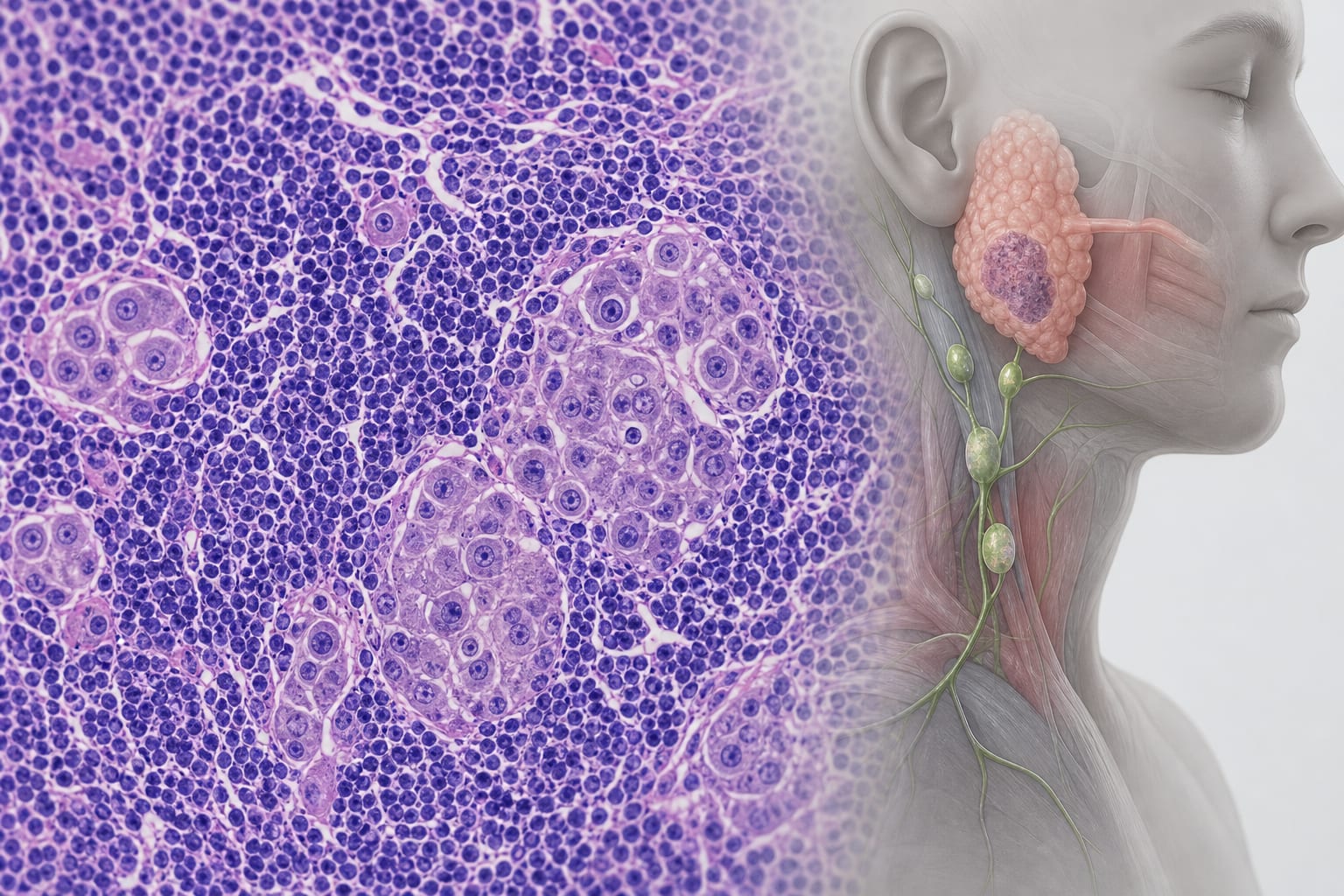
Case Report: Epidemiology, clinical features and progress in disease management for lymphoepithelial carcinoma of salivary glands: report of 3 cases - Report - MDSpire

Case Report: Epidemiology, clinical features and progress in disease management for lymphoepithelial carcinoma of salivary glands: report of 3 cases

  • By

  • Shunyi Huang

  • Cenwen Liu

  • Xueying Zeng

  • Zihan Huang

  • Feng Lin

  • Yongyuan Chen

  • Guanxiang Zhuo

  • Jiahui Lin

  • Dawei Lin

  • Qinqin Chen

  • Xinxin Chen

  • Yunyun Mei

  • Qing Guan

  • July 17, 2026

Share

Clinical Report: Insights and Management Advances in Lymphoepithelial Carcinoma

Background

Lymphoepithelial carcinoma (LEC) is a rare malignant tumor of the salivary glands, accounting for approximately 0.4% of such tumors. Understanding its clinical characteristics and treatment approaches is crucial due to its complex etiology and the challenges in management. Current treatment strategies primarily involve surgical resection followed by radiotherapy.

Data Highlights

CaseAgeGenderFollow-up DurationOutcome
141Female15 monthsNo recurrence
237Male15 monthsNo recurrence
3UnknownUnknown15 monthsHepatic metastasis diagnosed at 8 months

Key Findings

  • LEC is primarily associated with the parotid gland, constituting a rare form of head and neck cancer.
  • Two of the three reported cases exhibited cervical lymph node metastasis.
  • Postoperative follow-up revealed no local recurrence or distant metastasis in two cases after 15 months.
  • One case developed hepatic metastasis eight months post-radiotherapy, necessitating surgical intervention for the liver lesion.
  • Current treatment strategies emphasize surgical resection followed by radiotherapy.

Clinical Implications

Surgical resection remains the cornerstone of treatment for lymphoepithelial carcinoma, with postoperative radiotherapy being a standard adjunct.

Conclusion

Lymphoepithelial carcinoma of the salivary gland presents significant management challenges, necessitating a combined treatment approach.

Related Resources & Content

  1. Frontiers in Oncology, 2026 -- Metastatic progression and treatment challenges in EBV-associated pulmonary lymphoepithelioma-like carcinoma: a case report
  2. conexiant, 2026 -- Most Salivary Gland Neoplasms Found to Be Benign in Single-Center Study
  3. Frontiers in Oncology, 2026 -- Primary diffuse large b-cell lymphoma of the lip: a case report and literature review
  4. Postoperative radiotherapy versus postoperative radiochemotherapy after surgery of salivary gland cancer: a systematic review and meta-analysis - PMC
  5. Lymphoepithelial Carcinoma of the Salivary Gland: A Systematic Review and Single Institution Experience - Gibbs, 2026 - Otolaryngology–Head and Neck Surgery
  6. Frontiers in Oncology — Case Report: A rare pediatric case of secretory carcinoma of the parotid gland with high-grade components misdiagnosed as pleomorphic adenoma
  7. NCCN Head and Neck Cancers guideline
  8. Postoperative radiotherapy versus postoperative radiochemotherapy after surgery of salivary gland cancer: a systematic review and meta-analysis - PMC
  9. Lymphoepithelial Carcinoma of the Salivary Gland: A Systematic Review and Single Institution Experience - Gibbs - 2026 - Otolaryngology–Head and Neck Surgery - Wiley Online Library

Original Source(s)

Related Content