Clinical Report: Reassessing Uveitis Fellowship Training and Career Perspectives
Overview
Recent survey data and expert insights dispel common myths about uveitis fellowship, highlighting its procedural nature, competitive compensation, and rewarding career opportunities. Enhanced clinical exposure significantly increases trainee interest in this multidisciplinary subspecialty.
Background
Uveitis is often perceived by ophthalmology residents as a challenging and obscure subspecialty, leading to limited interest in fellowship training. Misconceptions include beliefs that uveitis lacks surgical opportunities, offers low compensation, and is inherently difficult to master. However, new data from the American Uveitis Society and practicing specialists reveal that uveitis combines medical and surgical care, provides competitive income, and benefits from multidisciplinary collaboration. Addressing the exposure gap during residency is key to changing perceptions and encouraging fellowship pursuit.
Data Highlights
Practice Aspect
Percentage of Uveitis Specialists
Perform intravitreal injections or surgical procedures
Over 70%
Perform cataract surgery routinely
Nearly 60%
Administer intravitreal injections as part of care
More than 75%
Annual compensation $300,000 - $400,000
Majority
Annual compensation over $400,000
Nearly 25%
Highest compensation (with additional fellowship)
Often exceeds $500,000
Key Findings
Uveitis specialists frequently perform surgical procedures, including cataract extraction, glaucoma surgeries, and vitreoretinal surgery.
Procedures such as anterior chamber paracentesis and vitreous taps are common and increasingly important due to rising recognition of infectious uveitis.
Compensation for uveitis specialists is comparable to other ophthalmic subspecialties, with many earning between $300,000 and $400,000 annually.
Additional fellowship training in retina, cornea, or glaucoma correlates with higher compensation, often exceeding $500,000.
Limited clinical exposure during residency contributes to misconceptions about uveitis difficulty and complexity.
Early rotation with uveitis specialists doubles the likelihood of residents considering fellowship training.
Clinical Implications
Clinicians should recognize uveitis as a subspecialty that integrates both medical and surgical expertise, offering diverse procedural opportunities and competitive compensation. Enhancing resident exposure to uveitis through dedicated rotations can improve recruitment and dispel misconceptions, ultimately benefiting patient care through specialized management.
Conclusion
Uveitis fellowship training offers a dynamic, multidisciplinary career path that combines intellectual challenge with procedural skills and rewarding compensation. Addressing training gaps and misconceptions can foster greater interest and expertise in this vital ophthalmic subspecialty.
Related Resources & Content
American Uveitis Society (AUS) Member Practice Survey, 2025 -- Uveitis Specialist Practice Patterns and Compensation
Thorne JE et al., 2016 -- Resource Use and Costs in Noninfectious Uveitis
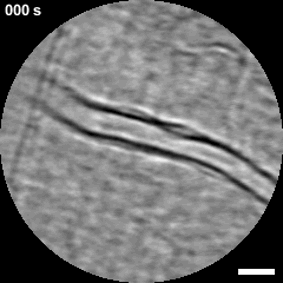
The movement of immune cells through the retinal vasculature has long been inferred from laboratory models. Now, advances in imaging are allowing clinicians to observe these processes directly. At the 2026 meeting of the Association for Research in Vision and Ophthalmology (ARVO) in Denver, Richard B. Rosen, MD, ScD(hon), FACS, FASRS, FARVO, described early clinical work using adaptive optics scanning laser ophthalmoscopy (AOSLO) to visualize leukocyte trafficking in vivo.