Clinical Report: Molecular Factors Associated With MRD After Quadruplet Therapy
Overview
This MIDAS ancillary study profiled 423 patients with newly diagnosed multiple myeloma (NDMM) using genomic, transcriptomic, and DNA methylation methods; 416 had all three data types available. The study was designed to characterize molecular features and identify factors associated with measurable residual disease (MRD) after Isa-KRd induction, but the supplied article excerpt does not report the MRD-associated results.
Background
Multiple myeloma is a genetically and clinically heterogeneous plasma-cell malignancy, and genomic, transcriptomic, and epigenetic features provide complementary information about its biology and clinical outcomes. Quadruplet regimens combining an anti-CD38 antibody, proteasome inhibitor, immunomodulatory drug, and dexamethasone are described in the source as the standard induction approach for NDMM. MRD, assessed by deep sequencing or flow cytometry, is a sensitive response measure and an early endpoint associated with progression-free and overall survival. The MIDAS trial evaluates MRD-guided consolidation and maintenance after standardized Isa-KRd induction.
Data Highlights
Measure
Reported data
Molecular characterization cohort
423 patients with NDMM
MIDAS enrollment
394 of 423 screened patients
Whole-genome sequencing
421 samples; mean depth 46× tumor DNA and 27× normal DNA
RNA sequencing
418 samples; mean 66 million read pairs per sample
Whole-genome enzymatic methylation sequencing
422 samples; mean depth 13×
All three molecular data types
Available for 416 samples
Normal plasma-cell reference samples
Five samples assessed by RNA-seq and WGEM-seq
Key Findings
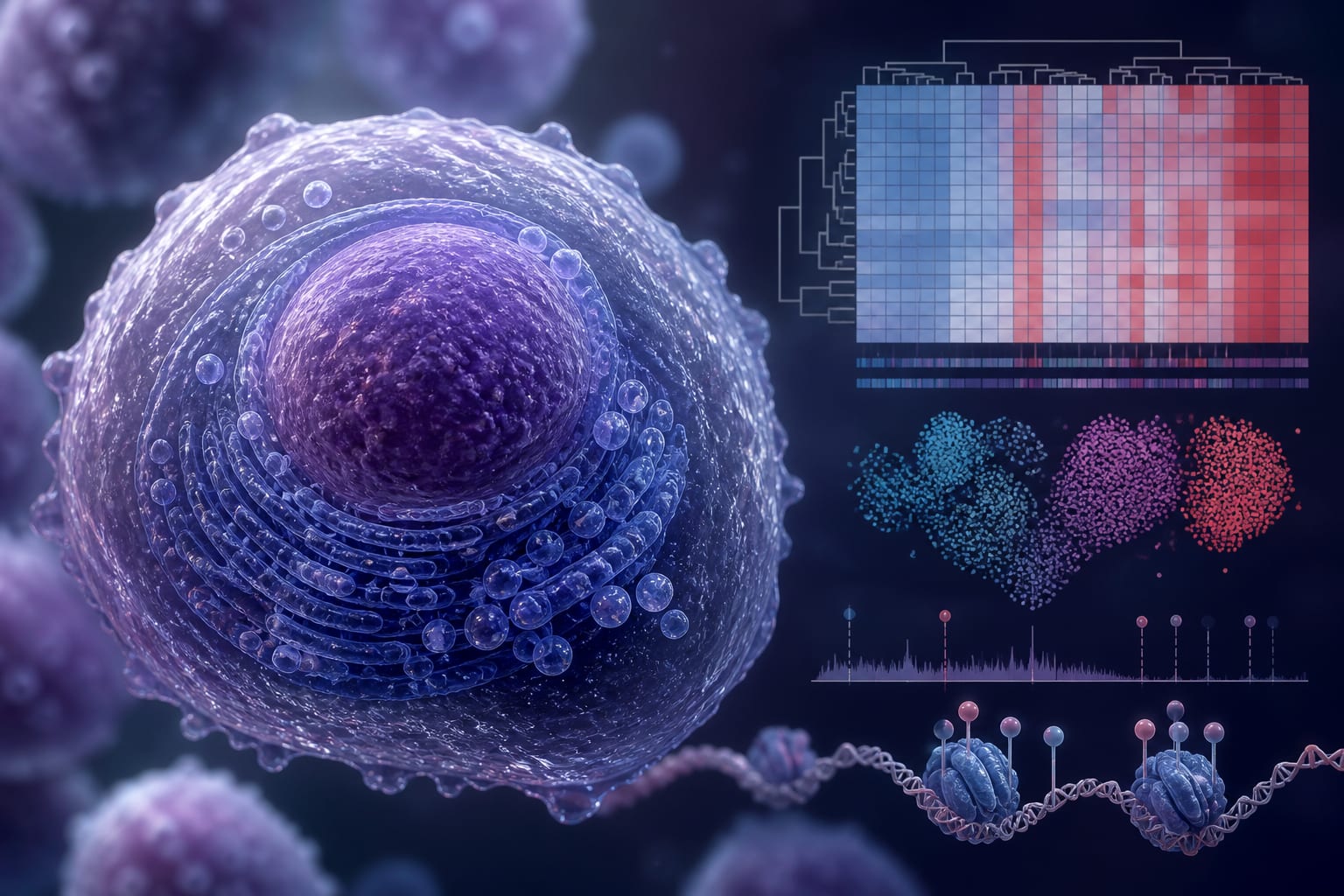
The ancillary study integrated whole-genome sequencing, RNA sequencing, and whole-genome enzymatic methylation sequencing in a uniformly treated MIDAS cohort.
Baseline molecular characterization included all 423 screened patients; analyses of molecular predictors of MRD were restricted to the 394 enrolled patients.
After quality control, molecular profiles were available for 421 WGS, 418 RNA-seq, and 422 WGEM-seq samples; 416 had all three data types.
Unsupervised gene-expression classification identified eight molecular groups that were strongly associated with genomic alterations and corresponded to previously reported transcriptomic subgroups.
The MS, MF, and CD expression groups were defined by driver translocations activating NSD2, MAF/MAFA/MAFB, and CCND1, respectively.
The supplied excerpt states that the study sought molecular predictors of MRD after Isa-KRd induction but does not provide the resulting MRD associations or their effect estimates.
Clinical Implications
The study design supports integrated assessment of molecular features in a cohort receiving standardized quadruplet induction, with MRD-predictor analyses limited to enrolled patients. The supplied excerpt does not provide specific molecular predictors or results that would support a change in clinical management.
Conclusion
The MIDAS ancillary study established a multiomic characterization cohort of patients with NDMM treated with Isa-KRd and identified eight expression groups linked to genomic alterations. The excerpt does not include the study’s findings on molecular factors associated with post-induction MRD.
Related Resources & Content
MIDAS ancillary study, source article excerpt, year not provided — Molecular Factors Associated With Minimal Residual Disease in Newly Diagnosed Multiple Myeloma After Quadruplet Therapy
by Florence Magrangeas, Mia Cherkaoui, Victor Bessonneau-Gaborit, Jennifer Derrien, Céline Chevalier, Catherine Guérin-Charbonnel, Benjamin Diamond, Mehmet Kemal Samur, Cyrille Hulin, Denis Caillot, Lionel Karlin, Bertrand Arnulf, Ola Landgren, Nikhil C. Munshi, Hervé Avet-Loiseau, Ludovic Martinet, Jill Corre, Aurore Perrot, Philippe Moreau, Cyrille Touzeau, Stéphane Minvielle, Eric Letouzé