A transfer learning-based multimodal model for early prediction of 90-day respiratory failure in dermatomyositis-associated interstitial lung disease - Report - MDSpire
Advertisement
A transfer learning-based multimodal model for early prediction of 90-day respiratory failure in dermatomyositis-associated interstitial lung disease
Clinical Report: Multimodal Model for Early Detection of Respiratory Failure in DM-ILD
Overview
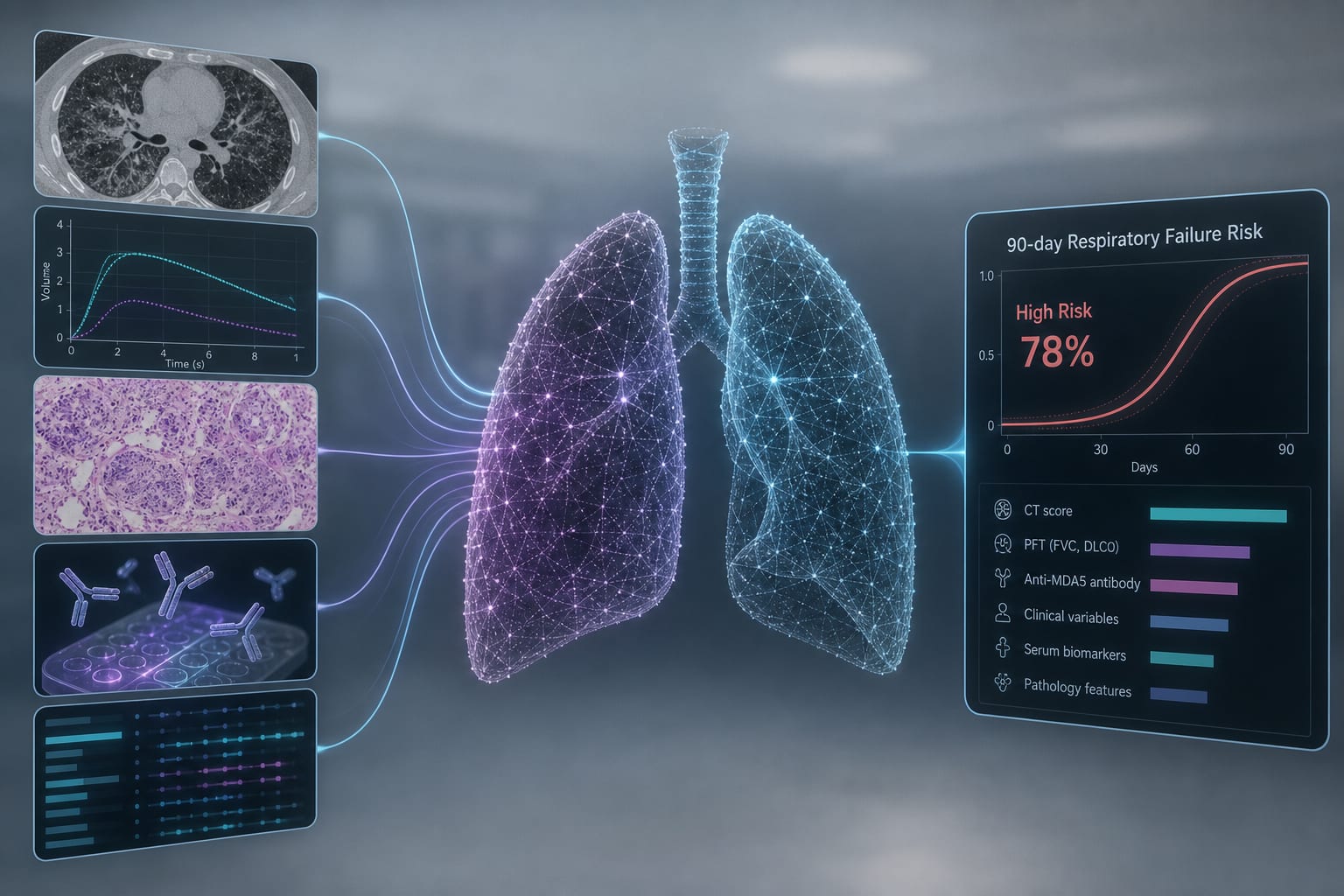
This study presents a multimodal model developed to predict 90-day respiratory failure in patients with dermatomyositis-associated interstitial lung disease (DM-ILD). The model demonstrated high discriminative performance.
Background
Dermatomyositis-associated interstitial lung disease (DM-ILD) is a severe condition often leading to respiratory failure and high mortality rates, especially in patients with anti-MDA5 antibody positivity. Early identification of high-risk patients is critical for timely intervention, yet routine testing for anti-MDA5 antibodies is not consistently available. This study aims to address the gap in risk assessment by utilizing data collected within the first 48 hours of patient admission.
Data Highlights
Model
AUC
PR-AUC
Early-fusion random forest model
0.967
0.879
Key Findings
The early-fusion random forest model showed the best performance with an AUC of 0.967.
SHAP analysis identified arthritis, pulmonary function indices, laboratory markers, and latent CT features as influential predictors.
Data were collected within the first 48 hours of admission, excluding anti-MDA5 results.
The model was internally tested on a cohort of 124 adult patients with DM-ILD.
Respiratory failure was chosen as a clinically relevant outcome for prediction.
Clinical Implications
This model may assist clinicians in stratifying patients at risk for respiratory failure in DM-ILD when serologic testing is delayed.
Conclusion
The admission-based multimodal model demonstrates performance for predicting 90-day respiratory failure in DM-ILD patients.