Breathing Disorders During Sleep in Heart Failure: Characterizations, Underlying Mechanisms, and Tailored Strategies
Background
Heart failure affects more than 60 million people worldwide. Sleep-disordered breathing—including obstructive sleep apnea (OSA) and central sleep apnea (CSA)—is common in heart failure and is associated with adverse remodeling, arrhythmias, and worse clinical outcomes. OSA may contribute to HF development and progression, whereas CSA is generally considered a consequence or marker of HF severity.
Data Highlights
Global HF burden: More than 60 million people
Typical LVEF improvement with short-term CPAP for OSA in HF: Approximately 3%-7%
CANPAP trial: 258 patients with HFrEF and CSA
SERVE-HF trial: 1,325 patients assigned to adaptive servo-ventilation or control
Clinical outcomes: No consistent reductions in mortality or HF hospitalization from treating sleep-disordered breathing
Key Findings
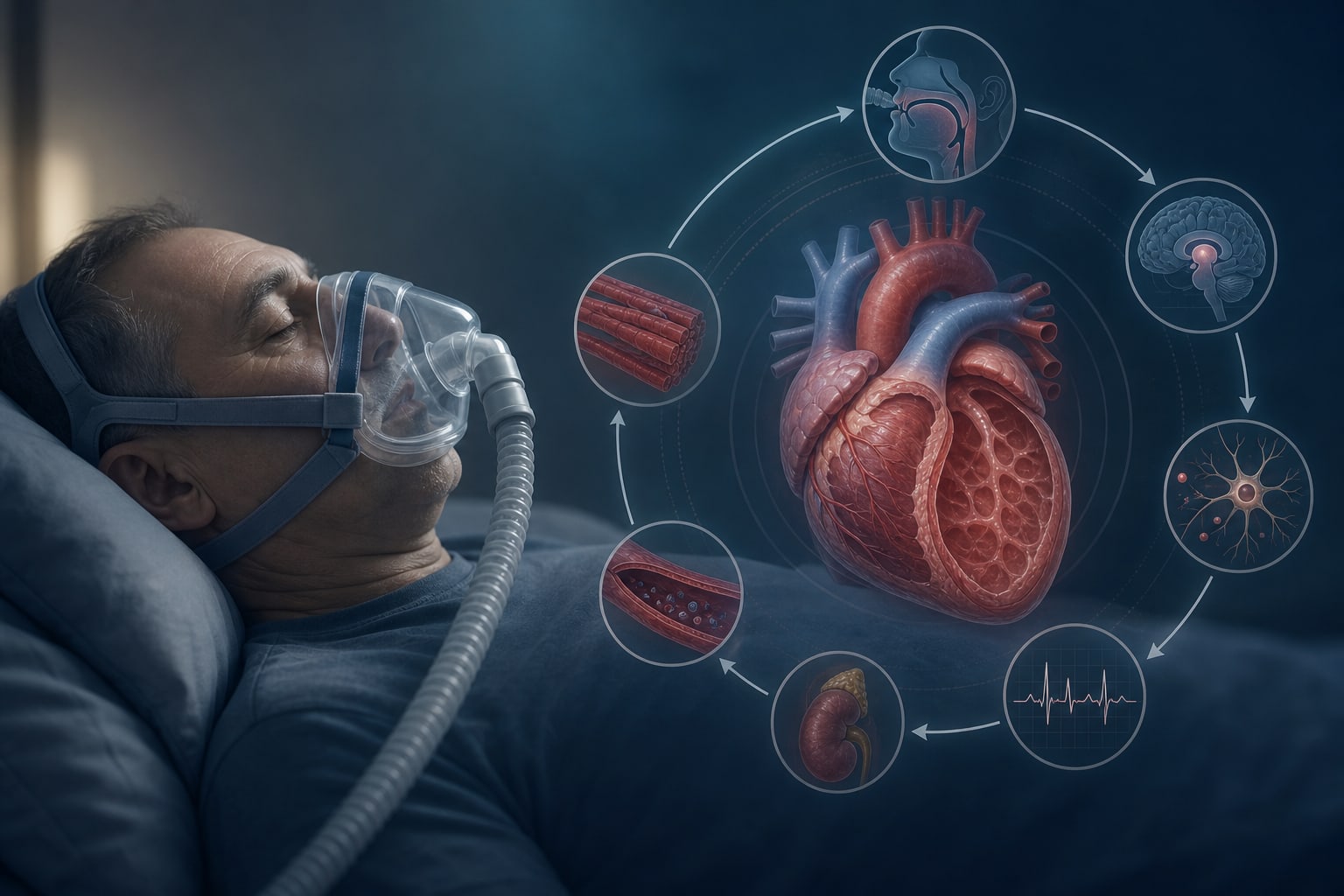
OSA may worsen HF through negative intrathoracic pressure, increased LV afterload and myocardial oxygen demand, intermittent hypoxia, arousals, and sympathetic activation.
Coexisting OSA and HF is associated with greater morbidity and mortality.
In HFrEF, OSA has been identified as an independent predictor of mortality, recurrent HF hospitalization, and adverse cardiac remodeling.
CSA is predominantly considered a consequence of HF and is associated with increased mortality.
Respiratory instability may persist during wakefulness and in the upright position, suggesting a broader cardiorespiratory disorder that conventional nocturnal testing may not fully characterize.
Improvements in apnea severity and physiological measures after treatment have not consistently translated into better clinical outcomes.
Clinical Implications
The 2022 ACC/AHA/HFSA guideline recommends formal sleep assessment for patients with HF and suspected sleep-disordered breathing to confirm the diagnosis and distinguish OSA from CSA. For patients with HF and OSA, CPAP may be reasonable to improve sleep quality and reduce excessive daytime sleepiness, but it has not been shown to reduce mortality or HF hospitalization. Management should reflect the SDB phenotype, HF phenotype, symptoms, oxygenation, and individual physiological characteristics.
Conclusion
Sleep-disordered breathing in HF is a heterogeneous cardiorespiratory disorder. OSA may contribute to HF progression, whereas CSA may primarily indicate disease severity or represent a compensatory response. Because improvements in conventional sleep and physiological measures do not necessarily improve clinical outcomes, assessment and treatment should extend beyond the apnea-hypopnea index and use a phenotype-specific approach.
Related Resources & Content
Sleep-Disordered Breathing in Heart Failure: Phenotypes, Mechanisms, and Precision Approach — Yi H, Drager LF, Wang X, Kasai T, Lee CH. Journal of Cardiac Failure. 2026. doi:10.1016/j.cardfail.2026.06.021.
2022 AHA/ACC/HFSA Guideline for the Management of Heart Failure — Heidenreich PA, Bozkurt B, Aguilar D, et al. Journal of the American College of Cardiology. 2022;79:e263-e421.
Continuous Positive Airway Pressure for Central Sleep Apnea and Heart Failure — Bradley TD, Logan AG, Kimoff RJ, et al. New England Journal of Medicine. 2005;353:2025-2033.
Adaptive Servo-Ventilation for Central Sleep Apnea in Systolic Heart Failure — Cowie MR, Woehrle H, Wegscheider K, et al. New England Journal of Medicine. 2015;373:1095-1105.
Adaptive Servo-Ventilation for Sleep-Disordered Breathing in Patients With Heart Failure With Reduced Ejection Fraction: ADVENT-HF — Bradley TD, Logan AG, Lorenzi Filho G, et al. The Lancet Respiratory Medicine. 2024;12:153-166.
Advanced heart failure and transplant cardiologist Sanjeev Kumar Gulati, M.D., FACC, has joined Baptist Health Heart & Vascular Care, and will serve as executive deputy director and system chief of cardiovascular medicine