A combined tumor burden–based nomogram for synchronous esophageal and gastric cancers: development and external validation - Report - MDSpire
Coming Soon: Introducing MDSpire News. Learn more
Conexiant’s news site is now MDSpire News. Learn more

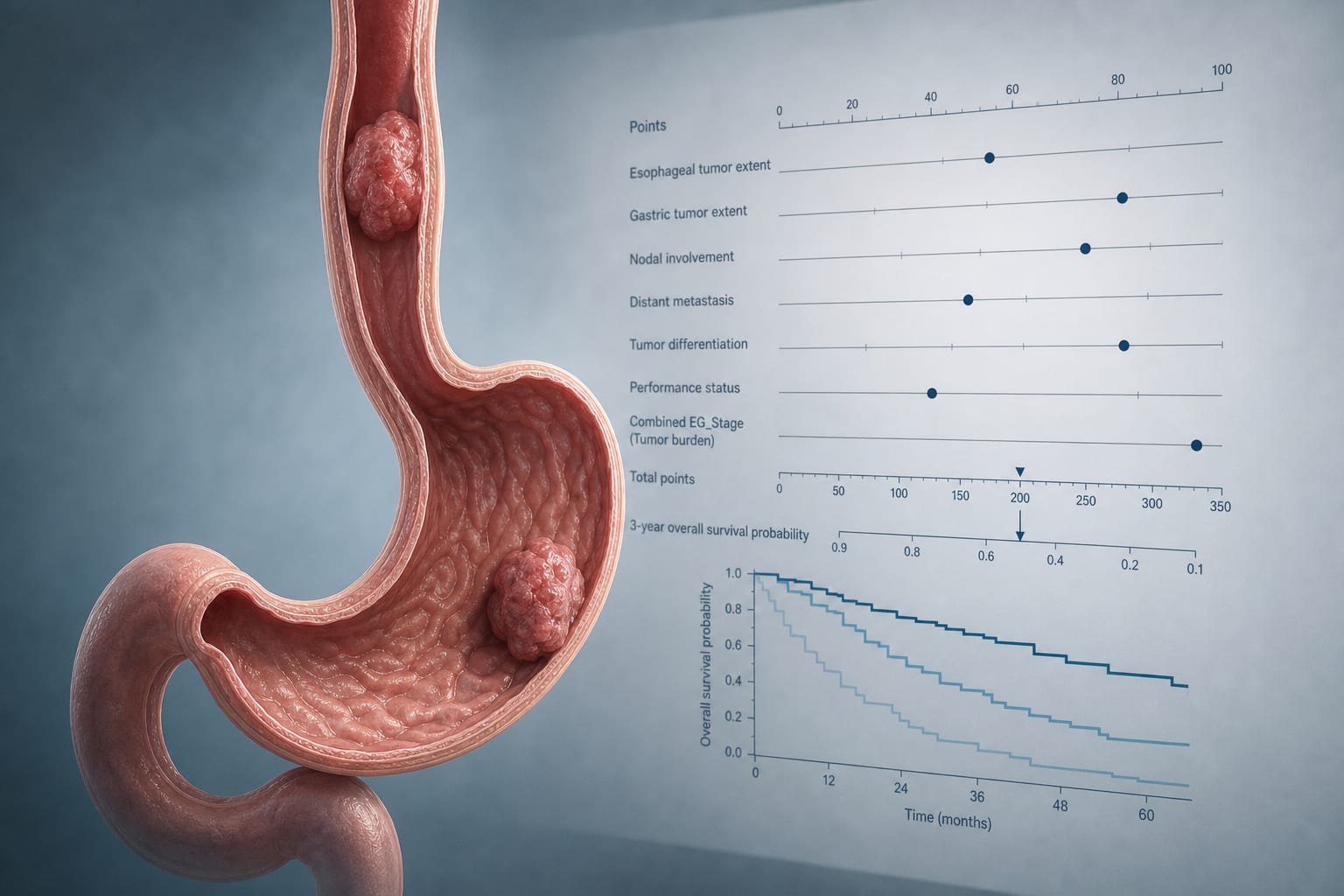
A novel nomogram utilizing tumor burden for assessing synchronous esophageal and gastric cancers: creation and external validation

  • By

  • Meng Xie

  • Jing Wang

  • Ziyu Jia

  • Ke Ji

  • Qi Wu

  • September 4, 2026

Share

Clinical Report: A novel nomogram utilizing tumor burden for assessing SEGC

Overview

This study developed and validated a prognostic nomogram for synchronous esophageal and gastric cancers (SEGC) that incorporates age, treatment modality, and a Combined EG_Stage framework. The model demonstrated modest discrimination and was validated using an external cohort.

Background

Synchronous dual-primary esophageal and gastric cancers (SEGC) are rare but challenging malignancies that complicate prognostic assessment due to differing tumor burdens. Traditional staging systems often fail to adequately represent the complexities of these coexisting tumors.

Data Highlights

MetricValue
C-index (external cohort)0.681
1-year AUC0.616
3-year AUC0.674
5-year AUC0.640
Median OS (high risk vs low risk)41 vs 22 months

Key Findings

  • The nomogram includes age, treatment modality, and Combined EG_Stage as prognostic factors.
  • Internal validation showed satisfactory calibration at 1-, 3-, and 5-year time points.
  • The external validation cohort yielded a C-index of 0.681.
  • Time-dependent AUCs for overall survival were 0.616, 0.674, and 0.640 at 1, 3, and 5 years, respectively.
  • Risk stratification significantly separated survival outcomes (P = 0.022).
  • Decision curve analysis indicated limited net benefit at selected threshold probabilities.

Clinical Implications

Further validation in larger, multicenter studies is essential due to the modest discrimination and limited sample size.

Conclusion

The study presents a novel prognostic nomogram for SEGC, which requires additional validation.

Related Resources & Content

  1. Updates in Surgery, 2021 -- A predictive nomogram for overall and disease-free survival following curative gastrectomy in gastric cancer patients
  2. Frontiers in Oncology, 2026 -- Development and internal validation of a prognostic nomogram incorporating F-NLR and HAGR scores in patients with oral squamous cell carcinoma
  3. Frontiers in Oncology, 2026 -- Development and Validation of a LASSO-Based Nomogram for Assessing Nutritional Risk Associated with Sarcopenia in Patients with Esophageal Cancer
  4. Gastric Cancer, 2020 -- Incidence Patterns and Prognostic Outcomes of Gastric Neuroendocrine Neoplasms: Insights from SEER Data and a Multicenter Investigation
  5. ESMO Clinical Practice Guideline interim update, 2025 -- Treatment of locally advanced oesophageal and oesophagogastric junction adenocarcinoma and metastatic squamous-cell carcinoma
  6. Pembrolizumab plus chemotherapy for advanced esophageal cancer: 5-year extended follow-up, 2025 -- KEYNOTE-590 study
  7. Surgical treatment in synchronous oesophageal cancers, 2025 -- A systematic review on survival outcomes
  8. ESMO Clinical Practice Guideline interim update on the treatment of locally advanced oesophageal and oesophagogastric junction adenocarcinoma and metastatic squamous-cell carcinoma - PMC
  9. Pembrolizumab plus chemotherapy versus chemotherapy for advanced esophageal cancer: 5-year extended follow-up for the randomized phase III KEYNOTE-590 study - PMC
  10. Surgical treatment in synchronous oesophageal cancers - A systematic review on survival outcomes - ScienceDirect

Original Source(s)

Related Content