Clinical Report: Determining a Safe Thermal Ablation Margin for Follicular Adenoma
Overview
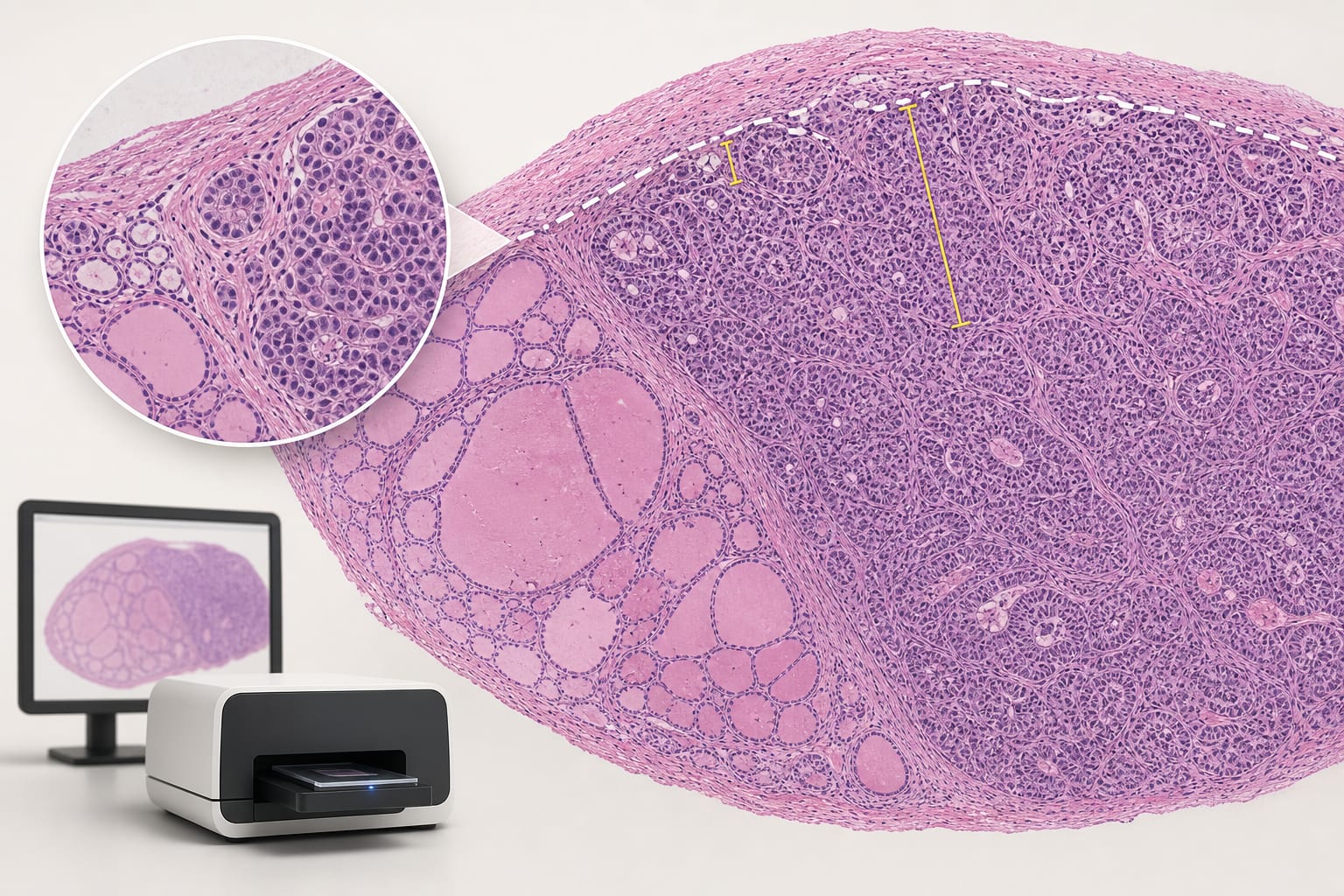
This study quantifies the microscopic extent of follicular carcinoma invasion to propose a safe thermal ablation margin for follicular adenoma. The findings suggest an extended ablation margin of 2mm beyond the sonographic tumor boundary to effectively cover occult minimally invasive follicular carcinoma.
Background
Differentiating between follicular adenoma and follicular carcinoma is challenging prior to surgery, which raises concerns about the potential for thermal ablation to treat undetected malignancies. Accurate assessment of the invasion depth in follicular carcinoma is critical for establishing safe ablation margins. This study aims to address these concerns by measuring the infiltration distances in follicular carcinoma.
Data Highlights
Measurement
Range (mm)
Mean ± SD (mm)
Capsule Infiltration Distance
0.14 - 6.10
1.49 ± 1.22
Minimally Invasive Infiltration Distance
0.09 - 1.36
0.56 ± 0.37
Key Findings
The capsule infiltration distance ranged from 0.14 to 6.10 mm, with a mean of 1.49 ± 1.22 mm.
The minimally invasive infiltration distance ranged from 0.09 to 1.36 mm, with a mean of 0.56 ± 0.37 mm.
Infiltration distances did not differ significantly by tumor stage, pathological classification, sex, or lymph node metastasis.
Age was associated with a larger capsule infiltration distance (P = 0.040).
The study supports an extended ablation safety margin of 2mm beyond the sonographic tumor boundary.
Clinical Implications
Clinicians should consider the proposed 2mm ablation margin when performing thermal ablation for follicular adenoma to mitigate the risk of inadvertently treating an occult follicular carcinoma. This margin accounts for the potential microscopic invasion that may not be detectable via imaging techniques.
Conclusion
The study provides critical insights into the safe thermal ablation margin for follicular adenoma, emphasizing the need for careful consideration of invasion depth in follicular carcinoma. Implementing the recommended margin may enhance treatment safety and efficacy.