Associations between vaginal microecological status and high-risk human papillomavirus positivity in women from Eastern China: a retrospective cross-sectional study - Report - MDSpire

Associations between vaginal microecological status and high-risk human papillomavirus positivity in women from Eastern China: a retrospective cross-sectional study

  • By

  • Junxia Wang

  • Xinyong Liu

  • Fangfei Liu

  • Juan Liu

  • Yan Zhao

  • Cuizhu Ma

  • Lina Wang

  • Xing Shi

  • July 10, 2026

  • 0 min

Share

Clinical Report: Linking Vaginal Microbiome Characteristics to hrHPV Infection

Overview

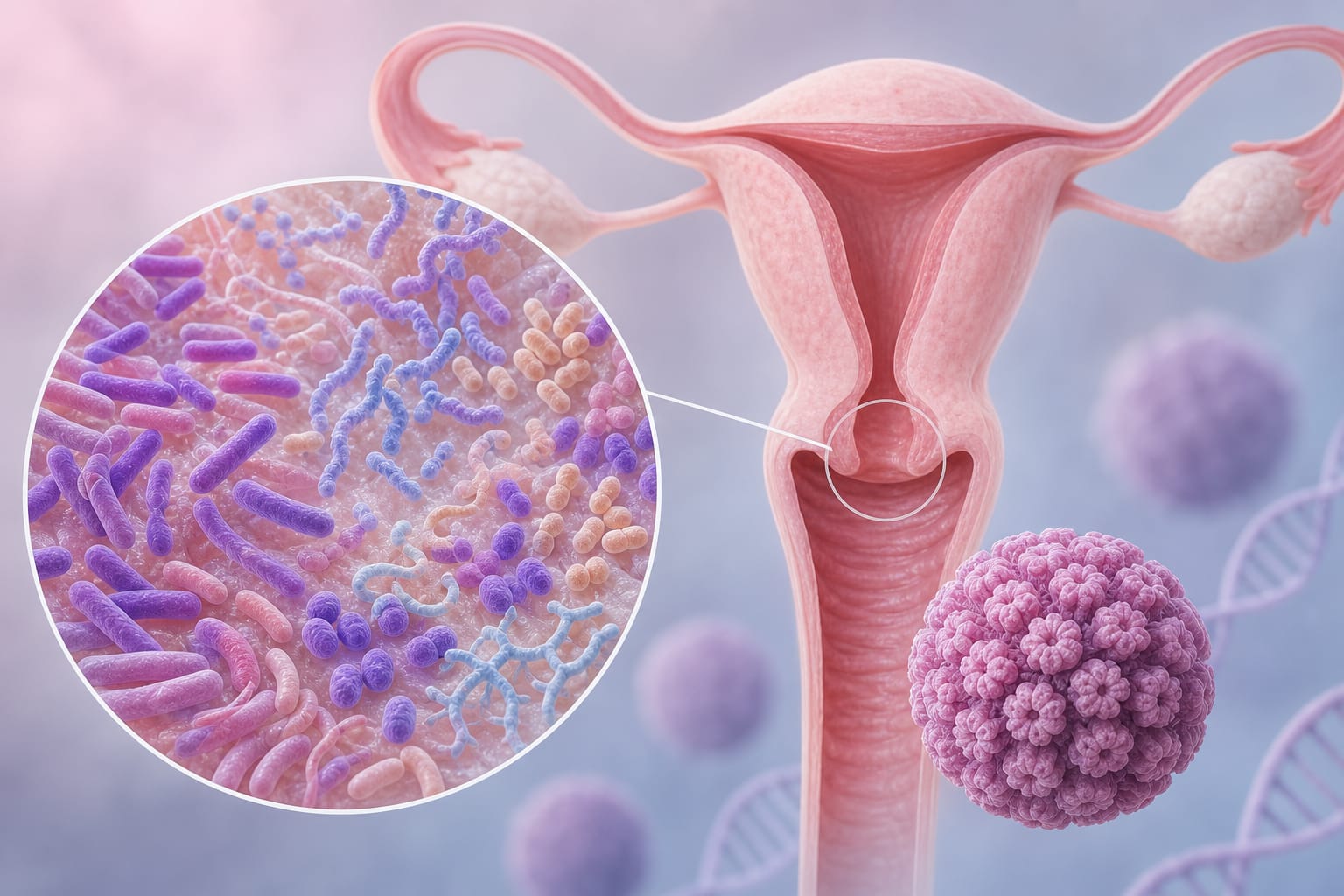
This study investigates the association between vaginal microecological status and high-risk human papillomavirus (hrHPV) infection in a large cohort of women from Eastern China. Findings indicate significant correlations between specific vaginal conditions and hrHPV positivity.

Background

Understanding the relationship between vaginal microbiome characteristics and hrHPV infection is crucial, as hrHPV is a significant factor in cervical cancer development. Disruptions in vaginal microecology may influence hrHPV persistence and clearance.

Data Highlights

MeasureValue
Overall hrHPV positivity15.99% (2,296/14,359)
Highest hrHPV positivity age group≤20 years (35.46%)
Bacterial Vaginosis (BV) OR1.572 (95% CI: 1.052–2.218)
Trichomonal Vaginitis (TV) OR1.738 (95% CI: 1.126–2.684)

Key Findings

  • Overall hrHPV positivity was 15.99% in the study cohort.
  • The highest hrHPV positivity rate was observed in women aged ≤20 years at 35.46%.
  • Bacterial vaginosis (BV) was associated with higher odds of hrHPV positivity (OR = 1.572).
  • Trichomonal vaginitis (TV) also showed a significant association with hrHPV positivity (OR = 1.738).
  • BV and TV were linked to hrHPV12 positivity, while TV was associated with HPV16/18 positivity.

Clinical Implications

Clinicians should consider the vaginal microbiome's role when assessing hrHPV risk in women, particularly in younger populations. Understanding these associations may inform future screening and management strategies for hrHPV-related conditions.

Conclusion

The study provides evidence of age-specific distributions of hrHPV positivity.

Related Resources & Content

  1. Frontiers in Medicine, 2026 -- Development and internal validation of a vaginal microecology-based multivariable prediction model for persistent high-risk human papillomavirus infection: a retrospective study
  2. The Journal of Infectious Diseases, 2023 -- Role of Atopobiaceae Family in Modulating Immunometabolic Factors During Human Papillomavirus Infection and Cervical Cancer Development
  3. The Journal of Infectious Diseases, 2023 -- Exploring the Vaginal Microbiome's Role in Cancer Development
  4. The Journal of Infectious Diseases, 2023 -- Bacterial Vaginosis Linked to Transcriptomic Alterations Without Increased Cervical Leukocyte Levels in Women at Elevated Risk for HIV Infection
  5. Draft Recommendation: Cervical Cancer: Screening | United States Preventive Services Taskforce
  6. Frontiers | The correlation between vaginal pathogens and high-risk human papilloma virus infection: a meta-analysis of case-control studies
  7. Draft Recommendation: Cervical Cancer: Screening | United States Preventive Services Taskforce
  8. Frontiers | The correlation between vaginal pathogens and high-risk human papilloma virus infection: a meta-analysis of case-control studies

Original Source(s)

Related Content