Research progress on the effects of epidural electrical stimulation on lower extremity function in patients with spinal cord injury - Report - MDSpire

Research progress on the effects of epidural electrical stimulation on lower extremity function in patients with spinal cord injury

  • By

  • Fei Xie

  • Chao Bai

  • Xinping Luan

  • Jian Xu

  • July 9, 2026

  • 0 min

Share

Clinical Report: Advancements in Understanding Epidural Electrical Stimulation's Impact

Overview

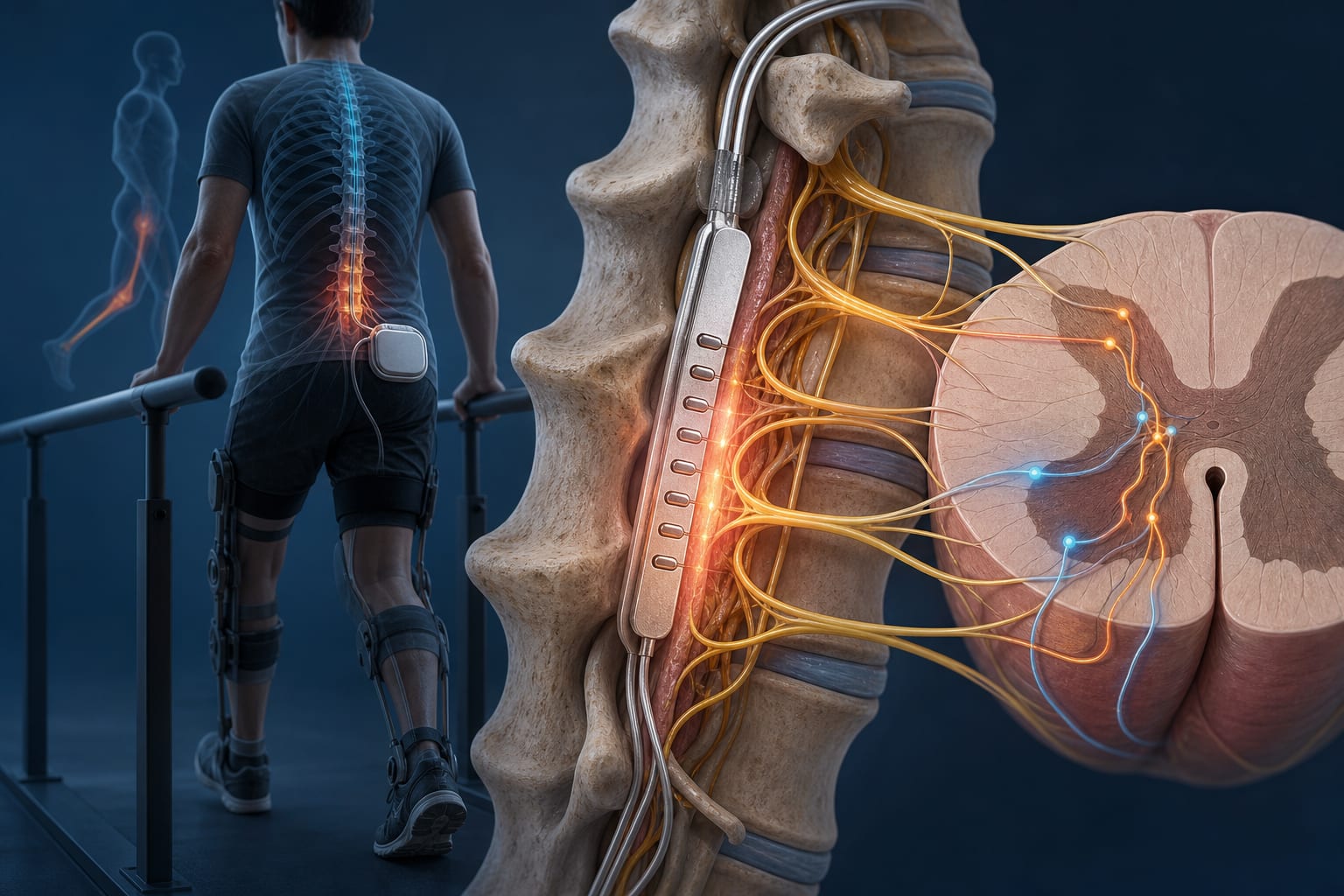
Epidural electrical stimulation (EES) has been investigated for its effects on lower limb motor function in spinal cord injury (SCI) patients. This report reviews the mechanisms, clinical efficacy, and limitations of EES.

Background

Lower extremity motor dysfunction following spinal cord injury significantly impacts patient quality of life and rehabilitation outcomes. Traditional therapies often fall short in restoring motor function below the injury site. EES aims to enhance spinal network excitability and facilitate motor recovery.

Data Highlights

Available evidence indicates that EES may promote functional recovery in patients with chronic incomplete SCI and some with motor-complete SCI, although findings are limited by small sample sizes and heterogeneity.

Key Findings

  • EES increases the excitability of spinal motor networks and enhances residual descending input.
  • Integration of EES with task-specific training has led to improvements in standing, stepping, walking, and spasticity control.
  • The therapeutic benefit of EES is influenced by factors such as injury level, stimulation parameters, and rehabilitation intensity.
  • Current evidence is limited by small sample sizes and the need for multicenter randomized controlled trials.
  • Standardized outcome assessments and long-term safety evaluations are necessary for broader application of EES in rehabilitation.

Clinical Implications

EES may be considered as a therapy for enhancing motor function in patients with spinal cord injuries, with attention to individualized parameter optimization and integration with rehabilitation strategies.

Conclusion

Further research is essential to establish the efficacy and safety of EES in clinical practice.

Related Resources & Content

  1. Frontiers in Neurology, 2026 -- Effects of postoperative electrical stimulation for quadriceps muscular atrophy of patients with incomplete Cervical Spinal Cord Injury. A Retrospective Study
  2. Pain Medicine, 2023 -- Early outcomes with a flexible ECAP based closed loop using multiplexed spinal cord stimulation waveforms—single-arm study with in-clinic randomized crossover testing
  3. Brain, 2023 -- On the use of sham transcutaneous spinal cord stimulation in spinal cord injury clinical trials
  4. Guidance Document for Spinal Cord Stimulation Clinical Studies: Designing, 2023
  5. Frontiers in Neurology — Comparing the effects of different electromagnetic stimulation on lower limb motor impairment after stroke: a protocol for systematic review and network meta-analysis
  6. Neurosurgery Adopts Position Statement on AO Spine/PRAXIS Clinical Practice Guidelines for the Management of Acute Spinal Cord Injury - AANS
  7. Transcutaneous spinal cord stimulation plus locomotor training versus sham-stimulation plus locomotor training in chronic spinal cord injury (eWALK): a multicentre, triple-blind, randomised, sham-controlled trial
  8. The Neurostimulation Appropriateness Consensus Committee (NACC)®: Recommendations for Spinal Cord Stimulation Long-Term Outcome Optimization and Salvage Therapy - Neuromodulation
  9. Spinal Cord Stimulation - AANS
  10. Guidance Document for Spinal Cord Stimulation Clinical Studies: Designing,
  11. High-frequency epidural electrical stimulation reduces spasticity and facilitates walking recovery in patients with spinal cord injury | Science Translational Medicine
  12. Transcutaneous spinal cord stimulation on motor function in patients with spinal cord injury: A meta-analysis - Changpiao Shi, Yi Chen, Liang Ye, Jun Feng, Guoli Dong, Shangbo Lu, 2024
  13. Epidural Spinal Cord Stimulation for Spinal Cord Injury in Humans: A Systematic Review - PMC
  14. Recovery of Over-Ground Walking after Chronic Motor Complete Spinal Cord Injury | New England Journal of Medicine
  15. Targeted neurotechnology restores walking in humans with spinal cord injury | Nature
  16. Neuromodulation of lumbosacral spinal networks enables independent stepping after complete paraplegia | Nature Medicine
  17. The neurons that restore walking after paralysis | Nature

Original Source(s)

Related Content