Clinical Report: Radiomic Assessment of Biplanar Ultrasound Imaging
Overview
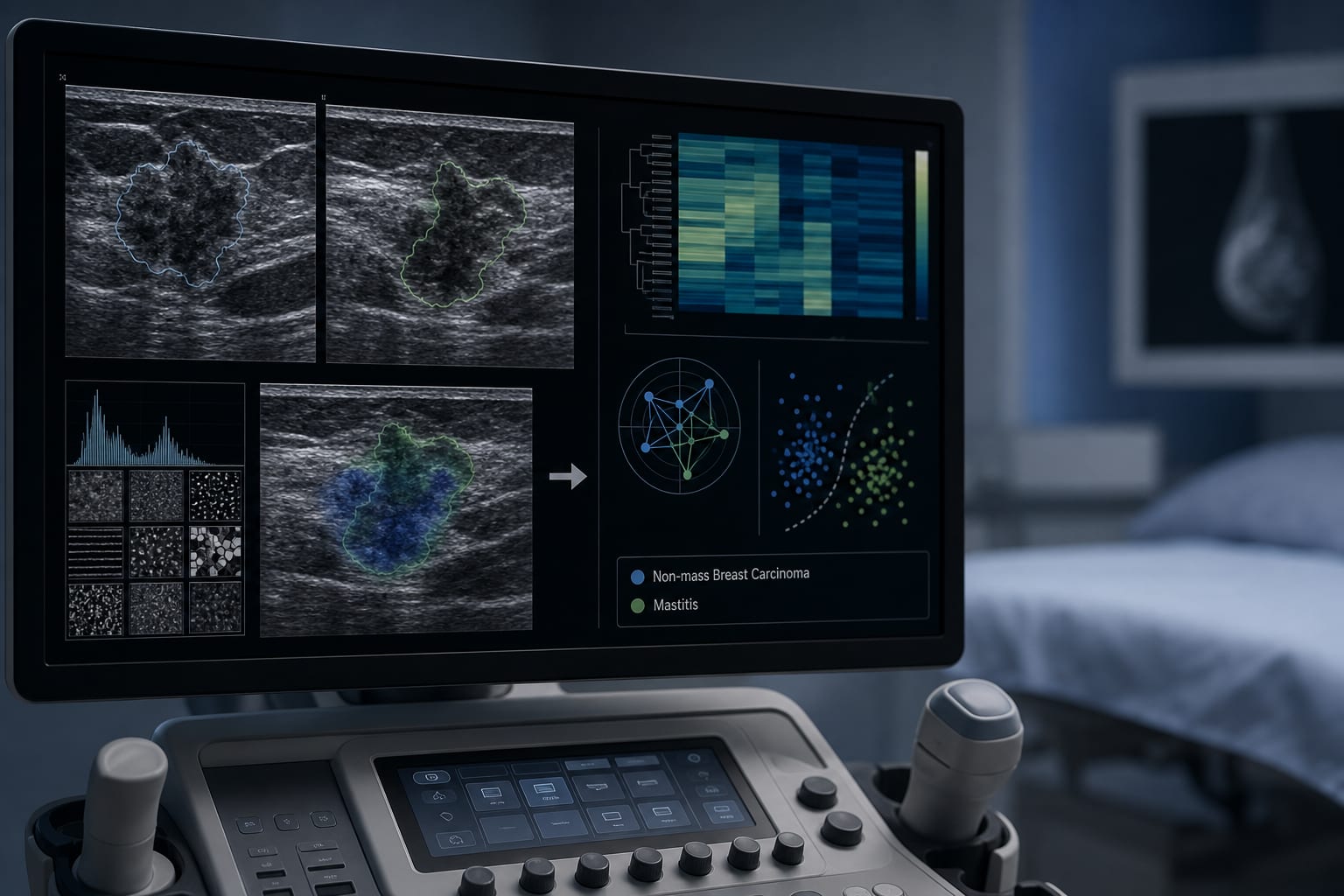
This study evaluates the effectiveness of radiomics models using biplanar ultrasound imaging to differentiate non-mass breast carcinoma (NMBC) from mastitis. The findings indicate that while the fusion model showed superior performance in the training cohort, its generalizability was limited in the validation cohort.
Background
Non-mass breast carcinoma (NMBC) poses a significant diagnostic challenge due to overlapping sonographic features with mastitis, which can lead to misdiagnosis and delayed treatment. Accurate differentiation is crucial as NMBC requires prompt oncological management, unlike mastitis, which typically warrants conservative therapy.
Data Highlights
Model
AUC
Accuracy
Transverse
0.730
69.0%
Longitudinal
0.823
78.6%
Fusion
0.800
78.6%
Combined Clinical-Radiomics
0.861–0.884
N/A
Key Findings
The fusion model outperformed single-plane models in the training cohort (AUC = 94.2%, accuracy = 87.6%).
In the validation cohort, the performance of the transverse, longitudinal, and fusion models was comparable (AUC = 0.730, 0.823, and 0.800, respectively; accuracy = 69.0%, 78.6%, and 78.6%, respectively).
The combined clinical-radiomics model showed performance metrics of AUC: 0.861–0.884 in the validation cohort.
Likelihood ratio tests confirmed that radiomics features and clinical variables contributed independently to the prediction.
Calibration and decision curve analysis indicated limited generalizability of the fusion model in the validation cohort.
Clinical Implications
The study suggests that integrating clinical variables with radiomics features may enhance diagnostic accuracy for distinguishing NMBC from mastitis. Clinicians should consider employing combined clinical-radiomics models for improved decision-making in preoperative assessments.
Conclusion
Biplanar ultrasound imaging-based radiomics models show potential for differentiating NMBC from mastitis, although their generalizability requires further validation.
Harold Burstein, MD, PhD, and Erica Mayer, MD, MPH discuss results from the SERENA-6 trial, which were presented at the 2026 ESMO Breast Cancer Congress.