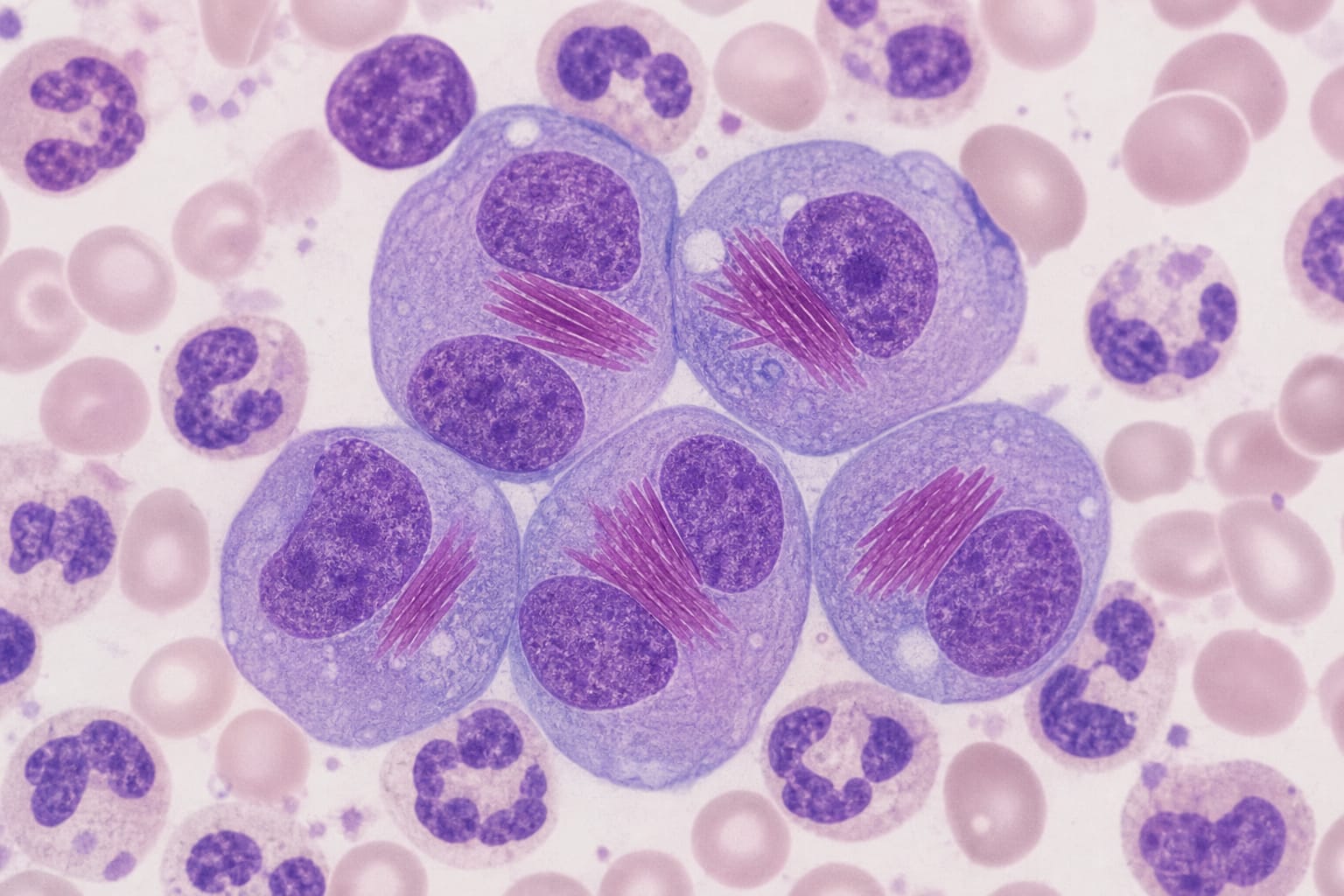
Clinical Report: Identification of 'Faggot Auer Rods' in Non-M3 AML
Overview
This report details a case of a 79-year-old male diagnosed with non-M3 acute myeloid leukemia (AML) exhibiting 'faggot-like' Auer rods. The findings highlight the potential for misdiagnosis when relying solely on morphological characteristics.
Background
Acute myeloid leukemia (AML) is a heterogeneous malignancy characterized by the proliferation of myeloid blasts. Accurate classification is crucial for treatment and prognosis, particularly in distinguishing between subtypes such as acute promyelocytic leukemia (APL) and non-M3 AML. Misidentification of Auer rods can lead to inappropriate treatment strategies.
Data Highlights
Case presentation of a 79-year-old male with leukocytosis and abnormal leukocytes in peripheral blood and bone marrow.
Key Findings
The patient presented with leukocytosis and elevated monocyte percentage.
Bone marrow aspirate revealed 40% abnormal leukocytes with 'faggot-like' Auer bodies.
Flow cytometry showed blasts positive for CD117, CD33, and MPO.
No APL-specific fusion genes were detected, leading to a diagnosis of non-M3 AML.
Faggot-like Auer bodies are not exclusive to APL and can appear in non-M3 AML.
Clinical Implications
This case emphasizes the importance of molecular testing in the diagnosis of AML to avoid misdiagnosis based on morphology alone. Clinicians should be aware of the potential for similar morphological features in different AML subtypes.
Conclusion
The identification of 'faggot-like' Auer rods in non-M3 AML underscores the need for careful diagnostic evaluation to prevent treatment errors.
Legend and Kelonia reveal 100 percent response rates in phase 1 trials, dual CAR T opens doors for kidney transplant patients, and iPDSC therapy beefs up failing hearts