Editorial: Innate lymphoid cells in cancer: volume II - Report - MDSpire

Editorial: Innate lymphoid cells in cancer: volume II

  • By

  • Nicolas Jacquelot

  • Emilie Narni-Mancinelli

  • Alexander David Barrow

  • June 15, 2026

  • 0 min

Share

Clinical Report: The Role of Innate Lymphoid Cells in Cancer Research - Volume II

Overview

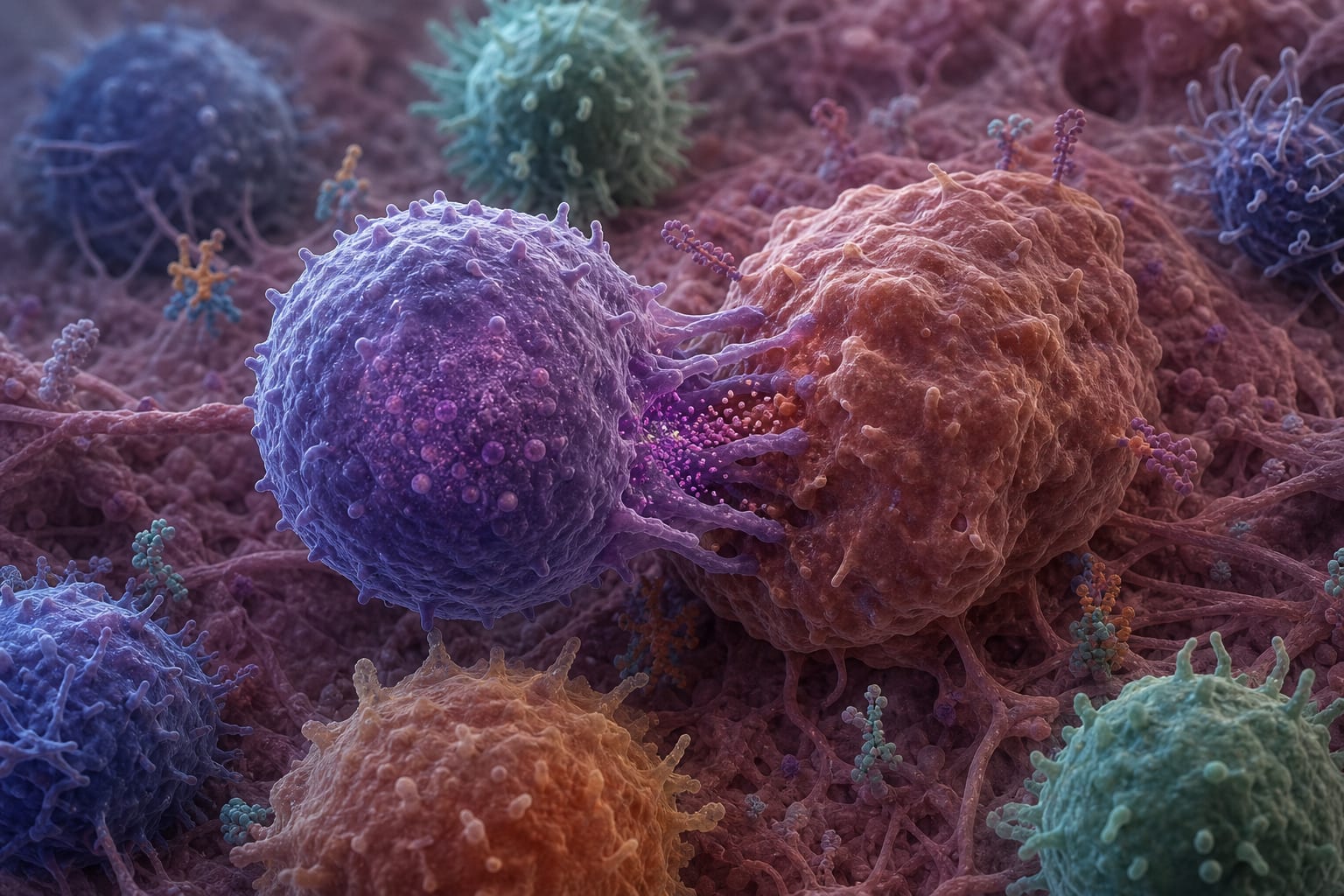
This editorial discusses the evolving role of innate lymphoid cells (ILCs) in cancer, highlighting their dual function as both tumor promoters and suppressors.

Background

Innate lymphoid cells (ILCs) are crucial components of the immune system, functioning independently of antigen-specific receptors. Their ability to rapidly respond and produce cytokines positions them as significant regulators of inflammation and tissue homeostasis, particularly in the context of cancer. Understanding ILC dynamics within the tumor microenvironment is essential for advancing cancer immunotherapy.

Data Highlights

No numerical data provided in the source material.

Key Findings

  • ILCs are active modulators of cancer progression and therapeutic outcomes.
  • NK cells exhibit predominantly anti-tumorigenic properties, while helper ILC subsets have context-dependent roles.
  • Seo et al. developed a 25-parameter spectral flow cytometry panel for high-resolution discrimination of ILC subsets in mammary tumors.
  • Sakata et al. identified ILT2 upregulation on CD56dim NK cells in hepatocellular carcinoma, linked to impaired cytotoxicity.
  • Maddineni et al. discovered IL-13-producing intraepithelial ILC1-like CD56dim NK cells in HNSCC tumors, suggesting a role in tumor progression.
  • Khan et al. found that CD56bright NK cells in bladder tumors are associated with favorable patient prognosis.

Clinical Implications

The findings highlight the necessity for a deeper understanding of ILC phenotypes and their regulatory mechanisms in cancer.

Conclusion

Continued research is essential to fully harness the therapeutic potential of ILCs.

Related Resources & Content

  1. Frontiers in Immunology, Editorial: A new perspective on the importance of dendritic cells in cancer immunity: from bench to patient’s bedside
  2. Frontiers in Immunology, Editorial: The role of innate immunity in the pathogenesis of autoimmune and autoinflammatory diseases
  3. Frontiers in Immunology, Editorial: Exploring unconventional T cells and CAR-T-cells in cancer immunotherapy
  4. Society for Immunotherapy of Cancer (SITC) consensus statement on essential biomarkers for immunotherapy clinical protocols - PMC
  5. Frontiers in Immunology — Editorial: Cancer Immunosurveillance
  6. Update to ASCO Living Guideline for NSCLC Without Driver Alterations Includes First Comparison of Immunotherapy Options
  7. IL-33-activated ILC2s induce tertiary lymphoid structures in pancreatic cancer - PMC
  8. Society for Immunotherapy of Cancer (SITC) consensus statement on essential biomarkers for immunotherapy clinical protocols - PMC
  9. Frontiers | The pivotal role of tertiary lymphoid structures in the tumor immune microenvironment
  10. De novo induction of tertiary lymphoid structures: an immunotherapeutic strategy in pancreatic cancer | Signal Transduction and Targeted Therapy
  11. The predictive value of intratumoral tertiary lymphoid structures on the response to immunotherapy in cancer patients: a systematic review and meta-analysis | BMC Cancer | Springer Nature Link
  12. IL-15: from discovery to FDA approval | Journal of Hematology & Oncology | Full Text
  13. Li et al. Journal of Hematology & Oncology (2025) 18:19
  14. Association of lymphopenia rescue and CA19-9 levels with overall survival following IL-15 superagonist N-803 and PD-L1 t-haNK chemo-immunotherapy for 3rd line or greater metastatic pancreatic cancer. | Journal of Clinical Oncology

Original Source(s)

Related Content