Endoscopic ultrasound-guided radiofrequency ablation for pancreatic cystic neoplasms: a comprehensive review
-
By
-
Xinzhu Sun
-
Nan Ge
-
June 15, 2026
-
0 min
Clinical Report: Endoscopic Ultrasound-Assisted Radiofrequency Ablation for PCLs
Overview
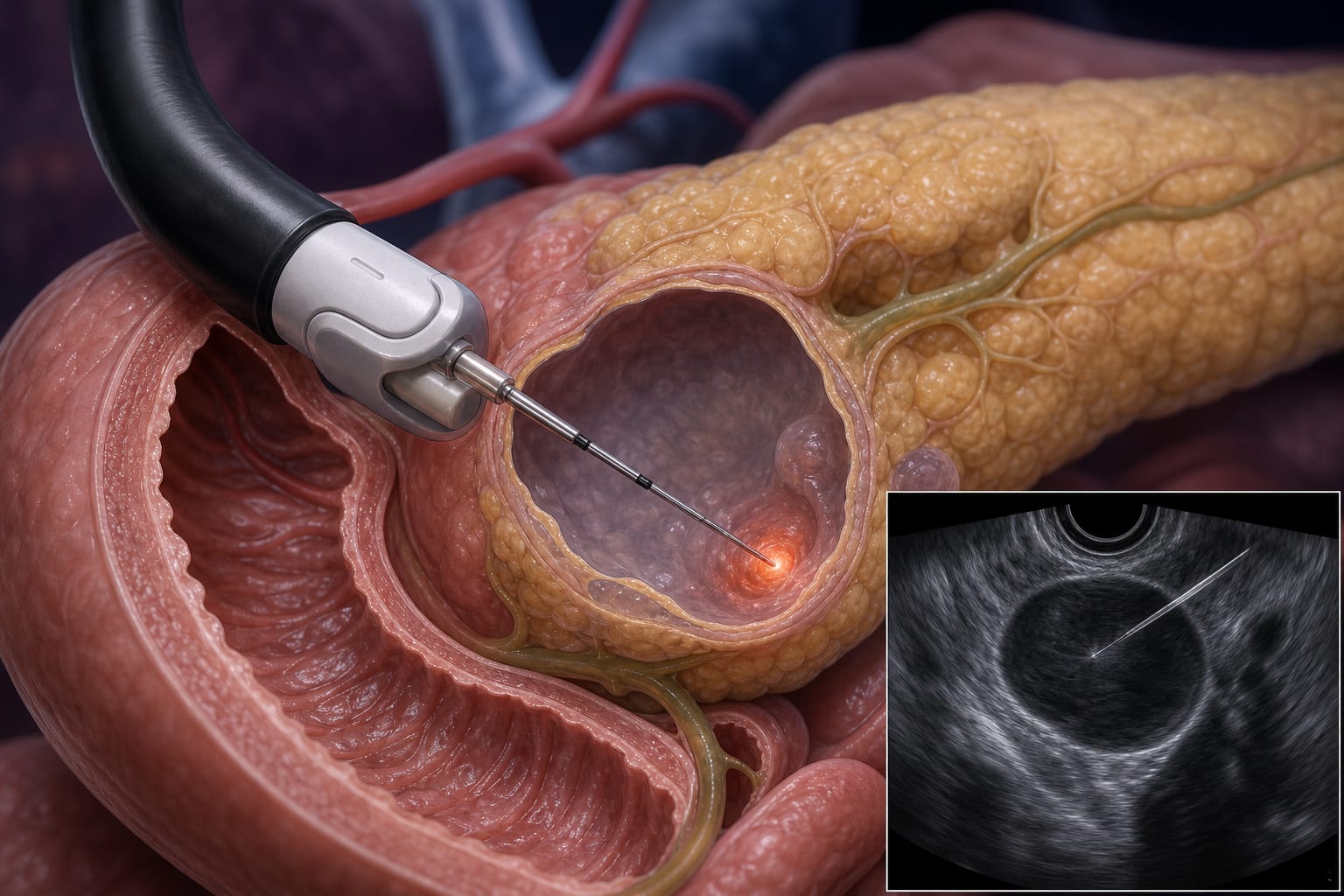
Endoscopic ultrasound-guided radiofrequency ablation (EUS-RFA) is emerging as a promising minimally invasive treatment for pancreatic cystic lesions (PCLs) with malignant potential. This review highlights the efficacy, safety, and operational procedures of EUS-RFA, emphasizing its role in managing high-risk patients unfit for surgery.
Background
The increasing detection of pancreatic cystic lesions (PCLs) poses significant management challenges, particularly for high-risk patients who may not be suitable for surgical intervention. Current guidelines rely on risk stratification, but the limitations of imaging specificity and the risks associated with surgical overtreatment necessitate alternative therapeutic approaches. EUS-RFA represents a potential solution, offering a targeted and less invasive option for treating PCLs.
Data Highlights
No numerical data available in the provided source material.
Key Findings
- EUS-RFA is characterized by high efficacy and safety for selected PCLs with malignant potential.
- Current management strategies for PCLs face challenges due to imperfect specificity of imaging techniques.
- High-risk patients unfit for surgery may benefit significantly from EUS-RFA as a minimally invasive treatment option.
- Standardization of EUS-RFA procedures and further evidence-based data are necessary for establishing its clinical value.
- Comparative analysis with EUS-guided chemical ablation highlights unique advantages of EUS-RFA.
Clinical Implications
Clinicians should consider EUS-RFA as a viable treatment option for high-risk patients with PCLs who are not candidates for surgery. The integration of EUS-RFA into clinical practice requires careful patient selection and adherence to standardized operational procedures to ensure optimal outcomes.
Conclusion
EUS-RFA represents a significant advancement in the management of pancreatic cystic neoplasms, particularly for patients at high risk for surgical complications. Continued research and standardization are essential for maximizing its clinical application.
Related Resources & Content
- Surgical Endoscopy, 2024 -- Meta-Analysis and Systematic Review of Radiofrequency Ablation for Unresectable Pancreatic Adenocarcinoma
- Surgical Endoscopy, 2022 -- Effectiveness and Predictive Determinants of Ethanol Ablation via Endoscopic Ultrasound in Benign Solid Pancreatic Tumors
- Journal of Gastroenterology, 2018 -- Role of Endoscopic Ultrasonography in the Diagnosis of Pancreatic Cancer
- Surgical Endoscopy, 2022 -- Comparative Analysis of Contrast-Enhanced Endoscopic Ultrasound-Guided Fine Needle Biopsy Versus Standard Fine Needle Biopsy: A Retrospective Investigation at a Medical Facility
- International evidence-based Kyoto guidelines for the management of intraductal papillary mucinous neoplasm of the pancreas - ScienceDirect
- Endoscopic ultrasound-guided radiofrequency ablation for large branch-duct intraductal papillary mucinous neoplasms: Safety and efficacy trial - PMC
- Endoscopic ultrasound-guided ethanol vs ethanol combined with paclitaxel for the ablation of pancreatic cystic lesions: a systematic review and meta-analysis - PMC
- International evidence-based Kyoto guidelines for the management of intraductal papillary mucinous neoplasm of the pancreas - ScienceDirect
- Endoscopic ultrasound-guided radiofrequency ablation for large branch-duct intraductal papillary mucinous neoplasms: Safety and efficacy trial - PMC
- Endoscopic ultrasound-guided ethanol vs ethanol combined with paclitaxel for the ablation of pancreatic cystic lesions: a systematic review and meta-analysis - PMC
This content is an AI-generated, fully rewritten summary based on a published scholarly article. It does not reproduce the original text and is not a substitute for the original publication. Readers are encouraged to consult the source for full context, data, and methodology.