Clinical Report: Personalized Repetitive Transcranial Magnetic Stimulation for SAD
Overview
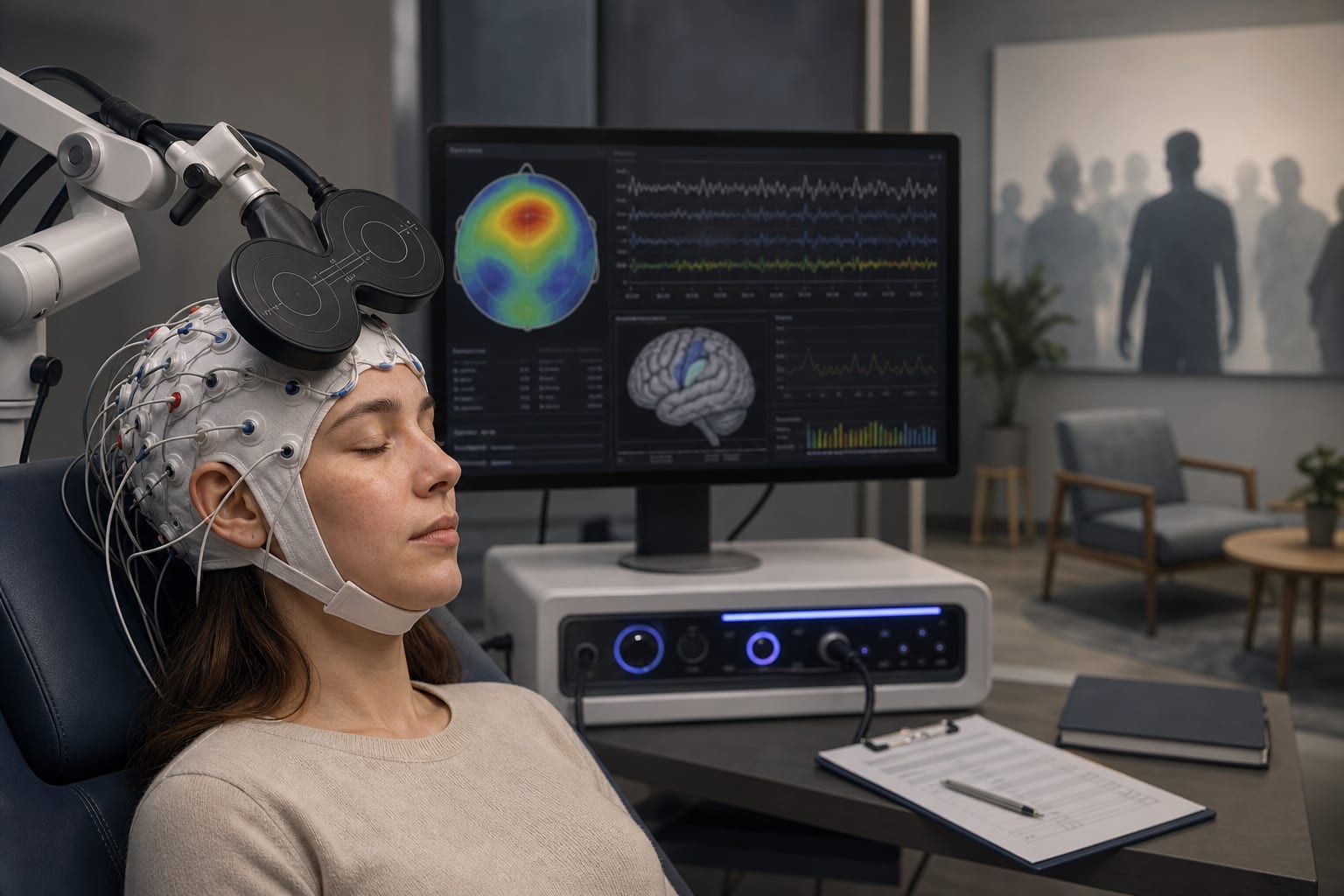
This case study evaluates the efficacy of personalized repetitive transcranial magnetic stimulation (PrTMS) guided by spectral EEG in a patient with performance-only social anxiety disorder (SAD). Significant reductions in social anxiety symptoms and improvements in mood and daily function were observed, suggesting PrTMS as a potential adjunctive treatment for SAD.
Background
Social anxiety disorder (SAD) is prevalent and often inadequately treated with standard therapies, which yield variable response rates. The performance-only subtype presents unique challenges, necessitating innovative treatment approaches. PrTMS, a novel neuromodulation technique, may enhance treatment outcomes by personalizing stimulation parameters based on EEG data and psychometric assessments.
Data Highlights
{'LSAS': 'Score reduced from 57 to [insert final score].', 'SPIN': 'Score reduced from [insert initial score] to [insert final score].', 'PHQ-9': 'Score reduced from [insert initial score] to [insert final score].', 'GAD-7': 'Score reduced from [insert initial score] to [insert final score].', 'Q-LES-Q-SF': 'Score improved from [insert initial score] to [insert final score].'}
Key Findings
PrTMS led to reductions in social anxiety intensity and avoidance behaviors.
Increased alpha band power and decreased delta band power were observed in EEG assessments.
Clinical improvements were accompanied by enhanced mood and daily functioning.
PrTMS may serve as a viable adjunctive treatment for performance-only SAD.
Further research is needed to validate the efficacy of PrTMS in larger populations.
Clinical Implications
The findings suggest that PrTMS could be considered for patients with performance-only SAD who do not respond adequately to first-line treatments. Clinicians may explore the integration of EEG-guided neuromodulation techniques to personalize treatment approaches and improve patient outcomes.
Conclusion
This case study indicates that PrTMS may be a promising adjunctive treatment for performance-only SAD, warranting further investigation in larger, controlled studies.
by Mark Odron, Yatharth Mahajan, Vipul Reddy, Krrishika Saxena, Charles Vigilia, Brianna Dela Cruz, Jayleen Lu, Nisha Thunga, Kenneth Blum, David Baron, Keerthy Sunder