Multidimensional therapeutic advantages of Smilax glabra (Tufuling)-containing formulae in gout: an integrated Systematic Review and network pharmacology-based prediction - Report - MDSpire

Multidimensional therapeutic advantages of Smilax glabra (Tufuling)-containing formulae in gout: an integrated Systematic Review and network pharmacology-based prediction

  • By

  • Qiaoyun Liu

  • Xiuming Li

  • Yuping Lin

  • Xianyu Tang

  • Guanjie Fan

  • Lu Sun

  • July 1, 2026

  • 0 min

Share

Clinical Report: Therapeutic Benefits of Smilax glabra (Tufuling) Formulations in Gout

Overview

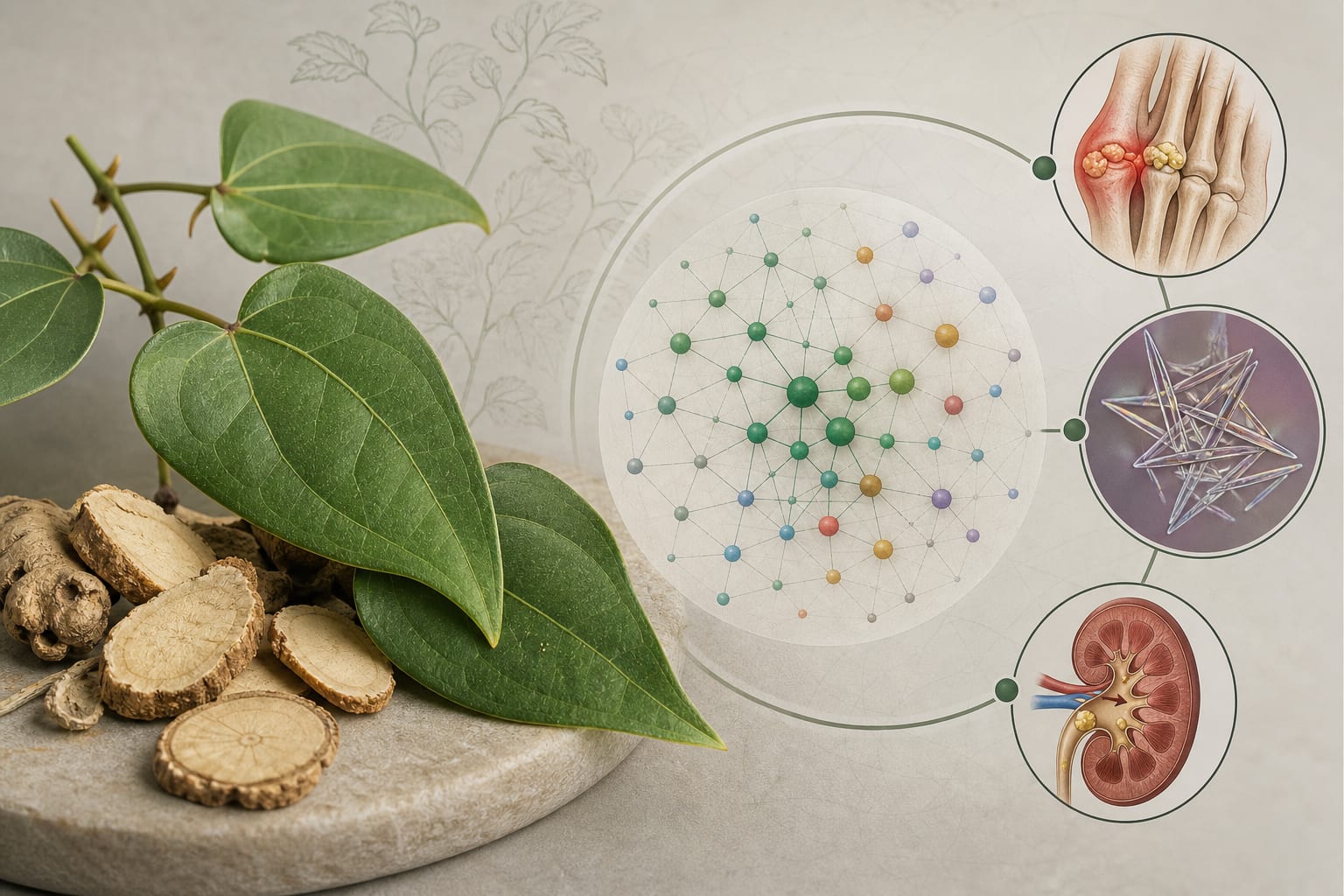
This systematic review and meta-analysis evaluated the efficacy and safety of Tufuling-containing traditional Chinese medicine (TCM) formulae for gout patients. Results indicated reductions in pain, serum uric acid, and inflammatory markers when combined with Western medicine, as reported in the included studies.

Background

Gout is a prevalent inflammatory arthritis caused by monosodium urate crystal deposition, affecting millions globally. The increasing incidence, particularly in younger populations, highlights the need for effective treatments. Traditional Chinese medicine, including herbs like Smilax glabra, offers potential therapeutic options for managing gout, especially in patients with dampness-heat accumulation, as noted in recent literature.

Data Highlights

OutcomeTufuling + WMWM Monotherapy
VAS Scores (Pain)Reported lower scoresReported higher scores
Serum Uric Acid LevelsReported lower levelsReported higher levels
C-Reactive Protein LevelsReported lower levelsReported higher levels
Erythrocyte Sedimentation RateReported lower levelsReported higher levels
Gastrointestinal Adverse Events73 cases161 cases

Key Findings

  • Tufuling-containing formulae showed reductions in pain and inflammatory markers compared to WM monotherapy, as reported in the analysis.
  • 56 RCTs with 4,605 participants were included in the analysis.
  • Network pharmacology identified 49 targets for Tufuling, with key pathways involved in inflammation and metabolism.
  • Molecular docking predicted binding of diosgenin to PTGS2 and IL1B.
  • Adverse events were reported less frequently with Tufuling interventions compared to WM alone.

Clinical Implications

Clinicians should consider the reported benefits and safety profile of Tufuling-containing formulations in their treatment plans for gout.

Conclusion

The findings indicate that Tufuling-containing formulae may improve symptoms of acute gout, although further rigorous studies are necessary to confirm long-term efficacy and safety.
Related Resources & Content

  1. Clinical Rheumatology, 2021 -- A Comprehensive Review and Meta-Analysis on the Efficacy and Safety of Total Glucosides of Peony in Combination with Methotrexate for Treating Rheumatoid Arthritis
  2. Frontiers in Immunology, 2026 -- Tripterygium wilfordii Hook. f. and Xinfeng Capsule in Rheumatoid Arthritis: A Review of Clinical Evidence, Molecular Mechanisms, and Translational Perspectives
  3. Frontiers in Medicine, 2026 -- Efficacy and safety of different curcumin formulations in osteoarthritis: an umbrella review of systematic reviews
  4. Clinical Rheumatology, 2011 -- A Review of Gouty Arthritis Pathophysiology and Its Clinical Management Strategies
  5. 2020 American College of Rheumatology Guideline for the Management of Gout - PubMed
  6. Long-term cardiovascular safety of febuxostat compared with allopurinol in patients with gout (FAST): a multicentre, prospective, randomised, open-label, non-inferiority trial - ScienceDirect
  7. Efficacy and safety of Chinese herbal medicines in reducing serum uric acid levels: a systematic review and meta-analysis - ScienceDirect
  8. 2020 American College of Rheumatology Guideline for the Management of Gout - PubMed
  9. Long-term cardiovascular safety of febuxostat compared with allopurinol in patients with gout (FAST): a multicentre, prospective, randomised, open-label, non-inferiority trial - ScienceDirect
  10. Efficacy and safety of Chinese herbal medicines in reducing serum uric acid levels: a systematic review and meta-analysis - ScienceDirect

Original Source(s)

Related Content