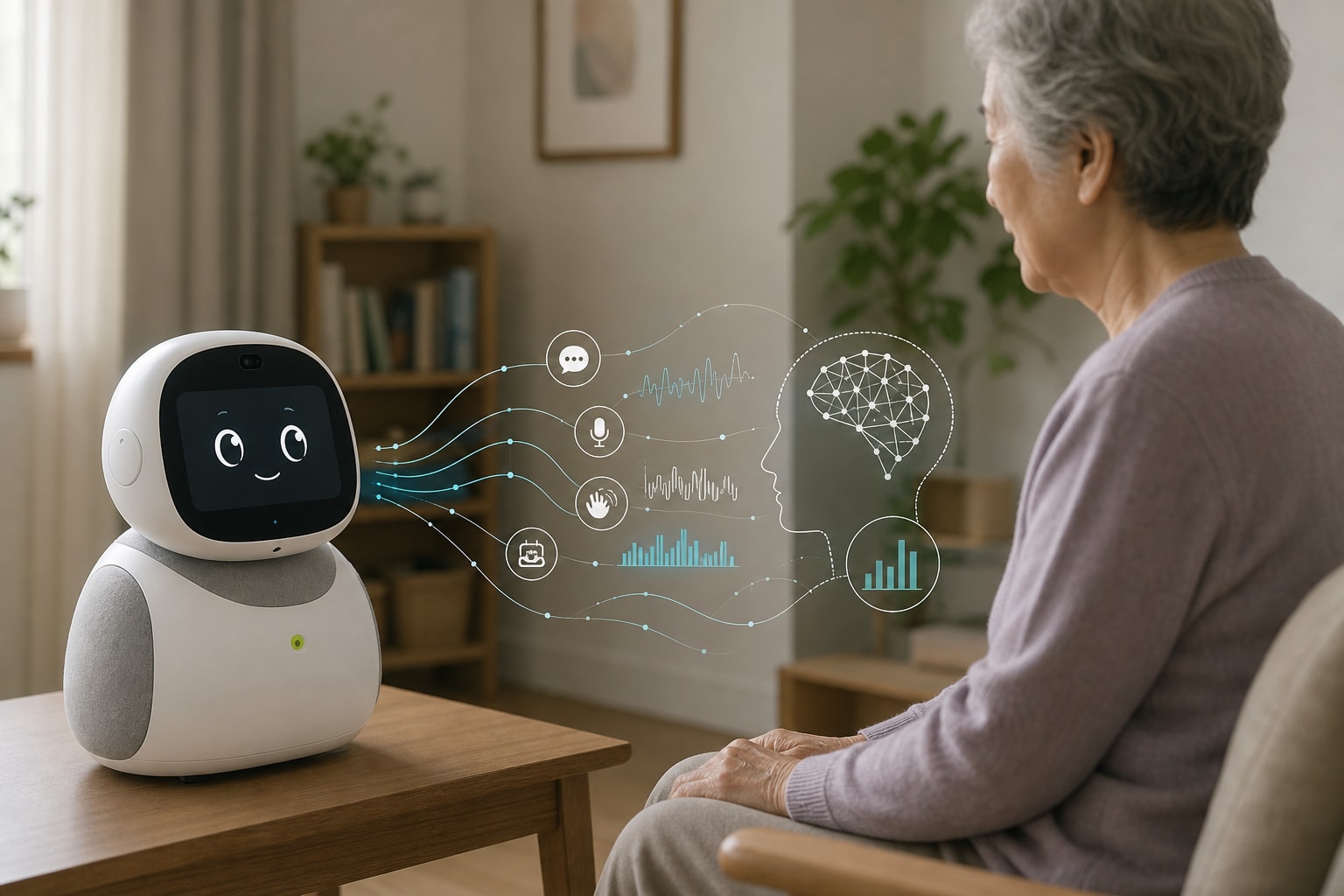
Identifying Depression Risk in Elderly Individuals Through Home-Utilized Socially Assistive Robots: An Empirical Investigation
-
By
-
Han Wool Jung
-
Jooho Lee
-
Jin Young Park
-
Woo Jung Kim
-
Jaesub Park
-
June 10, 2026
Clinical Report: Identifying Depression Risk in Elderly Individuals Through Home-Utilized Socially Assistive Robots
Overview
This study investigates the use of the socially assistive robot Hyodol to predict depression risk in elderly individuals. The model demonstrated high sensitivity in identifying symptomatic depression and those requiring referral to healthcare centers, highlighting the potential of SARs in mental health monitoring.
Background
Depression is a significant health concern among older adults, often exacerbated by mobility limitations and social isolation. Socially assistive robots (SARs) like Hyodol offer a promising solution for continuous mental health monitoring in home settings, potentially improving access to care and treatment adherence. The integration of technology in mental health care can enhance early detection and intervention for depression.
Data Highlights
| Measure | 2024 Cohort | 2025 Cohort |
|---|---|---|
| Sensitivity for symptomatic depression | 0.939 | N/A |
| Sensitivity for referral needed | 0.900 | N/A |
Key Findings
- The model achieved a sensitivity of 0.939 for identifying symptomatic depression.
- It achieved a sensitivity of 0.900 for identifying participants requiring referral to healthcare centers.
- Key features associated with depression included engagement with quiz content and frequency of free conversations.
- Regular meal intake and positive responses to daily check-ins were also linked to depression status.
- The model produced a considerable number of false positives, indicating a need for refinement.
Clinical Implications
Healthcare providers may consider integrating SARs like Hyodol into routine mental health monitoring for older adults. This approach could facilitate early detection of depression and improve access to necessary interventions, particularly for those with mobility challenges.
Conclusion
The findings suggest that Hyodol can serve as an effective screening tool for depression risk in elderly individuals, warranting further research to enhance its predictive accuracy and clinical utility.
Related Resources & Content
- Journal of Medical Internet Research, 2026 -- Human and Robot Assistance for Cognitive Load in Younger and Older Adults: Multimodal Within-Subject Experimental Study
- Frontiers in Digital Health, 2026 -- Healthcare professionals’ perspectives on usefulness, acceptability and implementation conditions of socially assistive robots in France: a cross-sectional survey and cluster analysis
- BMC Psychiatry, 2026 -- A Transparent Machine Learning Approach for Forecasting Depressive Symptoms in Elderly Chinese Individuals with Chronic Illnesses
- Frontiers in Psychiatry, 2026 -- Feasibility of smartphone app-based neuropsychological tasks for screening people with subclinical depression and anxiety: a preliminary validation study
- Recommendation: Depression and Suicide Risk in Adults: Screening | United States Preventive Services Taskforce
- Mental Health Gap Action Programme (mhGAP) guideline for mental, neurological and substance use disorders: executive summary
- Mental health of older adults
- January 2026 exceptional surveillance of depression in adults: treatment and management (NICE guideline NG222)
- Recommendation: Depression and Suicide Risk in Adults: Screening | United States Preventive Services Taskforce
- Effectiveness of AI-based conversational and socially assistive agents in older adults: a systematic review and meta-analysis | BMC Geriatrics | Springer Nature Link
- The effect of robot-based interventions on depression in older adults with cognitive impairment: A systematic review and meta-analysis - ScienceDirect
- Evaluating usability and acceptance of a socially assistive robot supported cognitive training for depression – results of the randomized controlled pilot study ‘AMIGA’
- JMIR Aging - Engaging Older Adults and Staff in the Co-Design and Evaluation of Socially Assistive Robot and Virtual Reality Activities for Long-Term Care: User-Centered Study
- From Dogs to Robots: Pet-Assisted Interventions for Depression in Older Adults—A Network Meta-Analysis of Randomized Controlled Trials | MDPI
Based on findings from:
Detection of depression risk among older adults using home-deployed socially assistive robots: a real-world study
Han Wool Jung, Jooho Lee, Jin Young Park, Woo Jung Kim, Jaesub Park. Frontiers In Psychiatry, 2026.
https://www.frontiersin.org/journals/psychiatry/articles/10.3389/fpsyt.2026.1740539/full
This content is an AI-generated, fully rewritten summary based on a published scholarly article. It does not reproduce the original text and is not a substitute for the original publication. Readers are encouraged to consult the source for full context, data, and methodology.