Suspended Lead Suits Linked to Lower Radiation in LAAO
-
By
-
Henry Thomas
-
March 24, 2026
-
3 min
Clinical Report: Suspended Lead Suits Linked to Lower Radiation in LAAO
Overview
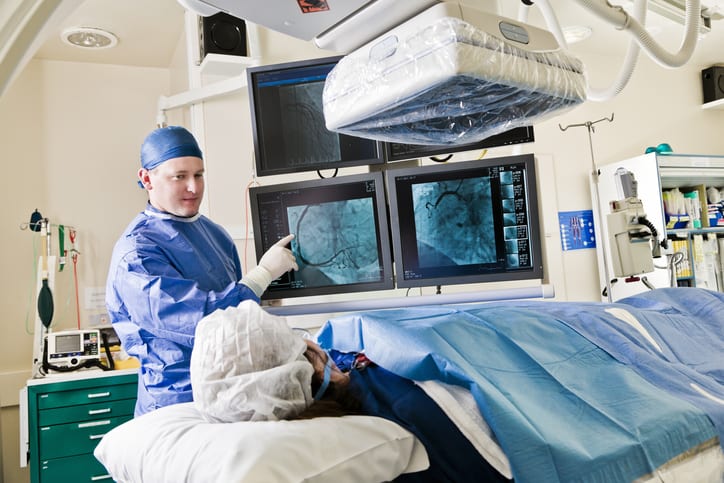
Suspended lead suits significantly reduced occupational radiation exposure among interventional echocardiographers during left atrial appendage occlusion (LAAO) procedures. The study found that 60% of procedures with these suits had undetectable radiation levels compared to none with traditional lead aprons.
Background
Occupational radiation exposure is a significant concern for healthcare professionals, particularly those involved in interventional procedures. Long-term exposure has been linked to serious health issues, including cataracts and malignant lesions. This study highlights the potential benefits of using suspended lead suits to mitigate radiation exposure during LAAO procedures.
Data Highlights
| Group | Median Head-Level Radiation Dose (μSv) | Percentage with Undetectable Radiation | Percentage with ≥20 μSv Exposure |
|---|---|---|---|
| Suspended Lead Suits | 0 | 60% | 0% |
| Traditional Lead Aprons | 11 | 0% | 30% |
Key Findings
- Median head-level radiation dose was 0 μSv with suspended lead suits versus 11 μSv with traditional lead aprons.
- 60% of procedures using suspended lead suits had undetectable radiation exposure.
- 30% of procedures with traditional lead aprons recorded radiation exposure of at least 20 μSv.
- Even after normalizing for procedural radiation use, exposure remained lower with suspended lead suits (0.0 μSv/Gy × cm² vs 0.6 μSv/Gy × cm²).
- The study was conducted at a single institution, focusing solely on LAAO procedures.
- Further multicenter studies are needed to assess the generalizability of these findings.
Clinical Implications
The use of suspended lead suits may represent a significant advancement in reducing radiation exposure for interventional echocardiographers. This could lead to improved long-term health outcomes for clinicians involved in high-radiation procedures. Adoption of this technology should be considered in clinical practice to enhance safety.
Conclusion
The findings suggest that suspended lead suits can effectively reduce radiation exposure during LAAO procedures, warranting further investigation into their broader application in interventional cardiology.
References
- Suspended Lead Suits and Radiation Exposure in Interventional Echocardiographers | Cardiology | JAMA Network Open, JAMA Network, 2023 -- Suspended Lead Suits Linked to Lower Radiation in LAAO
- Knee Surgery, Sports Traumatology, Arthroscopy — Impact of Laminar Air Flow on Particle Contamination During Total Knee Arthroplasty: Findings from a Randomized Prospective Cohort Study
- Clinical Research in Cardiology — Bilateral Infective Endocarditis: Management of Cardiac Resynchronization Device Leads and Left Atrial Appendage Closure
- European Radiology — Low-dose chest CT utilizing silver filtration and advanced deep learning reconstruction effectively minimizes radiation exposure while preserving quantitative data for the assessment and management of lymphangioleiomyomatosis (LAM)
- Clinical Research in Cardiology — Efficacy and Safety of LAA Occlusion in Atrial Fibrillation Patients with Previous Stroke: Insights from the Multicenter German LAARGE Registry
- 2025 SCAI/HRS Clinical Practice Guidelines on Transcatheter Left Atrial Appendage Occlusion
- Comparison of Anticoagulation With Left Atrial Appendage Closure After Atrial Fibrillation Ablation - American College of Cardiology
- Suspended Lead Suits and Radiation Exposure in Interventional Echocardiographers | Cardiology | JAMA Network Open | JAMA Network
This content is an AI-generated, fully rewritten summary based on a published scholarly article. It does not reproduce the original text and is not a substitute for the original publication. Readers are encouraged to consult the source for full context, data, and methodology.